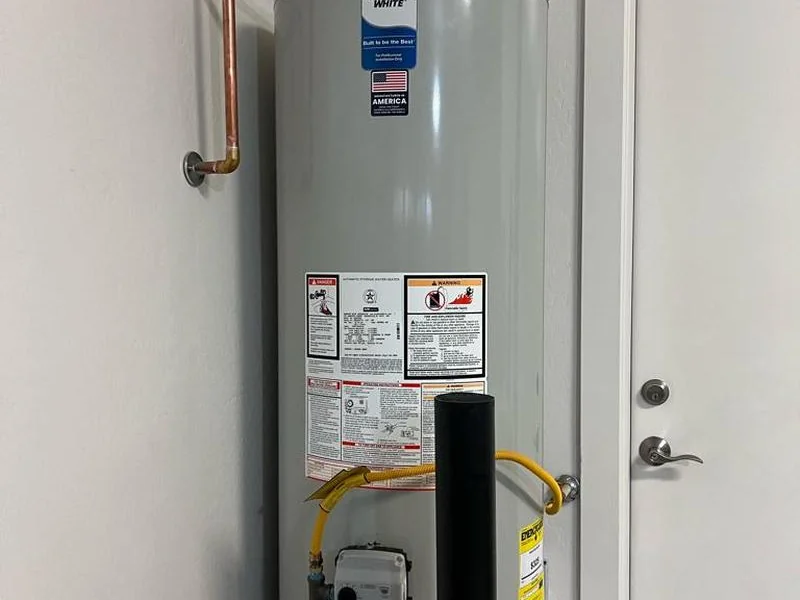
Moncks Corner's 29461 ZIP mixes historic downtown homes with fast-growing subdivisions like Foxbank Plantation, and across both, water heaters fail the same quiet way: a slow weep at a seam, a dripping fitting, a relief valve letting by, soaking floors and belongings for weeks before anyone notices. A drain pan with a proper drain line is the code-required defense that catches the leak and carries the water somewhere harmless. This page explains when pans are required, what correct installation looks like, the upgrades worth adding, and when to schedule the work. For pan installation anywhere in Moncks Corner, call (833) 713-2101.
What a Drain Pan Does and Where Code Requires One
A drain pan does a simple, vital job: it catches water escaping from the heater and routes it somewhere harmless before it can damage your home. Tank failures rarely begin with a flood; they begin with a weep at a seam, a drip at a fitting, or a relief valve discharging now and then. Without a pan, that water goes into drywall, subflooring, flooring and stored belongings. With a pan and a working drain line, the same failure is a service call instead of a renovation.
Code requires pans where leaks can cause damage. Under the South Carolina plumbing code, a water heater in a location where leakage would damage the structure must sit in a corrosion-resistant pan drained to an approved termination point. In Moncks Corner, that covers subdivision garages and laundry rooms, downtown utility closets, crawlspaces, and every attic installation in the newer two-story homes. New heaters must have them.
The town's two housing eras make the same argument different ways. In a downtown home, a utility-closet leak soaks original floors that cannot be replaced like-for-like. In a Foxbank attic, a leak destroys ceilings across two floors. A pan costs a fraction of either repair and works silently for decades. If your heater lacks one, that is the gap to close.
Anatomy of a Code-Correct Pan Installation
Four parts make a pan installation correct, and each one matters. The pan must be corrosion-resistant and sized to sit fully under the heater, catching drips from fittings and the relief valve as well as tank leaks. It needs a drain outlet. A drain line must run from that outlet to an approved termination point, sloped to flow and sized to carry a real leak. The termination must be somewhere harmless and visible, the building exterior or an indirect waste receptor, never a wall cavity.
The defect we see most is the pan with no drain: a tray set under the heater years ago with nothing connected, which fills, overflows and hides the leak longer than no pan would. Second is the drain line to nowhere, ending in a crawlspace or behind the heater. We verify the full drain path on every job.
Lake-country humidity punishes cheap pans. Thin metal rusts through in damp garages and crawlspaces within years, so we install pans rated for the environment, set level so water reaches the drain outlet. The relief valve keeps its own separate discharge piping; the pan drain and the relief discharge are distinct systems under code, and we keep them that way.
Leak Sensors, Auto Shutoff and Drain Upkeep
The pan catches water; accessories stop damage. A leak sensor in the pan alerts you the moment water appears, turning a leak discovered in weeks into one discovered in minutes. For attic heaters, where a slow leak is catastrophic, and for garage units surrounded by belongings, a sensor is the highest-value addition available.
An automatic shutoff valve on the heater's cold-water supply goes further: when the sensor detects water, the valve closes and the tank cannot keep refilling through the leak. In a two-story subdivision home, where an attic leak affects every floor below, this combination is the complete protection package. It also covers the away-from-home scenario, when nobody is around to notice.
Pan drains need periodic verification. In our climate, drain lines clog with sediment, algae and debris, and a clogged pan drain fails silently. We recommend checking flow through the pan drain now and then, and we clear and test the line on every pan visit.
Best Timing: Replacement Day, Retrofits and Failed-Pan Swaps
Replacement day is the ideal moment: the old heater is already out, the new one is going in, and the pan, drain line, sensor and shutoff install as one coordinated job. If your heater is due for replacement and lacks a pan, combining them is the obvious, economical move.
Retrofitting under an existing heater is routine: shut off the water, drain the tank enough to lighten it, lift the heater onto the pan, and run the drain line to an approved termination, usually a single visit. We also replace failed pans outright: rusted metal, cracked plastic and never-drained trays are common finds across the 29461, and a proper pan with a real drain restores the protection.
Every pan visit includes checking the surrounding installation: relief valve discharge piping, shutoff valve condition and general code compliance. Small issues caught during a pan job stay small, which is the entire philosophy behind the pan.
Local Insight
The 29461 ZIP is Moncks Corner, the Berkeley County seat at the junction of Highways 52 and 17A, minutes from Lake Moultrie. Downtown holds the courthouse, historic homes and the railroad-town grid, while the outskirts have boomed with subdivisions, Foxbank Plantation, Carnes Crossroads and the developments along Highway 52. Housing spans 20th-century originals to brand-new two-story construction, and water heater locations span the same range: downtown utility rooms and crawlspaces, subdivision garages, laundry rooms and attics.
That range is why pan work here varies. A downtown home with a heater in a tight utility closet needs a different approach than a Foxbank attic unit where a leak rains through two stories of ceilings. Berkeley County Water and Sanitation serves much of the area, and the lake humidity keeps everything damp, which punishes cheap metal pans. Whether the house is 1920s or 2020s, the logic is identical: catch the leak early, drain it away, and protect what is underneath.
Moncks Corner's building boom means the 29461 holds everything from 1920s downtown bungalows to houses finished last year. The older homes often have heaters in tight utility spaces with no room for error, while the new subdivisions have attic and garage units with builder-grade pans of varying quality. Across both, Lake Moultrie humidity keeps garages damp, which is exactly the environment that rusts out thin metal pans. Checking what is actually under your heater, and whether its drain line goes anywhere, is time well spent.