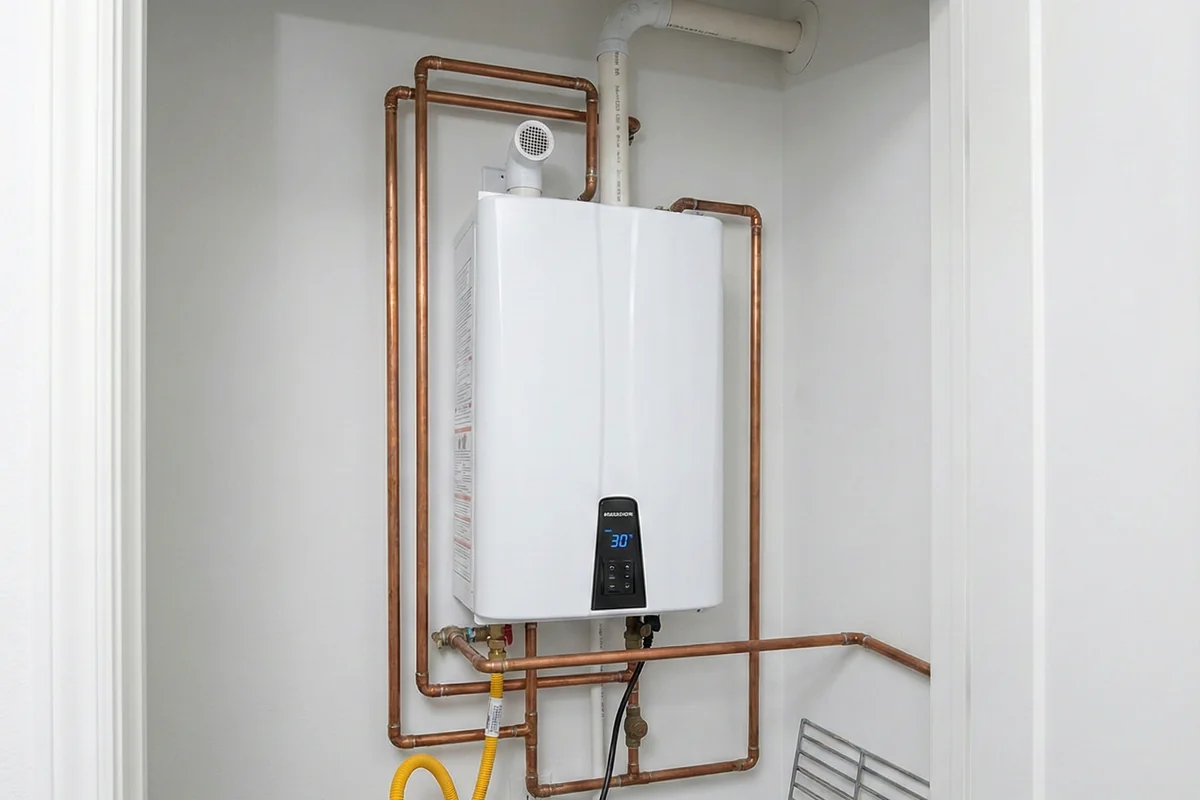
Tankless water heaters promise endless hot water and a compact footprint — and they deliver, until they leak. When a tankless unit leaks, the causes are entirely different from a tank heater's: heat exchanger cracks, failed internal seals, condensate drainage problems, or water connections stressed by thermal cycling. Diagnosing a tankless leak takes a technician who understands these units from the inside, not someone guessing with tank-heater instincts.
Tankless adoption is growing in Goose Creek, especially in renovations and new construction where builders tuck the compact units into tight utility spaces or mount them on exterior walls. But many local tankless units have never been descaled — and in our mineral-rich water, scale is the number one enemy of tankless heat exchangers. Scale buildup overheats the exchanger, stresses joints, and eventually opens leak paths that a maintained unit would never develop.
When you call (833) 713-2101, you get technicians who work on tankless systems regularly: gas and electric, condensing and non-condensing, the major brands installed across the Lowcountry. We diagnose with the unit's own error codes plus hands-on inspection, repair what is repairable, and tell you plainly when a heat exchanger failure means replacement makes more sense. Serving tankless owners throughout Goose Creek and the surrounding Charleston metro.
Where Tankless Leaks Start
Tankless units do not have a tank to rust through, so their leaks come from the components that handle heat and pressure cycling. The heat exchanger is the most serious source: mineral scale insulates its passages, creates hot spots, and eventually cracks the exchanger walls or opens brazed joints. A heat exchanger leak often shows as water dripping from inside the cabinet or from the condensate drain in volumes far beyond normal condensation.
Internal seals and gaskets are the next tier. Tankless units pack dozens of o-rings and gaskets into a small cabinet, and years of thermal expansion and contraction harden them. Water connections — the cold inlet, hot outlet, and gas line — loosen microscopically with every heating cycle until they weep. On condensing models, the condensate drain line can clog with sediment or freeze in a cold snap, backing acidic condensate up into the unit.
Installation-related leaks are common in our area. Tankless units mounted on exterior walls face Lowcountry humidity and driving rain; improper venting terminations let water track back into the cabinet. Undersized gas lines — a frequent find in retrofits — cause erratic combustion that stresses the exchanger. And units installed without isolation valves cannot be descaled or serviced properly, which accelerates every failure mode. When we diagnose, we check the installation as well as the unit, because fixing a leak without fixing its cause is temporary.
Our Tankless Diagnosis and Repair Process
Tankless diagnosis starts with the unit's own brain. Modern tankless heaters display error codes that narrow the field immediately — ignition failures, overheating lockouts, flow sensor faults. We read the codes, check the service history if the unit keeps one, and then verify with physical inspection rather than trusting the display alone.
With power and fuel safely isolated, we open the cabinet and trace the water path: inlet filter, flow sensor, heat exchanger, outlet — plus the condensate system on condensing models. We look for the white or green mineral crust that marks a slow weep, check every union and gasket under pressure, and inspect the heat exchanger for scale damage or cracks. Water chemistry matters here: we assess scale load because it determines whether the unit is a descaling candidate or a replacement candidate.
Repairable leaks — failed gaskets, loose unions, clogged condensate lines, faulty pressure relief valves — we fix with OEM-spec parts and retest under full operating load, not just at idle. A tankless unit behaves differently at full fire than at standby, so our verification includes running hot water at real flow rates. For heat exchanger failures, we give you the honest math: exchanger replacement approaches the cost of a new unit on many models, and we will show you both paths so you can decide with complete information. Every repair includes a descaling assessment, because in Goose Creek water, scale service is not optional maintenance — it is survival.
Tankless Parts, Tools, and Descaling Equipment
Tankless repair demands brand-specific knowledge and parts. We stock common service items — inlet water filters, flow sensors, gaskets and o-ring kits, pressure relief valves, condensate neutralizers and drain components — for the major brands installed in Goose Creek homes. Heat exchangers and control boards are model-specific, so we source those to order after diagnosis confirms the need.
Our descaling equipment is central to tankless work here. We use professional circulating descaling pumps with food-grade descaling solution, connected through the unit's isolation valves, to dissolve mineral buildup from the heat exchanger passages. In Goose Creek's water, a tankless unit that has never been descaled can have dramatically reduced flow and overheating exchangers — descaling often resolves "mystery" performance problems and is mandatory before we condemn any heat exchanger. If your unit was installed without isolation valves, we can add them, which makes every future service faster and cheaper.
Combustion analysis tools complete the kit for gas models. We verify proper gas pressure, check venting for blockages or improper slope, and confirm clean combustion — because a tankless unit starved for gas or air will soot its exchanger, overheat, and fail early. Water treatment discussion is part of the service too: in our mineral conditions, a scale-reduction system upstream of a tankless unit is one of the highest-value protections you can add, and we will explain your options without pressure.
Tankless Units in Goose Creek: Local Realities
Goose Creek's water is the defining challenge for tankless longevity here. The moderate-to-high mineral content that merely shortens tank heater life actively attacks tankless heat exchangers, where narrow water passages scale shut far faster than a tank's open volume. A tankless unit in Goose Creek that skips annual descaling is on a short road to exchanger damage — this is not manufacturer upselling, it is chemistry. We see the consequences regularly: units under seven years old with ruined exchangers that proper maintenance would have prevented.
Climate and installation patterns add stress. Exterior wall-mounted units — popular in renovations for their space savings — sit in Lowcountry humidity and face driving rain from summer storms. Vent terminations must be correctly placed and sealed, or wind-driven rain tracks into the cabinet and corrodes from the outside in. Garage installations bake in summer heat, which is less damaging to tankless units than to tanks but still ages electronics faster.
The retrofit factor is real in our housing stock. Many Goose Creek tankless units were installed as replacements for tank heaters without upgrading the gas line — tankless burners demand far more gas at peak fire than the tank they replaced. Undersized gas supply causes ignition failures, error codes, and exchanger stress that looks like unit failure but is really installation failure. Part of our service is verifying the installation fundamentals: gas sizing, venting, condensate drainage, and isolation valves. A correctly installed and maintained tankless unit serves Goose Creek homes beautifully for many years; a neglected or mis-installed one becomes an expensive lesson.