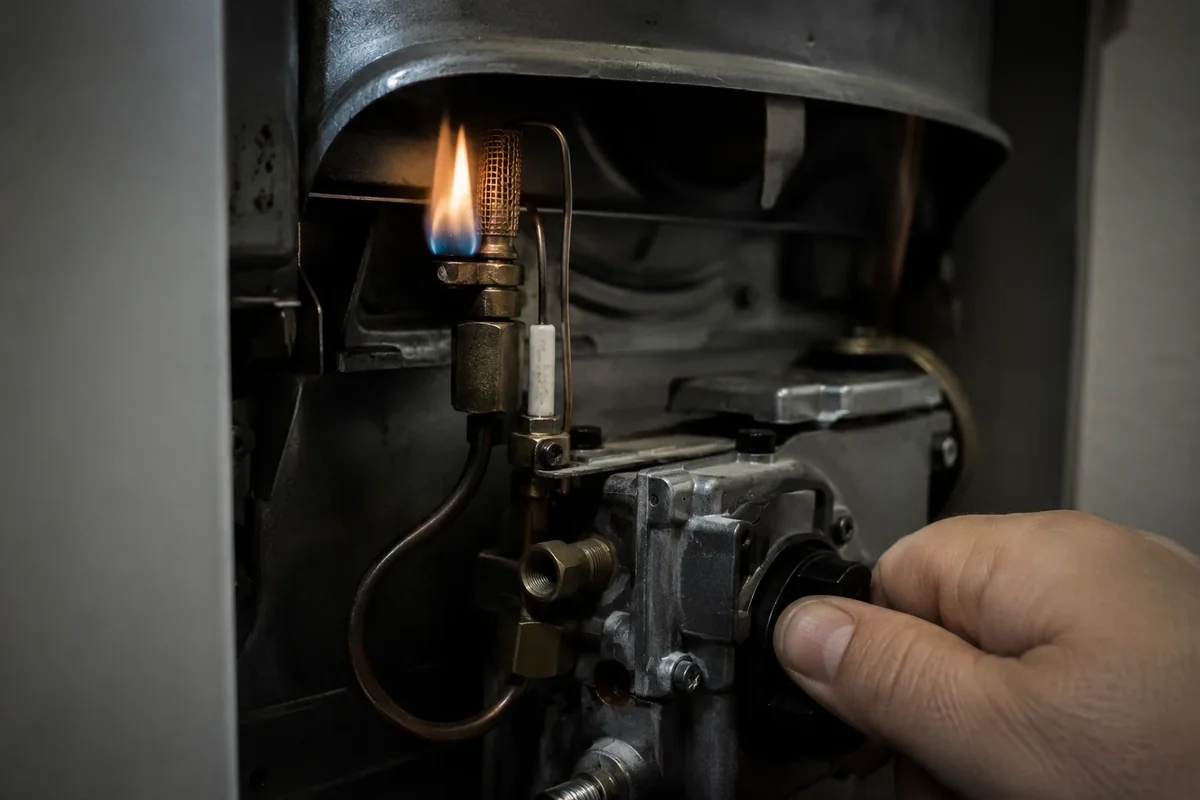
The gas control valve is the brain of your gas water heater — the brass-bodied unit on the front of the tank where the thermostat dial, pilot assembly, and gas connections all meet. It decides when the burner fires, how hot the water gets, and when to shut everything down for safety. When it fails, the symptoms are unmistakable: no hot water, a pilot light that will not stay lit, or water that swings between scalding and lukewarm.
Gas components demand respect. Unlike an electric thermostat swap, gas control valve work involves the fuel line, the pilot assembly, and combustion safety — three things that should never be improvised. In Goose Creek, where many homes run gas water heaters alongside gas furnaces or ranges, a failing control valve is both a comfort problem and a safety concern that deserves prompt, professional attention.
When you call (833) 713-2101, we diagnose whether the valve is truly the culprit — thermocouples, pilot assemblies, and sediment-covered burners cause identical symptoms and cost far less to fix. If the valve has failed, we replace it with the correct OEM-spec unit for your heater, verify every gas connection with proper leak detection, and confirm safe combustion before we leave. We serve gas water heater owners throughout Goose Creek, from older homes near Old Moncks Corner Road to new construction across the city.
Signs Your Gas Control Valve Is Failing
The signature symptom is a pilot light that will not stay lit. You relight it following the instructions, the burner fires, and hours later the water is cold again because the pilot died. Homeowners often replace the thermocouple first — and sometimes that is the fix — but when a new thermocouple does not solve it, the control valve's internal pilot magnet or gas regulation has usually failed.
No hot water at all, with the pilot lit but the burner never firing, points the same direction. The valve is not opening the main gas supply to the burner despite the thermostat calling for heat. Conversely, water that overheats — scalding hot regardless of the dial setting — suggests the valve's thermostat section has lost calibration and is no longer regulating burner run time. That is a safety issue, not just a comfort one.
Other clues include a gas smell near the valve (never ignore this — leave the area and call your gas utility first), visible corrosion on the valve body, a dial that turns with no resistance or will not turn at all, and a burner that short-cycles — firing for seconds, shutting off, firing again. In Goose Creek's humid air, external corrosion on valve bodies and gas connections progresses faster than in drier climates, and we see valves whose exteriors tell the story before the internals are even tested. Age matters too: valves on 10-plus-year-old heaters are living on borrowed time.
Our Replacement Process, Step by Step
Gas work follows a strict sequence, and we do not skip steps. First, the gas supply to the heater is shut off at the dedicated gas valve, and we confirm the pilot and burner are fully out. The water supply is closed and the tank is drained below the valve level — the control valve threads into the tank itself, so the water level must drop beneath its port.
With the tank safe, we disconnect the gas supply line, the pilot tube, and the thermocouple from the old valve, labeling everything. The old valve is unthreaded from the tank — on older heaters this takes care, because the tank threads must not be damaged. We inspect the tank's threaded port for corrosion or mineral buildup and clean it so the new valve seats properly.
The new valve must be the correct specification for your heater: matching gas type (natural gas vs. propane — they are not interchangeable), BTU rating, and thread size. We thread it in with approved gas-rated sealant, reconnect the pilot assembly, thermocouple, and gas supply line, then refill the tank and relight the pilot. The critical final steps are leak testing every gas connection with proper leak-detection solution — never just a sniff test — and verifying burner operation and thermostat calibration across a full heating cycle. Only when the burner lights cleanly, the water heats to the set temperature, and every joint tests tight do we call the job done.
Parts and Equipment We Use
The replacement valve itself is the heart of the job, and specification matters. We install valves matched to your heater's make, model, gas type, and capacity — an OEM or OEM-equivalent unit, not a universal "close enough" part. Natural gas and propane valves have different orifices and pressure settings; installing the wrong one creates a dangerous over-firing or under-firing condition. We verify the gas type at your meter before ordering or installing anything.
Beyond the valve, we replace what the valve touches. Thermocouples and pilot assemblies are inexpensive relative to the labor of opening the job twice, so if yours shows wear, we replace it during the same visit. Gas-rated thread sealant — never standard Teflon tape on gas connections — seals the tank threads and supply fittings. We carry manometers to verify gas pressure where the symptoms suggest a supply issue rather than a valve issue, because replacing a valve will not fix low gas pressure from the utility side.
Our leak-detection equipment includes electronic gas detectors and professional leak-detection solution for the final verification. Every connection we touch gets tested under pressure, and we document the results. We also check the venting while we are there: a gas water heater with a compromised vent can backdraft carbon monoxide, and valve replacement is a natural moment to confirm the draft is correct. The job is not finished until the heater runs a full cycle safely.
Gas Safety and Goose Creek Considerations
Let us be direct about safety: gas control valve replacement is not a DIY project. It involves breaking into the gas supply line, and mistakes create leak and carbon monoxide hazards that can be fatal. If you smell gas at any point — during our visit or otherwise — the rule is simple: do not operate switches or phones inside, leave the building, and call your gas utility's emergency line from outside. We reinforce this with every gas customer because it saves lives.
In Goose Creek, several local factors affect gas heaters. Humidity accelerates corrosion on valve bodies, gas connectors, and vent piping — we inspect all of it, not just the valve. Many local homes have their gas meter and supply routing through crawl spaces or along exterior walls where connectors age faster. Storm-season power events do not directly affect standing-pilot heaters, but power-vented and electronic-ignition models can behave erratically after surges, mimicking valve failure.
Code and practicality matter too. Berkeley County follows standard fuel-gas code requirements for shutoff valve placement, sediment traps, and venting clearances, and we bring every replacement up to current expectations for the components we touch. Combustion air is another local concern: heaters tucked into sealed closets in newer Goose Creek homes can starve for air, causing sooting and erratic burner behavior that looks like valve failure. Part of our diagnosis is confirming the heater can breathe. When the valve is genuinely the problem, we replace it; when it is something else, we say so and fix that instead.