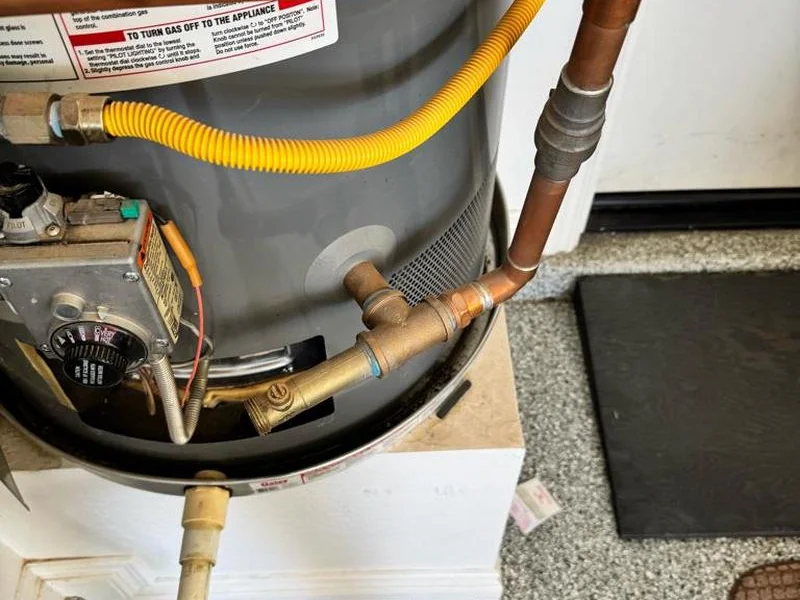
A water heater holds 40 to 50 gallons of water under pressure, and in Hollywood it usually sits somewhere a leak would be expensive — an attic over the bedrooms, a hall closet on finished flooring, a laundry room full of drywall. Low-lying ground near tidal creeks such as rantowles creek keeps the water table high, South Carolina's plumbing code answers that question directly: where leakage would cause damage, the tank must sit in a corrosion-resistant drain pan with a drain routed to a safe, visible termination. This page covers what that requirement means for Hollywood homes — when a pan is mandatory, how to size and set it, where the drain legally goes, and how Lowcountry flood zones, storm season, and water chemistry change the installation. Because a pan is only as good as its drain, we also cover the water alarms and automatic shutoff valves that turn a passive pan into genuine protection. Call (833) 713-2101 for a code-compliant pan installation, usually completed in a single visit.
When South Carolina Code Requires a Drain Pan in Hollywood
South Carolina follows the International Plumbing Code, and Section 504.7 states the rule plainly: where a water heater is installed in a location where leakage from the tank or its connections would cause damage, the tank must sit in a corrosion-resistant drain pan with a drain routed to an approved disposal point. In plain terms, if the water has somewhere valuable to ruin — finished floors, drywall, ceilings below, stored belongings — the pan is not optional. It is code.
In %s, that rule captures most indoor installations. %s Attic installations, the highest-consequence setup in residential plumbing, always require a pan — a 50-gallon tank above a bedroom ceiling is the scenario the code was written for. Interior closets, laundry rooms, and any unit sitting over finished space are in the same category. The classic exemption is the garage slab: where a leak would wet nothing but concrete, the code generally does not demand a pan — though as the sections below explain, 'not required' is not the same as 'not worthwhile.'
The code also specifies what counts as a pan: corrosion-resistant material — galvanized steel, aluminum, or plastic — at least 1-1/2 inches deep, sized so the tank sits fully within it. A paint tray, a shallow saucer, or a rusted-through relic from 1987 does not qualify. And the pan is only half the requirement; the other half is the drain, which must run to an indirect waste receptor, a floor drain, or the building exterior — never directly into the sanitary sewer, always with an air gap so a sewer backup cannot push waste water up into the pan.
Enforcement reality in Hollywood: many existing installations predate consistent pan enforcement, especially in homes built before the 2000s. That does not grandfather them into safety — it just means the protection was never installed. The natural correction point is replacement day. When a water heater is swapped, bringing the pan, drain, expansion tank, and TPR discharge up to current code happens in the same visit, on the same invoice, with no return trip. If your Hollywood heater sits where a leak would cause damage and has no pan — or a pan with no connected drain — that replacement-day upgrade is the moment to fix it.
One more code-adjacent consideration: insurance. After a water heater failure, adjusters increasingly ask whether the installation met code — including the pan requirement. A documented, code-compliant pan and drain do not just prevent damage; they simplify the claim if damage happens anyway. We photograph every pan installation we complete, so Hollywood homeowners have that documentation on file.
Sizing, Setting & Routing the Pan Drain Right
A drain pan only works when four details are right: size, material, level, and drain routing. Get any one wrong and the pan is decoration. Size first: the pan must extend under the full footprint of the tank, catching drips from the base seam, the drain valve, and the TPR discharge — a pan the tank overhangs is a pan that misses the leak. We measure the tank diameter and specify the pan to it; for the common 50-gallon residential tank that means a pan in the 24-to-26-inch range, deeper than the 1-1/2-inch code minimum where the installation allows.
Material is a Lowcountry decision. The code allows galvanized steel, aluminum, or plastic, but salt air and well-water sediment punish thin steel — we have pulled rusted-through steel pans out of %s-area homes that were hiding leaks rather than catching them. Our standard is aluminum or heavy plastic: corrosion-proof, light enough to set precisely, and indifferent to the mineral-laden water that flows through Lowcountry pan drains. In a damp crawlspace or a salty island enclosure, the pan material is not a detail — it is the difference between protection that lasts and protection that rots.
Level is the detail most often botched. A pan set on an uneven surface pools water at the low corner instead of delivering it to the drain fitting, which means the first quart of any leak sits in the pan evaporating while the drain stays dry. We set every pan on a solid, level platform — shimming a water heater is not acceptable practice — and we test the slope by pouring water in the pan and watching it exit at the termination. That thirty-second test, performed at installation, is what separates a working pan from a hopeful one.
The drain itself is where installations most often fail. Code minimum is a 3/4-inch drain; on well-water homes in the %s area we routinely upsize to a full inch, because iron and mineral sediment that weeps through the TPR valve will choke a smaller line over time. The drain runs sloped — no traps, no sags where sediment can settle — to one of the approved terminations: an indirect connection at a floor drain or laundry receptor with a proper air gap, or out through the wall to the building exterior, terminating 6 to 24 inches above grade where the discharge is visible. The exterior termination is our preference wherever practical, for one reason: a leak should announce itself as a wet spot on the siding, not vanish silently into the plumbing.
Two prohibitions close out the routing rules. The pan drain never connects directly to the sanitary sewer — the air gap is mandatory, so a sewer backup cannot drive waste water backward into the pan and under the heater. And the termination never sits where discharge creates a hazard: not over a walkway where algae will make it slick, not where it undermines the foundation grade. In Hollywood's climate, an exterior termination also needs a twice-yearly glance to confirm mud daubers, mulch, or landscaping have not sealed it shut — the Lowcountry's wildlife loves a small dark pipe opening.
Flood Zones, Storms & Pan Protection in Hollywood
The Lowcountry's relationship with water complicates everything about a drain pan, starting with the termination point. Low-lying ground near tidal creeks such as rantowles creek keeps the water table high. In that environment, a pan drain that terminates below grade — or into a low spot that ponds — can back-feed groundwater into the pan during wet weather, defeating the entire installation. The rule for Hollywood is absolute: the pan drain terminates above grade, at a visible point on the exterior wall, where water can only flow one direction — out.
Flood zones add a second design constraint. In mapped AE and VE zones — and %s's geography puts real consideration here — the termination should sit above the base flood elevation wherever the structure allows, so surge and floodwater cannot push back through the drain line. For elevated homes, that typically means routing the drain down through the enclosure and out the wall at a height that stays dry in anything short of a direct surge hit. It does not make the installation flood-proof — no pan stops storm surge, and honest contractors say so — but it keeps the pan's everyday job (catching the slow tank weep) working correctly between storms.
Hurricane season is also the argument for pairing the pan with a water alarm, discussed in the next section. When a %s homeowner evacuates ahead of a storm, the house sits unwatched for days; a tank that chooses that week to fail will run undetected without an alarm, pan or no pan. The pan contains the first gallons and routes them to the termination; the alarm reports the event. Together they convert 'come home to a surprise' into 'come home to a notification and a contained mess.'
There is one more Lowcountry-specific maintenance item: the exterior termination is prime real estate for mud daubers, spiders, and wind-blown mulch. A sealed-shut termination converts the pan into a bathtub at exactly the moment it is needed. Twice a year — we suggest when the clocks change — walk to the termination point and confirm it is open. Pour a cup of water into the pan indoors and watch it exit outside. That sixty-second ritual is the entire maintenance burden of a properly installed pan drain, and it is the difference between protection and performance art.
For Hollywood's lowest-lying streets, one final note: where the grade itself is nearly at the water table, even an above-grade termination needs thought about where the discharged water goes — onto a splash block or pad that carries it away from the foundation, not into a moat against the wall. Pan drainage is a small piece of the home's larger water-management picture, and on low ground every drop's destination matters.
Beyond the Pan: Alarms & Automatic Shutoff in Hollywood
A drain pan is the foundation of water heater protection, but it is not the whole building. The pan catches and routes water; it does not tell anyone the event is happening, and it cannot stop the supply. For %s homeowners who want genuine peace of mind — especially anyone with an attic unit, a finished basement below, or a property that sits vacant — the next two layers are a water alarm and an automatic shutoff valve, and they install in the same visit as the pan.
The water alarm is the highest-value device in residential plumbing. A simple battery-powered puck sitting in the pan shrieks at the first touch of water — loud enough to wake the house, cheap enough to be a rounding error on the invoice. For homes with Wi-Fi, monitored alarms go further: they push a notification to the owner's phone the moment water appears in the pan, which is the layer that protects vacation properties, rentals, and anyone who travels. On a %s installation we place the sensor at the pan's low point near the drain fitting, where water arrives first, and we test it in front of the homeowner before we leave.
The automatic shutoff valve is the layer that acts while nobody is home. Installed on the cold-water supply line to the heater and wired to the alarm sensor, it closes the supply the moment water is detected — converting an unlimited leak (full line pressure, for days) into a limited one (the tank's contents, once). For attic installations and absentee-owner properties, this is the device that prevents five-figure ceiling and flooring losses. It is a modest addition to a pan installation visit and, once installed, it guards the home silently for years on a battery that outlasts most smoke detector cells.
Two supporting components complete the protection picture during a pan installation visit. The thermal expansion tank — required by code on closed plumbing systems, which describes nearly every %s home on municipal water — absorbs the pressure spikes that make TPR valves weep into the pan in the first place; a pan that constantly receives expansion discharge is a symptom, and the expansion tank is the cure. And the TPR discharge line itself gets verified: properly sized, properly routed, terminating where scalding discharge cannot harm people. A pan installation is the natural moment to audit all of it, because the heater is already the center of attention.
Maintenance of the full system is minimal: test the alarm when the clocks change, glance at the exterior pan termination twice a year, and have the expansion tank's air charge checked during the water heater's annual service. That is the entire burden. Call (833) 713-2101 and we will spec the right combination — pan, drain, alarm, shutoff — for your specific Hollywood installation, installed to code in a single visit.
Local Insight
Hollywood's well-water homes need their pan drains sized like they mean it. Iron and mineral sediment — the same material that shortens tank life in the 29449 area — rides out through the TPR weep and the drain valve into the pan, and a minimum-code 3/4-inch drain line can choke on that sediment over time. A clogged pan drain is a special kind of failure: the pan fills, overflows silently, and the homeowner believes they are protected while standing water works on the subfloor. On Hollywood well-water installations we specify a full 1-inch drain as standard and make the twice-yearly flush check part of the handover — pour water in the pan, confirm it exits at the exterior termination, done. The pan material matters here too. Sediment-laden water sitting in a steel pan accelerates the pan's own corrosion, so we install aluminum or plastic pans that do not become part of the problem. For Hollywood's pier-foundation and crawlspace installations, the pan sits on a solid, level platform — not balanced on shims over uneven ground — with the drain routed out through the foundation to daylight. It is unglamorous work, but in well country the pan drain is a working part of the plumbing, not a formality, and it should be built like one.