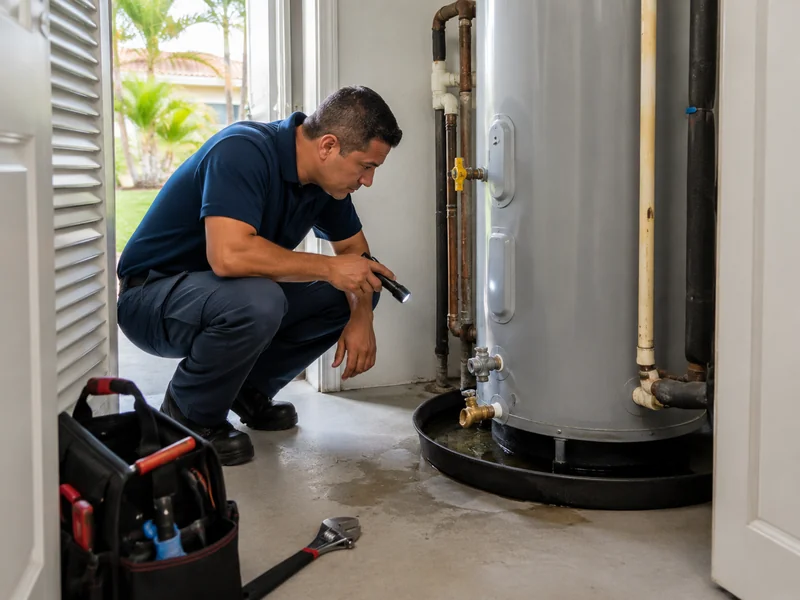
A water heater leak rarely announces itself with a flood. In Summerville, it usually starts as a faint warm spot on the floor, a water bill that creeps upward for no reason, or a musty smell near the utility closet — small clues that are easy to dismiss in a climate where dampness feels normal. But better modern drainage, though rapid growth has stressed some stormwater systems, and that background moisture is exactly what makes a slow tank weep or a pinhole fitting leak so hard to pin down without the right equipment. This page explains how professional leak detection works for Summerville homes: where water heater leaks hide, why the Lowcountry's high water table and humidity complicate the search, and the acoustic, infrared, and pressure-testing methods that locate the source without tearing your house apart. If you suspect your water heater is leaking, call (833) 713-2101 — most detection visits take one to two hours and end with a clear, documented answer.
Where Water Heater Leaks Hide in Summerville Homes
Most water heater failures do not begin with a dramatic flood. They begin with a pinhole — a slow weep at the bottom of the tank where years of sediment have settled, insulating the steel from the burner or element below. That one overheated spot cracks the glass lining, the steel starts to rust, and the tank begins to sweat water it was never meant to release. By the time a homeowner in Summerville notices anything, the leak has often been running for weeks.
The tank body is only one suspect. In Summerville, where homes are 1990s–2010s subdivisions with modern construction standards, we find just as many leaks at the connections: the flexible supply lines, the dielectric unions where copper meets steel, the shutoff valve, and the drain valve at the tank's base. Each of these joints lives under full line pressure around the clock. Well systems add another wrinkle — pressure tanks that have lost their air charge let household pressure spike, and every spike works the fittings a little looser.
Then there is the temperature-and-pressure relief valve, the safety device on the side of every tank. A dripping TPR valve is frequently misread as a tank leak, but it is usually telling a different story: thermal expansion with nowhere to go, a failed expansion tank, or household pressure running too high. Because the Summerville Commissioners of Public Works, the discharge piping and the valve itself get a dedicated check during every inspection — replacing a tank when the real culprit is a fifteen-dollar expansion issue is a mistake nobody should pay for.
Lowcountry humidity creates the great impostor: condensation. On a humid August afternoon, a cold-water line or a tank jacket in a vented space can sweat enough to leave a genuine puddle, and more than one Summerville homeowner has been quoted a replacement for what was really physics. Part of our job is ruling condensation out — or in — before anyone spends money. We check ambient conditions, insulation, and whether the moisture pattern matches sweating or an actual pressurized leak.
Where your heater lives shapes where its leak shows up. A slab-and-crawlspace mix built under modern codes. In Summerville, the newer-growth side of Summerville, toward the Nexton and Cane Bay corridors. A leak in any of these spots rarely announces itself at the tank — it wicks into drywall, swells a baseboard, or warms a patch of slab two rooms away. That is why detection starts with understanding the house, not just staring at the tank.
Why Leak Detection Is Harder in the Lowcountry
Finding a water heater leak in Summerville is genuinely harder than in most of the country, and the reasons are all geographic. Start with the water table. Better modern drainage, though rapid growth has stressed some stormwater systems. When the soil under a home is already saturated, a damp crawlspace or a moist slab edge might be pure groundwater — or it might be groundwater plus a slow hot-water leak riding along with it. Telling those two apart is the central skill of Lowcountry leak detection.
Foundation type decides the difficulty. A slab-and-crawlspace mix built under modern codes On a slab, escaping hot water has nowhere to go but sideways through the concrete, and we hunt it with thermal imaging and acoustic listening — a warm signature under the floor, or the faint hiss of pressurized water picked up through the slab. In a crawlspace or pier home, the water drops straight down and vanishes into wet soil, so we work the problem from above instead: moisture mapping at the tank platform, temperature readings on the supply lines, and rust patterns on the jacket that gravity cannot fake.
Humidity is the third complication. A vented crawlspace in Summerville in July sits near one hundred percent relative humidity, which means cold pipes sweat, tank jackets sweat, and even the moisture meter needs interpretation. We calibrate for ambient conditions on every visit — a reading that would scream 'leak' in Arizona might be Tuesday in Summerville. The trick is differential measurement: comparing suspect areas against known-dry reference points in the same house, so the house itself becomes the baseline.
Water chemistry adds a final local twist. The summerville commissioners of public works Mineral-heavy water lays down sediment that cooks onto the tank bottom and shortens tank life, while also leaving crusty deposits at weeping fittings that can temporarily seal a small leak — until the crust breaks and the drip returns worse than before. We read those deposits like a history: fresh white crust means active weeping, old brown scale means a leak that sealed itself and may reopen.
None of this means a leak cannot be found — it means the finder needs the right tools and the local knowledge to use them. A national-chain technician running a generic checklist will miss what a Lowcountry specialist catches, because the ground, the air, and the water here all conspire to hide the evidence. That local calibration is exactly what our detection process is built around.
How We Find the Leak: Acoustic, Infrared & Pressure Testing
Our detection visit follows a deliberate sequence, moving from the least invasive methods to the most, so we find the leak with the smallest possible footprint on your home. It starts before we touch a tool: a conversation about what you have noticed — the water bill, the sounds, the smells, the stains — because the homeowner's observations narrow the search enormously. Then we inspect the water heater itself, top to bottom: supply connections, shutoff valve, TPR valve and its discharge line, drain valve, expansion tank, and every inch of the jacket for rust streaks, mineral crust, or damp insulation.
Next comes moisture mapping. We take systematic readings with pin and pinless moisture meters across floors, walls, and baseboards around the heater's location, building a contour map of where the moisture is heaviest. A genuine leak creates a gradient — wettest at the source, fading with distance — while ambient dampness reads flat. In Summerville homes, where better modern drainage, though rapid growth has stressed some stormwater systems, that gradient is often the single most decisive piece of evidence we collect.
Infrared thermography comes third. A thermal camera sees what eyes cannot: the warm plume of hot water migrating through a slab, the hot stripe of a leaking line inside a wall, the telltale warmth at a weeping tank seam. We scan the floors and walls around the heater and along the hot-water distribution path. On a slab home — common across the Summerville area — this is frequently the moment the leak's location snaps into focus, sometimes to within a few inches.
For the leaks that still hide, we bring acoustic detection: highly sensitive ground microphones and listening discs that pick up the hiss of pressurized water escaping through a pinhole, even under concrete or behind drywall. And when a buried or in-slab line is the suspect, we isolate and pressure-test individual runs — capping sections and watching a gauge, which tells us definitively whether a given segment holds pressure or bleeds it away. Tracer gas, a harmless hydrogen-nitrogen mix, is the final resort for the most elusive slab leaks; it escapes where water escapes and is sniffed out at the surface with a sensitive detector.
The visit ends with documentation, not guesswork: photos of the source, moisture readings, thermal images where relevant, and a plain-English explanation of what failed and why. You get a clear next step — repair the fitting, replace the valve, or replace the tank — priced before any work begins. Most Summerville detection visits wrap up in one to two hours, and the great majority never require opening a wall or cutting concrete.
After We Find It: Repair, Replace & Prevent in Summerville
Finding the leak is half the job; choosing the right fix is the other half, and the honest answer depends on what failed and how old the tank is. A leaking flex connector, a weeping drain valve, or a discharging TPR valve on an otherwise healthy eight-year-old tank is a repair — targeted, same-day, and a fraction of replacement cost. A tank body that is rusting through at the base or the seam is not a repair candidate at any age; once the steel itself is compromised, the only fix is a new water heater, because patch jobs on a failing tank fail again within months.
Age is the tiebreaker. Conventional tank water heaters typically serve 10 to 12 years in the Lowcountry — shorter on well water or barrier-island air, longer with diligent maintenance. When a tank past that range starts weeping, putting repair money into it is usually false economy; the next failure is already forming. We will tell you straight which side of that line your unit falls on, with the serial number's manufacture date as the evidence, not a sales pitch.
Replacement in South Carolina is also a code-compliance moment. Current code requires an expansion tank on closed plumbing systems, a properly piped TPR discharge line, and — where the unit sits above finished space or where leakage would cause damage — a drain pan with a routed drain. Many Summerville homes still run heaters installed under older rules, missing one or more of these. A replacement done right brings all of it up to standard in a single visit, which is also when we right-size the pan and drain for your specific installation.
Prevention is where the long-term money is saved, and the Lowcountry asks for a specific routine. Flush sediment annually — non-negotiable on well water, wise everywhere else. Check the anode rod every few years; it is the sacrificial component that decides whether the tank or the rod corrodes. Keep household pressure in the 50–70 psi range with a working pressure-reducing valve. And put a water alarm in the drain pan or at the tank base — a twenty-dollar device that has saved Summerville homeowners thousands by catching the next weep in week one instead of month three.
Whether your outcome is a same-day repair or a full replacement, the goal is the same: no more mystery moisture, no more climbing water bill, and a water heater you can stop thinking about. Call (833) 713-2101 and we will schedule the detection visit — most Summerville appointments are available within a day or two, because a suspected leak should never wait for next week.
Local Insight
The 29485 subdivisions are young enough that their water heaters are failing on schedule — and that schedule is the story. Builder-grade tanks installed across the Nexton and Cane Bay corridors in the 2000s and 2010s are now arriving at the 10-to-15-year mark together, which means the failure pattern is predictable: bottom-seam weeps on tanks that were never flushed, TPR valves discharging because thermal expansion has nowhere to go on these closed municipal systems, and the occasional installation defect that took a decade to matter. When we get a 29485 detection call, we already know the three most likely culprits before we arrive — and we are usually right. Because these are modern-code homes on slabs and crawlspaces with good drainage, detection here is clean work: moisture maps read clearly, infrared performs well, and access is generally straightforward. The value of the visit is triage and timing. A weeping fitting on a 13-year-old tank buys planning time; a weeping seam means scheduling the replacement now, on your calendar, with the code upgrades — expansion tank, pan, proper TPR discharge — that the original builder-grade installation may have skipped. In 29485, detection is less about finding a mystery and more about reading a clock accurately.