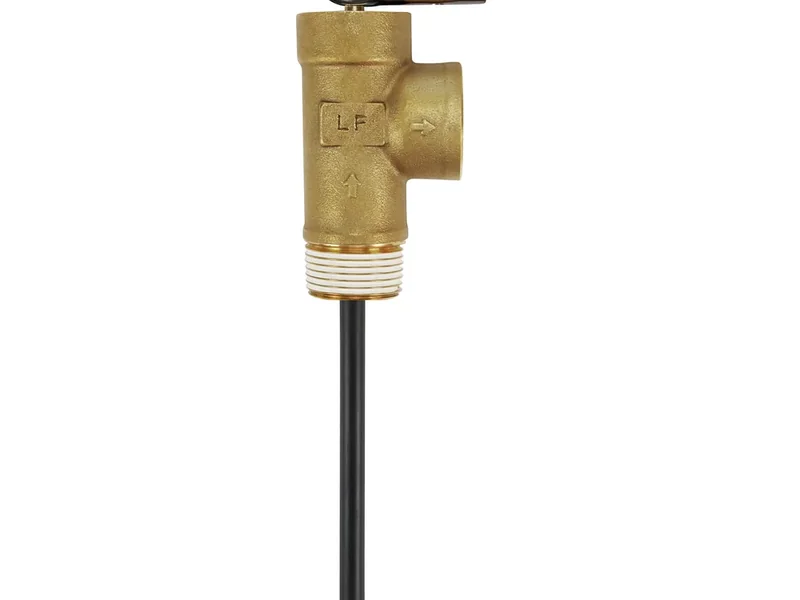
Moncks Corner's water heaters — from town-center historic homes to new lake-area subdivisions — share one critical safety device: the TPR valve. The temperature and pressure relief valve vents the tank if pressure exceeds 150 PSI or temperature passes 210°F, and across the 29461 area it fails in the Lowcountry's familiar patterns: thermal expansion trapped by PRVs and check valves, seats eroded by years of relief duty, probes scaled by hard regional water.
The county seat's mix of municipal connections with pressure-reducing valves and rural well systems with check valves means closed plumbing systems are the norm here — exactly the conditions that punish TPR valves. We replace failed TPR valves across Moncks Corner the same day: correctly rated valves, code-compliant discharge piping, and the expansion or pressure cause behind the failure properly diagnosed and addressed.
What a TPR Valve Does — and Why It's Safety-Critical
The temperature and pressure relief valve — TPR valve — is a small brass valve on the side or top of your water heater, and it's the single most important safety device on the tank. It has one job: open automatically if tank pressure exceeds 150 PSI or water temperature passes 210°F, discharging scalding water through its discharge pipe before pressure can rupture the tank. A water heater is a sealed pressure vessel; without a working TPR valve, a runaway heating event can turn it into a rocket. Documented tank explosions have launched heaters through roofs — this valve is what stands between normal operation and that outcome.
The valve works through two independent mechanisms. A spring-loaded pressure element lifts at 150 PSI, and a thermal probe extending into the tank lifts the valve as water approaches 210°F. Either one opening discharges water, which drops both pressure and temperature — that's the protection. The valve then reseats when conditions normalize. It's a beautifully simple device, and it only works if it's correctly rated for the tank, free of scale and corrosion, and piped to discharge safely.
Here's what most homeowners miss: the TPR valve is also a diagnostic instrument. A discharge pipe that drips after heating cycles is the valve reporting excessive pressure — usually thermal expansion trapped in a closed plumbing system. A valve that weeps constantly has a seat damaged by that duty. And a valve that looks fine but is scaled or corroded shut is the most dangerous state of all: protection that exists on paper but not in practice. Annual testing — lift the lever, verify strong flow, verify it snaps shut — is the maintenance this life-safety device deserves.
Why Your TPR Valve Is Dripping or Leaking
A dripping TPR discharge pipe is the valve doing exactly what it was designed to do — relieving pressure — which means the real question is why the pressure is there. The causes, in order of frequency:
1. Thermal expansion in a closed system. This is the runaway leader. When water heats, it expands about 2-4% in volume. In an open system that expansion pushes harmlessly back toward the street main — but pressure-reducing valves, check valves, and backflow preventers close the system, trapping the expansion. Pressure spikes with every heating cycle, and the TPR valve — the only legal exit — bleeds it off, drip by drip. If your discharge pipe drips after hot-water use and you have a PRV or check valve, this is almost certainly your cause.
2. Excessive incoming water pressure. Street pressure above 80 PSI stresses everything, and sustained high pressure can hold the TPR valve near its relief point continuously. 3. A failed valve seat. Years of relieving expansion duty erode the seat until the valve weeps even at normal pressure — the drip becomes constant rather than cyclical. 4. Excessive temperature setting. A thermostat cranked past 140°F, or a failed thermostat overheating the tank, pushes the thermal probe toward its limit. 5. Debris or scale on the seat. Mineral deposits prevent full sealing, so the valve seeps. The fix always starts with diagnosis — gauge-test the pressure, check for trapped expansion, test the valve's function — because replacing the valve without addressing a closed system just schedules the next replacement.
What Plumbing Code Requires for TPR Discharge Piping
Replacing the valve is only half the job — the discharge piping has to meet code, and in our experience it often doesn't. The plumbing code (International Plumbing Code, adopted across South Carolina) is specific about TPR discharge lines, because this pipe carries scalding water during a relief event:
Full size, all the way. The discharge pipe must be at least the same diameter as the valve outlet — typically 3/4 inch — with no reductions anywhere in the run. A reduced pipe can't carry the full relief flow. Gravity drain only. The pipe must pitch downward continuously to its termination; traps or uphill sections are prohibited. Terminate visibly, within 6 inches of the floor — or discharge to the building exterior. The termination must be somewhere a drip gets noticed: an air gap above a floor drain, or outside where it's observable. No threads on the end. The discharge end must not be threaded — this prevents anyone from capping it. No valves, tees, or restrictions anywhere in the line. The pipe serves one valve and nothing else.
Materials matter too: the pipe must handle high-temperature discharge — copper, CPVC, or other rated materials, not standard PVC which softens. Common violations we correct: discharge pipes cut short inside walls, terminated into crawlspace dirt where drips hide, reduced from 3/4 to 1/2 inch at some point in the run, or — the worst — capped or plugged by someone tired of the dripping. A capped TPR line is both a code violation and the removal of the tank's last protection. Every TPR replacement we do includes bringing the discharge piping up to this standard.
Moncks Corner has both closed-system types: municipal neighborhoods where PRVs tame high street pressure — closing the system at the meter — and well-water properties on the town's edges where check valves close it at the pump. Both trap thermal expansion and make the TPR valve the relief point for every heating cycle. Our 29461 TPR replacements start by identifying your system's closure, gauge-test the pressure story, and pair the new valve with expansion protection where readings confirm it's needed.
TPR Valve Trouble Spots Across the Lowcountry
Certain Lowcountry conditions punish TPR valves harder than average, and recognizing the pattern speeds the diagnosis. High municipal pressure zones are the first: where street pressure runs above 80 PSI, PRVs get installed — closing systems and putting every water heater's expansion on its TPR valve. Neighborhoods with PRV history show TPR drips as a near-routine complaint.
Well-water territories are the second: check valves close these systems by design, and mineral-heavy well water scales seats and probes aggressively. Rural TPR valves live a double-hard life — maximum expansion duty plus maximum scale. Hard-water municipal areas are the third: limestone-region supplies cake valve seats until they weep and slow probe response until it's dangerously sluggish.
Hot garages and damp installs are the fourth: heat weakens valve springs over the years, humidity corrodes bodies and mechanisms, and crawlspace or ground-level installs hide discharge terminations where drips go unnoticed for seasons. High-demand rentals are the fifth: vacation and workforce rentals cycle tanks relentlessly, multiplying the annual relief events that erode seats. The through-line: the TPR valve is the component that absorbs every system-level problem — pressure, expansion, scale, heat — so when it drips, the smart move is diagnosing the system, not just swapping the valve. That's the approach on every TPR call we run: new correctly rated valve, code-compliant discharge, and the underlying cause — expansion, pressure, or scale — actually fixed.
Local Insight
TPR valve failures in Moncks Corner follow the area's dual water systems. In the municipal neighborhoods — town center, established subdivisions, new lake-area communities — pressure-reducing valves are standard where street pressure runs high, and each PRV closes the system. Thermal expansion spikes pressure with every recovery cycle; the TPR valve bleeds it off, drip by drip, until the seat erodes and the valve weeps constantly. The garage-floor puddle under the discharge pipe is the symptom homeowners notice.
On the well-water edges of 29461, check valves do the same closing from the pump side: expanded hot water can't return toward the well, so every heating cycle pressurizes the house side and the TPR valve takes the beating. Well-water minerals add scale to the seat and probe — a scaled probe responds sluggishly to temperature, the dangerous failure mode. We replace Moncks Corner TPR valves with 150 PSI / 210°F rated units matched to the tank, verify probe length, and flush sediment so the new probe senses clean water.
Every replacement here gets the complete correction: full-size discharge piping to a visible termination within 6 inches of the floor — no threads, no caps, no hidden terminations — and an expansion tank where gauge readings confirm trapped expansion. New valve plus working expansion absorption is what ends the dripping permanently instead of pausing it.