St. Stephen sits at the northern edge of Berkeley County near Lake Moultrie's upper reaches — a small town of longtime homes, lake-area properties, and rural routes where private wells are common and water heaters work without much attention for years at a time. Electric tanks in utility rooms, carports, and outbuildings run on well water heavy with sediment and on controls that are often 15-plus years old.
Thermostat failure in St. Stephen follows the rural script: sediment-buried lower thermostats that cut tank capacity in half, high-limit trips after summer thunderstorm surges, and contacts worn through from decades of cycling. The symptom families notice first is the short shower — hot water that fades halfway through the morning routine. We replace water heater thermostats across St. Stephen in a single visit, with sediment and element checks that make the repair last on well water.
Signs Your Water Heater Thermostat Is Failing
A failing thermostat rarely announces itself politely. The most common sign is inconsistent hot water: the shower starts hot and fades to lukewarm in minutes, or the temperature swings from scalding to cool without anyone touching a tap. That happens because the lower thermostat — which controls the lower heating element responsible for most of the tank's capacity — has stopped calling for heat. Only the top of the tank warms up, so the household gets a fraction of the rated gallons.
The second classic symptom is water that's too hot. A thermostat with welded contacts or drifted calibration overheats the tank well past its setpoint, delivering scalding water at the tap. This is more than uncomfortable; water above 140°F can cause third-degree burns in seconds, which is why the U.S. Department of Energy recommends a 120°F setting. If your taps run dangerously hot, treat it as urgent.
The third sign is the red reset button tripping. That button is the high-limit safety switch mounted on the upper thermostat, and it trips when the tank overheats. An occasional trip after a power surge is one thing; a button that trips repeatedly means the thermostat behind it is failing and the tank is overheating on a regular basis. Other clues include a tank that runs out of hot water far faster than it used to, rumbling or popping from sediment overheating near a failed lower element, and a circuit breaker that trips when the heater runs — which can indicate a shorted element the thermostat can no longer manage.
How a Professional Thermostat Replacement Works
A thermostat replacement is a contained, same-day repair — no tank swap, no plumbing rework, no drywall. The process starts with diagnosis: we shut off power at the breaker, remove the access panels, and test both thermostats and both heating elements with a multimeter. Thermostat continuity, element resistance, voltage at the terminals — the readings identify exactly which component failed, so we replace what's broken instead of throwing parts at the tank.
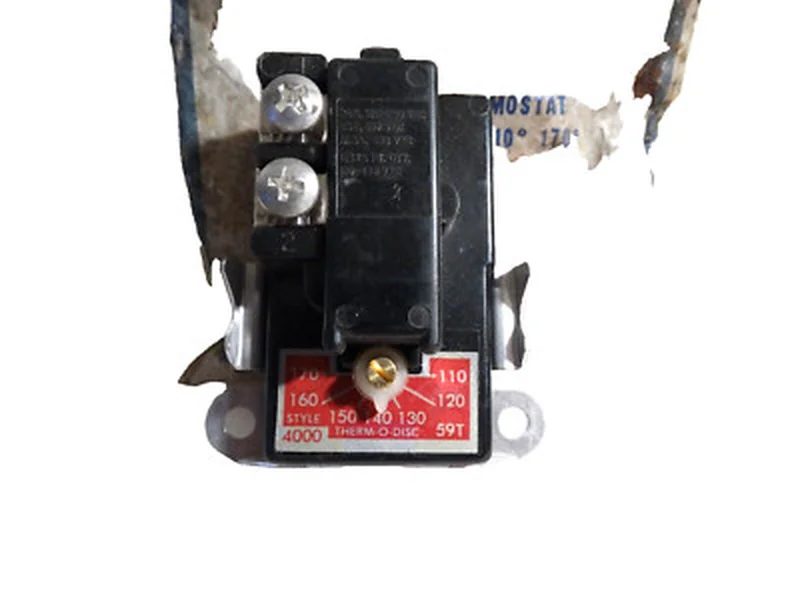
Next comes safe access. Power stays off and locked out while we remove the insulation and the plastic element covers. On electric tanks there are two thermostats — upper and lower — clipped against the tank wall beside their respective elements. We disconnect the wiring (noting every connection), unclip the failed thermostat, and clip in the replacement, making sure it sits flush against the tank wall; a thermostat that doesn't make firm contact can't sense water temperature accurately.
Then reassembly and calibration: wiring reconnected to the diagram, insulation and covers replaced, panels secured. Both thermostats get set to 120°F — the DOE-recommended setting that balances comfort, efficiency, and scald protection — and we verify the high-limit reset is functional. Power goes back on, and we test through a heating cycle: confirm the elements draw proper amperage, the thermostats cycle off at setpoint, and hot water at the tap reads a safe, steady temperature. Most replacements finish in under an hour, and the household has full hot water the same day.
Why Water Heater Thermostats Fail Faster in the Lowcountry
Lowcountry conditions are rough on water heater controls, and thermostats here tend to fail years ahead of national averages. Heat is the first factor: garage and utility-room temperatures sit above 95°F for months, baking wire insulation, corroding terminals, and aging every electrical component inside the access panels. A thermostat's bimetallic contacts and calibration springs don't love living in an oven.
Hard water is the second. Mineral-heavy supplies across the Charleston area lay scale on lower heating elements, and a scaled element heats slowly — stretching every recovery cycle longer. Longer cycles mean more wear on thermostat contacts per cycle, on top of the area's already high hot-water demand. Scale also buries the lower thermostat's sensing area directly, so it reads the sediment bed instead of the water and satisfies early.
Lightning and power surges are the third. Summer thunderstorm season delivers voltage spikes that trip high-limit resets and damage thermostat electronics outright; we see scorched terminals after active storm weeks. Humidity is the fourth: damp air in crawlspaces, closets, and ground-level enclosures corrodes terminals green and degrades connections, so the thermostat gets erratic voltage and behaves erratically. Put the four together — heat, hard water, surges, humidity — and Lowcountry thermostats earn their replacement sooner. The defense is straightforward: test at the first symptom, replace both thermostats as a pair, treat the terminals, and keep the tank flushed so scale never buries the controls.
St. Stephen's well water and lake-region groundwater define its thermostat failures. Sediment — sand, silt, dissolved minerals — settles over the lower thermostat and element, insulating the sensor so it reads the sediment bed instead of the water. The upper thermostat then does all the work, satisfies early, and the household gets half a tank. Add 15-year-old controls with pitted contacts, and 29479 tanks fail the classic rural way. Our St. Stephen service pairs every thermostat replacement with a sediment-depth check and element test.
Thermostat Replacement vs. a New Water Heater: How to Decide
The repair-or-replace question comes down to the tank's condition, not the thermostat's. Thermostats are wear parts — they're supposed to be replaceable, and on a sound tank, new thermostats restore full performance for a small fraction of a heater swap. The decision hinges on three inspections we perform on every thermostat call.
First, tank age and shell condition. A 10-year-old tank with a solid shell, no rust at the base, and no moisture around the fittings has years left; new thermostats are the obvious call. A 15-plus-year-old tank with base rust, weeping fittings, or a rumbling sediment bed is near the end regardless of what the thermostats do — and we'll say so plainly rather than sell controls for a dying tank.
Second, the anode rod's likely condition. We can't see it without pulling it, but age and water chemistry tell the story: on hard or well water, anodes deplete faster, and a depleted anode means the tank is corroding from the inside. Third, sediment depth. A tank with inches of hardened sediment burying the lower element will keep killing lower controls; sometimes a flush buys years, sometimes the scale is the verdict.
The honest math: if the tank is sound, a thermostat replacement — both thermostats, tested elements, treated terminals, 120°F calibration — typically costs a fraction of a new installed heater and returns the tank to full capacity the same day. If the tank is failing, that same money is better applied to replacement. Our job on a thermostat call is to give you the inspection results straight, recommend the option we'd choose for our own house, and let you decide with real information.
Local Insight
Small-town rural conditions shape thermostat work in St. Stephen. Homes in town and along the rural routes toward the lake and the forest run electric tanks in utility rooms, carports, and outbuildings — unconditioned spaces with big seasonal temperature swings and year-round humidity. Those conditions age wiring insulation, corrode terminals, and stress thermostat housings, while the controls inside accumulate decades of heating cycles. We service every St. Stephen thermostat call as a complete controls job: both thermostats tested and renewed, elements verified, terminals cleaned and treated.
Well-water sediment is the area's signature failure. Private wells and lake-region groundwater around St. Stephen carry sediment loads that bury lower thermostats in silt — the sensor ends up reading the sediment bed, satisfying early while the family gets lukewarm water, or the element superheats the bed and trips the high-limit. New thermostats on a buried lower element will fail the same way, so we check sediment depth on every well-water tank and give an honest recommendation: flush, element service, or straight talk when the tank itself is at the end of its life.
Neglect compounds everything in a small town where water heaters run for years without a glance. High-limit resets trip after thunderstorm surges and nobody notices until the cold showers start; thermostats drift for seasons before anyone connects the scalding tap to the controls. If your St. Stephen water heater is past 12 years and showing any erratic behavior — short supply, temperature swings, tripping resets — the thermostats have earned a meter test, and we do it in one visit with parts on the truck.