Johns Island is the Lowcountry's rural-urban frontier — the Angel Oak, working farms, and longtime family properties on well water, alongside fast-growing subdivisions along Maybank Highway and Main Road on municipal connections. Water heaters here span the full range: aging electric tanks in farmhouses and manufactured homes, modern units in new-construction garages, all working in Lowcountry heat, humidity, and — on the rural side — sediment-heavy well water.
Thermostat failures on Johns Island split the same way: rural well-water tanks with sediment-buried lower thermostats, suburban tanks with cycle-worn or surge-damaged controls. The symptoms are universal — erratic temperatures, short hot-water supply, tripping high-limit resets — but the cause depends on which Johns Island your home belongs to. We diagnose and replace water heater thermostats across the island in a single visit, testing thermostats, elements, and sediment before recommending anything.
How to Tell a Thermostat Problem From an Element Problem
Thermostats and heating elements fail with frustratingly similar symptoms — lukewarm water, short supply, slow recovery — which is why guessing wastes money. Here's how they differ. A failed lower thermostat leaves the lower element idle, so only the upper third of the tank heats; you get hot water briefly, then lukewarm. A failed lower element produces the identical symptom, because the result is the same: the bottom of the tank never heats. Only a meter test tells them apart.
A failed upper thermostat is more dramatic: the upper element does the heavy lifting on every electric tank, so when its thermostat quits, you may get little or no hot water at all — or the high-limit trips constantly. Scalding water, on the other hand, points squarely at the thermostat: elements either heat or they don't, but only a thermostat with stuck contacts or drifted calibration can overheat the tank.
Sediment complicates the diagnosis. A thick layer of mineral sediment on the tank floor buries the lower thermostat's sensing area and the lower element together, mimicking a controls failure while being a maintenance problem. That's why a proper service call tests everything: continuity across each thermostat, resistance across each element, voltage at the terminals, and a look at sediment depth. The meter doesn't guess — and neither should the repair. When we arrive for a thermostat call, that full electrical workup is the first thing we do, so the part we replace is the part that actually failed.
What Happens During Your Thermostat Service Visit
When our technician arrives, the first step is listening: when did the symptoms start, does the reset button trip, is the water too hot or not hot enough, how old is the tank. Those answers narrow the diagnosis before a panel comes off. Then power goes off at the breaker — verified dead with a meter, because water heater circuits carry 240 volts and there are no shortcuts with that.
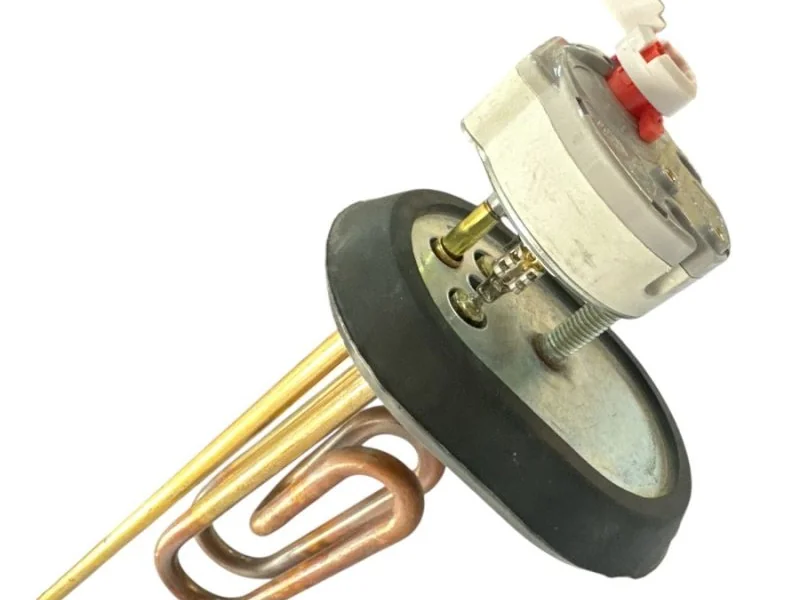
Testing comes before replacing. We pull both access panels and check the full control circuit: each thermostat's continuity and calibration, each element's resistance (a healthy 4500-watt element reads around 13 ohms), terminal condition, and the high-limit switch. We also note sediment signs and the tank's overall condition — because a thermostat call on a tank with a rusting base gets an honest conversation, not just new parts.
The replacement itself is straightforward: failed thermostats unclipped, new ones clipped flush to the tank wall, wiring reconnected exactly to the diagram, insulation and safety covers restored. We replace upper and lower thermostats as a pair — they're the same age and fail on similar timelines, so doing both prevents the second service call three months later. Final steps: set both to 120°F, restore power, and verify through a live heating cycle — proper amperage draw, clean thermostat cut-off at setpoint, and safe, steady temperature at the nearest tap. You get a working water heater back the same visit, with the failed parts shown to you, not just described.
The Four Lowcountry Forces That Wear Out Thermostats
Ask why a thermostat failed here and the answer is usually a combination of four local forces. First, ambient heat. Water heaters in Lowcountry garages, carports, and utility sheds spend half the year in 95°F-plus air. The thermostat senses tank water, not room air — but the heat cooks wiring insulation, oxidizes terminals, and shortens the life of the high-limit mechanism sitting right beside the thermostat.
Second, mineral-laden water. Whether it's limestone hard water on municipal systems or sediment-heavy private well water, the Charleston area's water lays deposits on lower elements and lower thermostats. Deposits insulate the sensor, forcing the thermostat to misread tank temperature; they also make elements heat inefficiently, stretching cycles and piling wear onto contacts rated for a finite number of operations.
Third, electrical storms. The Lowcountry's summer lightning is among the most active in the country, and the surges trip high-limit safety switches and pit thermostat contacts. One surge-weakened thermostat may work for months before its calibration finally drifts into scalding territory — the delayed failure that surprises homeowners.
Fourth, humidity and salt air. Damp crawlspaces corrode terminals; barrier-island salt air attacks every electrical connection aggressively. Corroded terminals feed the thermostat erratic voltage, and erratic voltage produces erratic temperatures. Every professional thermostat replacement here should therefore include terminal cleaning and treatment — new thermostats on green-corroded terminals are a repair with a built-in expiration date.
Johns Island's two water realities produce two thermostat failure modes. The rural west and south — farms, family land, manufactured homes on wells — bring sediment-buried lower thermostats: sand and mineral silt insulating the sensor so the tank heats halfway. The developing corridors along Maybank and Main Road bring hard-water scaling and lightning-surge damage in younger tanks. Our 29455 thermostat service is built for both: full meter-testing of controls plus a sediment assessment, so the repair matches the actual failure.
When New Thermostats Are the Right Call — and When They Aren't
Thermostats are designed to be replaced; tanks are designed to eventually be replaced. Knowing which one your situation calls for saves real money. New thermostats are the right call when the tank shell is sound — no rust streaks at the base, no damp fittings, no bulging — the unit is under roughly 12 years old (or older but well-maintained on treated water), and the symptoms match controls failure: erratic temperatures, short hot-water supply, tripping high-limit, scalding spikes. In those cases a same-day thermostat replacement returns full-tank performance at a fraction of replacement cost.
Replacement is the honest recommendation when the tank shows its age: rust at the base or around fittings, water staining down the shell, a tank past 15 years on hard or well water, or sediment so deep and hardened that the lower element is entombed. New thermostats can't fix a corroding shell or a scaled-solid tank bottom — and we'd rather talk you out of a repair than sell you one with a short horizon.
There's a middle ground worth knowing about: the aging-but-sound tank, say 12 to 15 years, no rust, moderate sediment. Here new thermostats plus a flush and an anode check can buy two to five more years — a perfectly rational bridge repair that lets you plan the eventual replacement on your schedule instead of during an emergency. We lay out all three paths with straight pricing: repair now, bridge repair, or full replacement. No pressure, no upsell — just the inspection findings and what we'd do in your position.
Local Insight
Johns Island's transformation shapes every thermostat call. The longtime rural properties — farmhouses, manufactured homes, family compounds off the island's back roads — run older electric tanks on private wells, and well-water sediment is the dominant failure mode: the lower thermostat buried in silt, sensing the sediment bed instead of the water, satisfying early while the family gets half a tank of hot water. These tanks are often 15-plus years old with original controls, so age and sediment fail together.
The growth corridors tell the newer story. Subdivisions along Maybank Highway, Main Road, and the roads toward Kiawah have modern tanks in garages on municipal water — but hard water still scales lower elements over the years, and the island's frequent lightning trips high-limit resets and damages thermostat electronics. We see 29455 tanks under 10 years old with surge-damaged thermostats after active storm seasons.
What unites both sides is diagnostic discipline. Lukewarm water, short supply, and tripping resets can mean a thermostat, an element, sediment, or a wiring problem — and the fix differs completely. Our Johns Island visits test both thermostats, both elements, and the high-limit with a meter, check sediment depth on well-water tanks, and set the new controls to 120°F. You get the repair your tank actually needs, whether that's two thermostats or a deeper conversation about the tank's future.