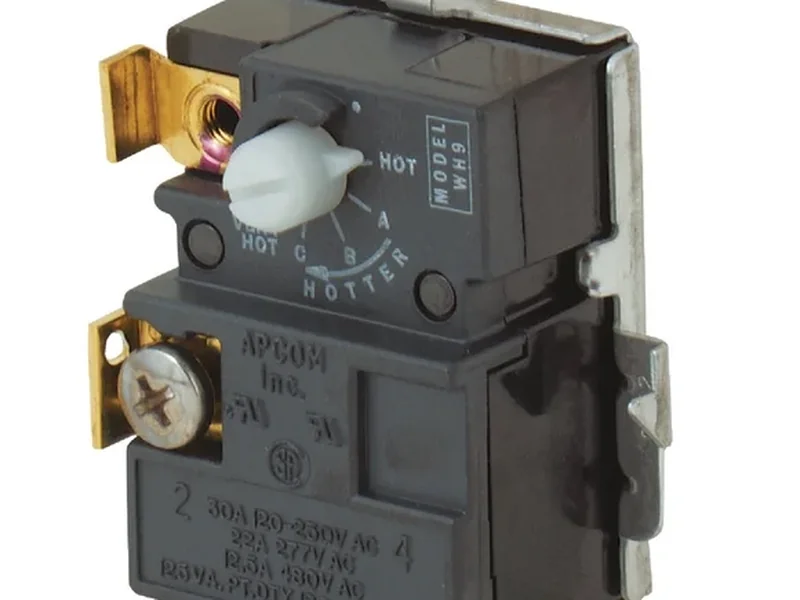
Hanahan — the commuter suburb north of North Charleston, neighbor to the Naval Weapons Station, home to Tanner Plantation, Otranto, and growing subdivisions — runs on water heaters of every age: original tanks in 1970s–90s homes, replacements from the last decade, and new units in fresh construction. The thermostat is the control they all share, and its failures show up the same way everywhere: scalding water from a stuck-on control, lukewarm water from a stuck-off one, hot water that quits halfway, a reset button that keeps tripping. In a community with many military families — frequent moves, unfamiliar houses — a misbehaving thermostat is often discovered, not remembered. This page explains thermostat failures, safe temperature settings and calibration, thermostat-versus-element diagnosis, and what replacement involves. For bad water temperatures now, call (833) 713-2101.
Thermostat Failures Across Hanahan's Housing Generations
Hanahan's three housing generations fail thermostats differently. In the 1970s–90s homes — Tanner Plantation, Otranto, the streets near the weapons station — controls are often original and decades old: contacts pitted, springs weakened, calibration long drifted. Failures here are age failures, and they frequently accompany tired elements and deep sediment — the whole heater is old, not just the control.
In the replacement generation — heaters installed in the last decade — thermostats fail as individual parts: a stuck-on control overheating the tank, a lower thermostat dying and halving the hot water supply. These are clean repairs on sound tanks, usually worth doing. In new construction, thermostat issues are rare but not unknown — typically calibration drift or a factory control that never held temperature properly.
The failure signatures are universal across generations. Stuck-on: water climbing past the setpoint toward scalding, steam at taps, the red high-limit reset tripping repeatedly — a safety issue, especially with children. Stuck-off: no heat call, lukewarm or cold water. Partial: failed lower means hot water runs out fast; failed upper often means none at all.
Military-family turnover adds the discovery factor: buyers inherit heaters with unknown histories, and the thermostat's condition is discovered through symptoms, not records. For new Hanahan homeowners, a baseline heater service — both thermostats tested, temperature verified, tank assessed — is the smart first move, whether or not symptoms have appeared.
Safe Temperatures for Busy Households
The 120-degree Fahrenheit setting is the family-household standard: comfortable for bathing, laundry, and dishes, with scalding risk held low. The burn-time facts: 140 degrees scalds seriously in seconds; 130 in about half a minute; 120 in minutes. In homes with young children — and Hanahan has many — the thermostat's accuracy is child-safety equipment, full stop.
Sudden scalding with no dial change means likely stuck-on failure: dial down, keep kids from hot taps, call (833) 713-2101. Repeated high-limit trips confirm active failure — stop resetting, start diagnosing. Lukewarm at a high setting: the control isn't calling, or sediment blinds the sensor.
Verify annually with a kitchen thermometer: hot tap nearest the heater, full minute of running, fill a cup, measure. Dials run 5 to 10 degrees off as tolerance; more is drift. Adjust, wait hours, re-test. If temperature won't hold, replace the control.
New-to-Hanahan families: check the water heater temperature in the first week, not the first year. Inherited settings from previous owners — sometimes cranked high to compensate for a failing lower element — are a common surprise, and a thermometer check plus a professional assessment sorts it in one visit.
Thermostat or Element? Sorting It Out
The symptom overlap is real — no hot water, not enough hot water — and the diagnostic sequence resolves it. Power off at the breaker, verified dead. Upper panel off: check the red reset button. Tripped once and holds? Possibly isolated. Tripping repeatedly? Active cause — stuck thermostat, failing element, sediment — still present.
- No hot water: upper thermostat, upper element, or tripped reset.
- Runs out fast: lower thermostat, lower element, or sediment.
- Too hot / reset tripping: thermostat stuck on — safety priority.
- Lukewarm: control not calling, or element failed open.
Multimeter testing decides: each thermostat for switching, each element for resistance, power off throughout. In Hanahan's older tanks, sediment assessment rides along — deep sediment mimics control failure and must be flushed for any repair to hold. In newer tanks, the readings are usually clean and decisive.
Mounting matters for the visit: thermostats on the tank surface under the panels (no draining to replace); elements inside the tank (draining required). Diagnose before draining — especially in garage and laundry-closet installations where drain routing is awkward. The meter comes out before the hose, every time.
Replacement Across the Generations
The replacement procedure is consistent — 240-volt professional work: power off and verified dead, panels and insulation removed, both thermostats tested and replaced as a pair (standard practice; the failed one's partner is stressed), new controls matched to voltage, range, and configuration, wiring transferred one wire at a time, thermostats seated firmly against the tank, 120 degrees set, full cycle run with tap verification. Gas heaters get the control valve/thermostat assembly with professional gas connections, leak-tested.
What varies by generation is the judgment around it. Newer tanks: the control repair is clearly worthwhile — the heater has years left. Middle-aged tanks (around 10 years): the visit assesses rust, sediment, and weeping to decide whether the control repair is sound or the heater is nearing replacement. Older tanks (past 10–12 years, especially with symptoms beyond the thermostat): whole-heater replacement is usually the honest recommendation.
Hanahan's older generation often benefits from bundling: thermostat replacement plus tank flush plus element testing, all in one visit with the panels already off and the power already safe. It resolves years of deferred maintenance at once and gives the heater — if it's worth keeping — a clean baseline.
For new homeowners: the baseline service visit is a smart first investment in an unfamiliar heater — both thermostats tested, temperature verified at 120, tank age and condition assessed, flush scheduled. It converts unknown history into a known plan. To schedule in 29410, call (833) 713-2101.
Local Insight
Hanahan's character is the commuter suburb with a military heartbeat — the Naval Weapons Station next door, Tanner Plantation and Otranto's established streets, new subdivisions filling in, and a steady turnover of families arriving and departing. That turnover means Hanahan has more "inherited" water heaters than most suburbs: controls with unknown histories, settings left by previous owners, maintenance that may or may not have happened.
The Goose Creek Reservoir and the area's low-lying terrain keep things damp — garages, crawlspaces, and utility areas where heaters live stay humid, aging terminals and contacts. Berkeley County's moderately hard water sediments tanks steadily. Neither factor is extreme; together across decades, they're why the older generation's thermostats are failing on schedule now.
For military families especially: the first-week heater check — temperature verified with a thermometer, age noted from the serial number, a professional baseline if anything seems off — is wise protection in an unfamiliar house. Water temperature is one of those things you want to know, not discover. And when the orders come to move again, a serviced heater with a known history is one less thing on the list.