Daniel Island's master-planned neighborhoods — homes built from the 1990s through today — run some of the Lowcountry's youngest water heaters, many still on their original tanks and controls. But even young thermostats fail, and the island's first generation of heaters is now entering the window where controls wear out: upper and lower thermostats on electric tanks, gas control valves on gas units, each with a finite cycle life. In Daniel Island homes — hardwood floors, finished spaces, households that expect everything to simply work — a failed thermostat shows up as scalding water, lukewarm showers, or hot water that quits mid-routine. This page explains how thermostats fail, safe temperature settings and calibration, thermostat-versus-element diagnosis, and what professional replacement involves. For water temperature problems now, call (833) 713-2101.
Thermostat Failures in Newer-Generation Heaters
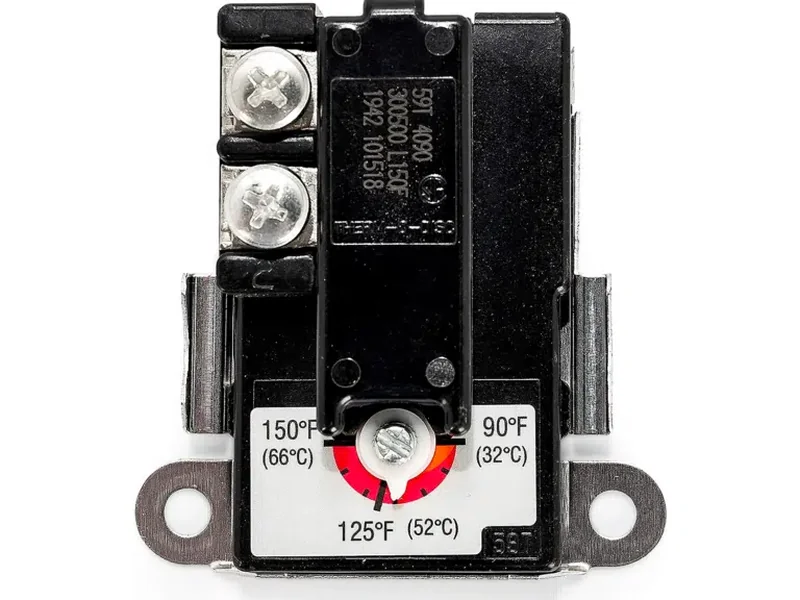
Daniel Island's electric tank heaters — many original to 1990s–2010s construction — use the standard two-thermostat system: upper and lower, sequenced with two elements, the upper carrying the red high-limit reset. These are quality controls, but they're electromechanical devices with finite lives: internal contacts pit with every switching cycle, springs weaken, calibration drifts. The island's first-wave heaters are now old enough for all of it.
The failure patterns are universal. Stuck-on: the thermostat keeps calling for heat past the setpoint, water climbs toward scalding, the reset trips repeatedly as the safety fights the failed control — a safety issue in any home, and a particular concern where households include young children. Stuck-off: no heat call, lukewarm or cold water. Partial: failed lower thermostat means hot water runs out fast (only the top heats); failed upper often means no hot water at all.
What distinguishes Daniel Island failures is context, not mechanism. These are younger tanks in good condition — so a failed thermostat is usually just a failed thermostat, not the tank's retirement notice. The water is Charleston Water System's moderately hard supply: enough to sediment the tank bottom over the years, occasionally enough to contribute to lower-sensor issues, but not the brutal well water that destroys rural tanks. Diagnosis here is cleaner, and repair is the default far more often.
Calibration drift deserves mention in newer homes: thermostats can drift several degrees over the years without fully failing, so the 125-degree setting from move-in day is 135 today. The annual thermometer check catches drift before it becomes a scalding surprise.
Temperature Safety and Calibration
The 120-degree Fahrenheit standard applies on Daniel Island as everywhere — comfortable for all household uses, with scalding risk held low. The burn-time physics: 140 degrees scalds seriously in seconds; 130 in about half a minute; 120 in minutes. In homes with children — and Daniel Island has many young families — the thermostat's accuracy is child-safety equipment.
Sudden scalding with no dial change signals a likely stuck-on failure: turn the dial down, keep children from hot taps, call (833) 713-2101. Repeated high-limit trips confirm the failure is active — stop resetting and get diagnosis. Lukewarm water at a high setting means the control isn't calling or the sensor is compromised.
Calibrate annually with a kitchen thermometer: run the hot tap nearest the heater a full minute, fill a cup, measure, compare to the dial. Five to ten degrees of difference is normal tolerance; more is drift. Adjust, wait several hours, re-test. If the temperature won't stabilize at the setting, the thermostat needs replacement — and in a younger Daniel Island tank, that's a straightforward, worthwhile repair.
Smart-home note: some Daniel Island owners have leak sensors and smart thermostats elsewhere in the house — but the water heater's own thermostat is still electromechanical and still needs its annual verification. Technology hasn't retired the thermometer check.
Thermostat or Element? Clean Diagnosis
With younger tanks and moderate water, Daniel Island diagnosis is usually clean — the multimeter gives clear answers without sediment muddying the picture. The sequence: power off at the breaker, verified dead. Check the upper thermostat's red reset: tripped once and holds after a single reset? Possibly an isolated overheat. Tripping repeatedly? Active cause — stuck thermostat or failing element — needs finding.
- No hot water: upper thermostat, upper element, or tripped reset.
- Runs out fast: lower thermostat or lower element.
- Too hot / reset tripping: thermostat stuck on.
- Lukewarm: control not calling, or element failed open.
Multimeter testing — each thermostat for switching, each element for resistance, power off throughout — identifies the failed part precisely. Sediment gets a check too; even on municipal water, years of accumulation can insulate the lower sensor, and a flush alongside the control replacement is good practice.
The mounting distinction matters for visit planning: thermostats sit on the tank surface under the access panels (no draining to replace); elements are inside the tank (draining required). Accurate diagnosis before draining keeps the visit efficient — particularly in Daniel Island utility closets and finished garages where the work area deserves protection.
Professional Replacement on Daniel Island
Thermostat replacement is 240-volt professional work, handled with finished-home care: power off at the breaker and verified dead, panels and insulation removed with the work area protected, both thermostats tested and replaced as a pair — standard practice, since the failed one's partner has been stressed and matched controls age together. New thermostats matched to voltage, range, and configuration; wiring transferred one wire at a time; controls seated firmly against the tank; temperature set to 120 degrees; full heating cycle run with tap temperatures verified; work area left clean.
Gas heaters receive the control valve/thermostat assembly — thermostat, gas valve, and ignition in one unit, with gas connections made and leak-tested by the professional. No exceptions, no shortcuts.
The tank-condition call is simpler here than in older neighborhoods: most Daniel Island tanks are young enough that a thermostat failure is just a control repair, fully worthwhile. Past 10 to 12 years — the island's oldest heaters are arriving there — the assessment gets honest: rusting, heavily sedimented, or weeping tanks make whole-heater replacement the better money, and the visit should say so plainly.
Many Daniel Island visits also bundle the deferred maintenance: a tank flush (years of municipal sediment don't leave on their own), element testing, and a pressure check. With the panels already off and the power already safe, it's efficient — and the heater leaves baselined for the years ahead. To schedule in 29492, call (833) 713-2101.
Local Insight
Daniel Island is the Lowcountry's planned community — architectural review, homes from the 1990s forward, young families, professionals commuting via I-526. The water heaters are correspondingly young: original-equipment tanks and controls, professionally installed, on Charleston Water System's moderately hard supply. It's a strong starting point for reliable service — which makes the maintenance story here about preserving an advantage, not recovering from neglect.
HOA standards govern exteriors, but water heater thermostats live inside — no architectural review, no visible changes, just a service visit. The planned-community factor that does matter is expectations: Daniel Island households expect systems to work flawlessly, and a thermostat failure feels like a betrayal. The reframe is useful — controls are wear items with finite lives, and scheduled verification catches them before the symptom.
Young families are the demographic note: children, busy mornings, multiple bathrooms. The 120-degree setting and the annual thermometer check are the complete child-safety program for water temperature — simple, scheduled, and effective. In a community built around family life, it's the detail that deserves not to be overlooked.