West Ashley's 29407 neighborhoods — ranch homes off Ashley River Road, the St. Andrew's area, streets near Citadel Mall — are full of water heaters at the age where controls start failing. Many of these 1950s–1970s houses still run tanks installed decades ago, and the thermostats governing them are wearing out on schedule: water that scalds without warning, hot water that quits halfway through the morning routine, reset buttons tripping for no apparent reason. In family neighborhoods, a stuck-on thermostat is a child-safety issue; in homes with aging tanks, a failed control is often the tank's retirement notice. This page explains how thermostats fail, safe temperature settings and calibration, telling thermostat problems from element problems, and what replacement involves. For water that's too hot, too cold, or gone, call (833) 713-2101.
Thermostat Failures in Aging West Ashley Tanks
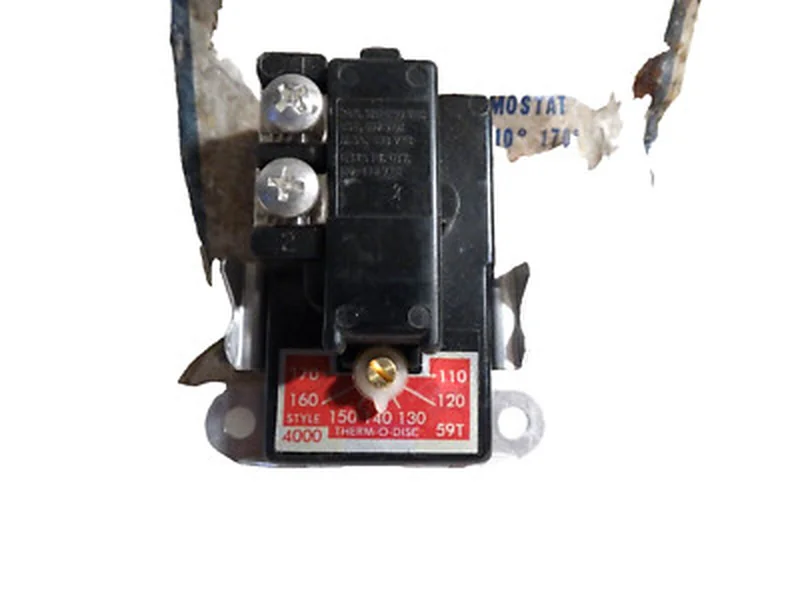
West Ashley's electric tank heaters — the overwhelming majority here — each carry two thermostats, upper and lower, sequenced with two elements. The upper heats the top first, then hands off; it also carries the red high-limit reset that trips on overheating. In 29407's aging tanks, these controls are often original equipment now decades old, and they fail in the textbook patterns.
Stuck-on is the dangerous one: the thermostat keeps calling for heat past the setpoint, driving water toward 140 degrees and beyond — where serious burns happen in seconds. In family neighborhoods with young children, this failure can't wait. Signs: water suddenly much hotter than the dial setting, steam at the tap, the reset button tripping repeatedly as the safety battles the failed control.
Stuck-off and partial failures are the daily annoyances that signal end-of-control-life: no hot water (upper thermostat or element), hot water that runs out fast (lower thermostat or element — only the top heats), lukewarm throughout. In West Ashley's ranch homes, "runs out fast" is the most common complaint, and it's as often the lower control as the tank size.
Age compounds everything. Decades of thermal cycling fatigue the thermostat's internal contacts; humid garage and crawlspace air corrodes terminals; sediment from years of moderately hard Charleston water buries lower elements and blinds lower sensors. When a 29407 thermostat fails, the visit should assess the whole aging system — control, elements, sediment, tank — because the failed part is rarely the only tired component.
Safe Temperatures for Family Homes
The 120-degree Fahrenheit recommendation exists for households exactly like West Ashley's: families with children, where a moment's inattention at the tap shouldn't mean a burn unit. The numbers: at 140 degrees, a serious scald takes seconds; at 130, about half a minute; at 120, minutes of exposure. Young children's thinner skin burns faster at every temperature, which makes the thermostat's accuracy a child-safety matter, not a comfort preference.
A sudden jump to scalding with no dial change means the thermostat has likely failed on — turn the dial down, keep kids from hot taps, and call (833) 713-2101. Don't normalize it or wait to see if it settles. Lukewarm water at a high setting means the control isn't calling for heat or sediment is blinding the sensor.
Verify with a thermometer: run the hot tap nearest the heater for a full minute, fill a cup, measure with a kitchen thermometer. Dials run 5 to 10 degrees off as manufacturing tolerance; larger gaps mean drift. Adjust, wait several hours, re-test. If temperature won't hold at the setting, replace the control — adjustment can't fix a failing thermostat.
Teach the household, too. In homes with kids, the 120-degree setting plus a quick thermometer check each season is the complete safety program. And if grandparents or older relatives live in the home, remember their skin is also more burn-vulnerable — the same 120-degree ceiling protects them.
Thermostat or Element? Diagnosing Aging Systems
In aging West Ashley heaters, thermostat and element failures overlap — and sediment often joins the masquerade. The diagnostic sequence sorts them. With power off at the breaker: check the upper thermostat's red reset button. Tripped once and holds? Possibly isolated. Tripping repeatedly? The cause — stuck thermostat, failing element, deep sediment — is active; stop resetting and diagnose.
- No hot water: upper thermostat, upper element, or tripped reset.
- Runs out fast: lower thermostat, lower element, or sediment burial — the 29407 classic.
- Too hot / reset tripping: thermostat stuck on — safety priority.
- Lukewarm: control not calling, or element failed open.
Multimeter testing is definitive: each thermostat checked for switching, each element for resistance, power off throughout. Sediment depth is assessed in parallel — in decades-old West Ashley tanks, inches of sediment are common, and sediment can mimic control failure by insulating the lower sensor. The honest fix is parts plus flush, not parts alone.
The practical distinction: thermostats mount on the tank surface under the access panels — no draining to replace. Elements are inside the tank — draining required. Accurate diagnosis before draining saves real time, especially in ranch-home garages where the drain routing is awkward. Test first, drain only if the element is the culprit.
Replacement in West Ashley's Older Homes
Thermostat replacement is 240-volt professional work: power off at the breaker and verified dead, panels and insulation removed, both thermostats tested and usually replaced as a pair — a failed upper has stressed the lower, and matched controls age together. New thermostats match voltage, range, and configuration; wiring transfers one wire at a time; controls seat firmly against the tank; temperature set to 120 degrees; full heating cycle run with tap temperatures verified.
Gas heaters get the combined control valve/thermostat assembly — gas connections, professional only, leak-tested afterward.
The critical judgment in 29407 is tank condition, because so many tanks here are old. Under 10 years with a sound tank: the control replacement is a sound repair. Past 10 to 12 years, rusting, heavily sedimented, or weeping: a new thermostat is money toward a dying tank — whole-heater replacement is the honest recommendation, and in a family home the reliability matters as much as the economics.
Many West Ashley heaters are also due for the companion work: a full flush (decades of sediment don't leave voluntarily), new elements if testing shows weakness, and a pressure check. Bundling it into the thermostat visit is efficient — the panels are already off, the power is already safe, and the heater leaves with years of deferred maintenance resolved at once. To schedule in 29407, call (833) 713-2101.
Local Insight
West Ashley is Charleston's post-war suburb, and its water heaters are post-war too — or replacements of replacements, many now decades old. The ranch neighborhoods off Ashley River Road and in St. Andrew's run tanks in garages and laundry closets, on Charleston Water System's moderately hard supply, through humid summers that corrode terminals and contacts. Thermostat failures here are age failures, and they're arriving on schedule across the whole ZIP.
Family demographics make temperature safety the headline. These are neighborhoods of young families — children, busy mornings, multiple bathrooms — where a stuck-on thermostat is a pediatric burn risk and "runs out fast" disrupts the whole household routine. The 120-degree setting isn't abstract here; it's the number that keeps the morning safe.
The remodel economy adds the second story: West Ashley's flippers and renovators replace water heaters during kitchen and bath overhauls, so some 29407 tanks are young. If yours is a recent replacement, the thermostat visit is simpler — likely just the control. If it's original to the house, the visit is really a whole-heater assessment wearing a thermostat disguise. Know which one you have before deciding.