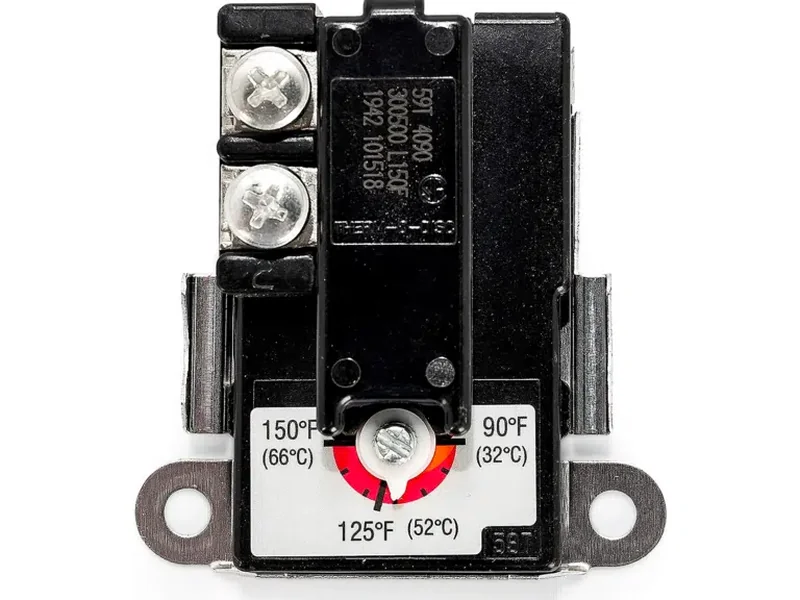
Downtown Charleston's 29401 peninsula — historic single houses, converted warehouses, inns, and rentals from the Battery to upper King Street — heats water with equipment spanning three centuries of building technology. The thermostat is the small control governing all of it: two thermostats on an electric tank, a gas control valve on a gas unit, each deciding whether the water is safe or scalding. In a district where many heaters serve inns and short-term rentals, a failed thermostat isn't just a household inconvenience — it's a guest-safety issue, with guest safety riding on a small, inexpensive part. This page explains how thermostats fail, temperature safety and calibration, thermostat-versus-element diagnosis, and what professional replacement involves in peninsula buildings. For unsafe water temperatures now, call (833) 713-2101.
Thermostat Failures in Peninsula Buildings
Electric tank heaters dominate downtown's retrofits, and each carries two thermostats — upper and lower — working in sequence with two heating elements. The upper thermostat heats the top first, then hands off to the lower; it also carries the red high-limit reset, the safety that trips on overheating. In 29401's inns and multi-unit buildings, these controls cycle far more than in a residence — more guests, more gallons, more thermal cycles — and they wear accordingly.
The stuck-on failure is the safety-critical one. A thermostat that won't stop calling for heat drives water toward 140 degrees and beyond, where serious burns happen in seconds. In a rental or inn, where guests can't be expected to know the heater's quirks, an overheating tank is a liability event waiting for a victim. Signs: water suddenly much hotter than the setting, steam at taps, the reset button tripping repeatedly as the safety fights the failed control.
The stuck-off and partial failures are the comfort killers: no hot water (upper thermostat or upper element), hot water that runs out fast (lower thermostat or lower element — only the top heats), lukewarm throughout (control not calling, or element failed). In a multi-bath historic home or an inn, "runs out fast" often gets misread as "tank too small" when it's actually the lower half never heating.
Peninsula retrofits add an installation wrinkle: heaters tucked into carriage houses, garden-level closets, and tight utility nooks where access panels are hard to reach and ventilation is poor. Heat and humidity in those spaces age thermostat contacts and wiring faster. A downtown thermostat visit often includes improving access and airflow as well as replacing the control.
Temperature Safety, Scalding, and Calibration
The recommended setting — 120 degrees Fahrenheit — is a safety standard with hospitality implications downtown. At 140 degrees, a serious scald takes seconds; at 130, about half a minute; at 120, minutes of exposure. For inns, rentals, and any home hosting guests, 120 isn't just advisable — it's the defensible standard. A guest scalded by a 150-degree tap is a problem no innkeeper wants.
Sudden scalding with no dial change means the thermostat has likely failed on: turn the dial down, warn occupants, and call (833) 713-2101. Don't keep resetting a tripping high-limit button — the repeated trip confirms the failure is active. Lukewarm water at a high setting means the control isn't calling for heat, or sediment is blinding the sensor.
Calibrate with a thermometer, because dials are approximate — commonly 5 to 10 degrees off, sometimes more. Run the hot tap nearest the heater for a full minute, fill a cup, measure with a kitchen thermometer, and compare to the setting. Adjust, wait several hours for stabilization, re-test. If the temperature won't hold, the thermostat is drifting and needs replacement, not adjustment.
For property managers, the practical protocol: verify 120 degrees at every turnover or season start, log the reading, and treat any guest complaint about water temperature as a maintenance ticket, not a preference. The five-minute thermometer check is the cheapest liability prevention in the building.
Thermostat or Element? Diagnosing in Tight Spaces
Downtown's tight installations make diagnosis-before-dismantling especially valuable — nobody wants to drain a tank in a carriage-house closet on a guess. The sequence: with power off at the breaker, check the upper thermostat's red reset button. Tripped once and holds after reset? Possibly an isolated event. Tripping repeatedly? The cause — stuck thermostat, failing element, sediment — is active, and resetting without diagnosis just resumes the overheating.
- No hot water: upper thermostat, upper element, or tripped reset.
- Runs out fast: lower thermostat, lower element, or sediment.
- Too hot / reset tripping: thermostat stuck on — safety issue.
- Lukewarm: control not calling, or element failed open.
Multimeter testing is definitive: power off, each thermostat checked for switching, each element for resistance. In inns with high throughput, sediment assessment matters too — heavy sediment mimics control failure and must be addressed alongside parts. Thermostats mount on the tank surface under the panels (no draining to replace); elements are inside the tank (draining required). Knowing which is failed before opening the drain valve saves real time in a tight space.
Gas units — common in larger peninsula buildings — use the combined gas control valve/thermostat. A burner that runs constantly, a dial that won't hold temperature, or pilot/ignition trouble points to the assembly. It's gas work, strictly professional, with leak testing on every connection.
Professional Replacement in Historic Buildings
Thermostat replacement on electric heaters is 240-volt work: power off at the breaker, verified dead, panels and insulation removed, both thermostats tested and typically replaced as a pair (a failed upper stresses the lower; matched controls age together). New thermostats match voltage, range, and configuration; wiring transfers one wire at a time; the controls seat firmly against the tank for accurate sensing; temperature is set to 120 degrees; and the heater runs a full cycle with tap temperatures verified.
In 29401's tight retrofits, the visit also addresses access and environment: ensuring panels can actually be removed for future service, checking that the closet ventilates, and noting any wiring or contact corrosion from the humid peninsula air. These details prevent the next failure as surely as the new part does.
Gas control valve replacement is the gas equivalent — thermostat, valve, and ignition in one assembly, with gas connections made and leak-tested by the professional. No shortcuts, no exceptions.
The tank-condition judgment is critical downtown, where some heaters serve buildings far older than the tank. Under 10 years with a sound tank: replace the control. Past 10 to 12 years, rusting, or weeping: the new thermostat is money toward a dying tank — whole-heater replacement is the honest call. In rental and inn properties, the reliability math favors replacement sooner; a failed heater costs bookings, not just comfort. To schedule in 29401, call (833) 713-2101.
Local Insight
The 29401 peninsula heats water for a visitor economy. Inns, short-term rentals, and restaurants run their heaters far harder than residences — more gallons, more cycles, more wear on every control. A thermostat that would last a decade in a home may fail in six at an inn, and the failure modes skew toward the dangerous end: stuck-on overheating under heavy cycling. If you manage a downtown rental property, the thermostat deserves the same scheduled attention as the HVAC filters.
Historic buildings add the access challenge. Heaters live in carriage houses, garden-level closets, and retrofitted nooks where a technician works by headlamp — and where a scalding incident involves guests, not just family. The combination argues for proactive control checks: verify the 120-degree setting and test both thermostats on a schedule, rather than waiting for the symptom that brings the emergency call.
Charleston Water System's moderately hard supply scales tanks steadily, and scale plus heavy cycling is the pairing that kills lower thermostats downtown — sediment insulates the sensor, the control overworks, the part fails early. The complete downtown service is control replacement plus a tank flush: the sediment that confused the old thermostat will confuse the new one just as fast.