On the shores of Lake Moultrie, Bonneau's homes — fishing camps, older cottages, manufactured houses, and newer lake-view builds — mostly heat water with electric tank heaters, and every one of them depends on a small part most owners never think about: the thermostat. When it fails, the signs are hard to miss: shower water that scalds without warning, hot water that gives out halfway through, or a tank gone cold with the reset button tripped. Lake-country well water makes thermostat trouble more common here — sediment buries lower elements and confuses sensors, and iron-rich water accelerates tank aging. This page explains how thermostats fail, the scalding dangers of overheating and how to set temperature safely, how technicians distinguish thermostat from element failures, and what replacement involves. For unsafe or missing hot water now, call (833) 713-2101.
How Thermostats Fail on Lake Moultrie
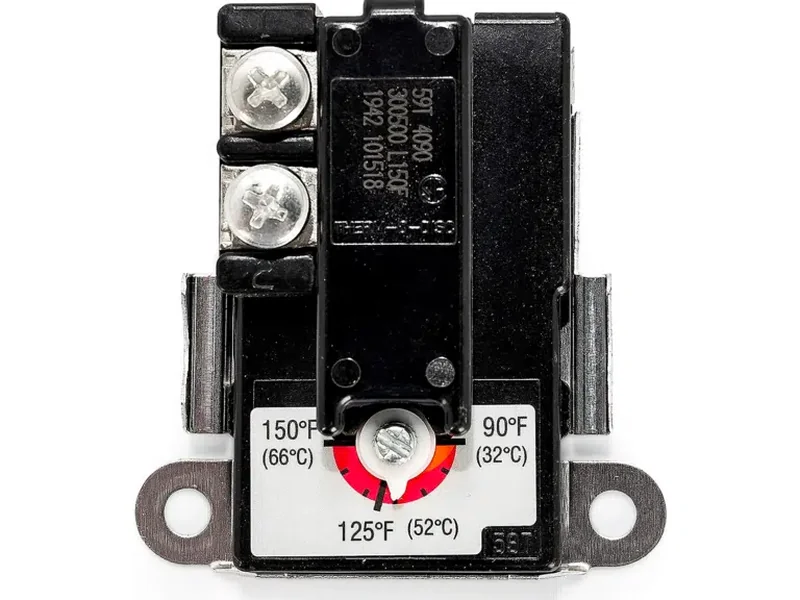
Electric tank heaters — the standard in Bonneau — use two thermostats, upper and lower, each paired with a heating element. The upper thermostat runs the show: it heats the top of the tank first, then hands off to the lower. It also carries the red high-limit reset button, the safety that trips when water overheats. This teamwork is precise when it works and confusing when it doesn't, because a failure in either thermostat produces a different symptom.
The dangerous failure is a thermostat stuck "on." It keeps calling for heat past the setpoint, driving water toward 140 degrees and beyond — scalding territory. Warning signs: water suddenly much hotter than usual, steam at the tap, or the reset button tripping over and over as the safety fights the stuck control. In a lake house full of weekend guests, including kids, an overheating tank is a genuine safety hazard that shouldn't wait.
The inconvenient failures: a thermostat stuck "off" (no heat call, lukewarm or cold water), a failed lower thermostat (hot water runs out fast — only the top heats), or a failed upper thermostat (often no hot water at all, since the lower never gets its turn). Each has a distinct signature that a technician reads like a map.
Bonneau's well water writes its own chapter. Sediment — sand, minerals, iron compounds — settles on the tank bottom and buries the lower element and thermostat, insulating them from the water they're supposed to sense. The control then overheats the tank trying to satisfy a sensor that can't feel the water. In lake-country homes, thermostat replacement without addressing sediment is a temporary fix; the honest service pairs the new control with a tank flush.
Scalding Risk and Safe Temperature Settings
Temperature setting is safety equipment. The standard recommendation is 120 degrees Fahrenheit — comfortable for every household use while keeping burn risk low. The physics: at 140 degrees, a serious scald can occur in seconds; at 130, in about half a minute; at 120, it takes minutes of continuous exposure. For households with children, older adults, or guests unfamiliar with the house — the classic lake-weekend scenario — 120 is the responsible ceiling.
A sudden jump to scalding water with no dial change means the thermostat has likely failed "on." Turn the dial down, keep children away from hot taps, and call (833) 713-2101 — don't wait to see if it settles. Conversely, lukewarm water at a high setting means the thermostat isn't calling for heat, or sediment is blinding the sensor. The tap tells the truth; the dial may not.
Verify with a thermometer, because dials lie. Run the hot tap nearest the heater for a full minute, fill a cup, and measure with a kitchen thermometer. Compare to the dial: 5 to 10 degrees of difference is normal manufacturing tolerance; more means the thermostat is drifting. Adjust, wait several hours for the tank to stabilize, and re-test. If temperature won't hold at the setting, the control needs replacement.
Gas heaters — common in some Bonneau homes — use a combined gas valve and thermostat with a dial marked in relative terms (warm, hot, very hot) rather than degrees. The 120-degree target still applies, tested the same way. A burner that runs constantly or a dial that won't hold temperature means the control assembly needs professional replacement.
Thermostat vs. Element: The Diagnosis
Thermostat and element failures overlap in symptoms, so guessing wastes money. The diagnostic sequence is methodical. First, the reset button: with power off at the breaker, remove the upper access panel and check the red high-limit reset on the upper thermostat. Tripped? Press it once. If hot water returns and stays, it may have been an isolated overheat. If it trips again, the cause — stuck thermostat, failing element, heavy sediment — is still active, and repeated resetting just resumes the overheating.
- No hot water: upper thermostat, upper element, or tripped reset.
- Runs out fast: lower thermostat, lower element, or sediment burial.
- Too hot / reset tripping: thermostat stuck on.
- Lukewarm only: thermostat not calling, or element failed.
The multimeter settles it: power off, each thermostat tested for proper switching, each element for correct resistance. An element that's failed reads open or shorted; a thermostat that won't switch is done. Sediment level is assessed at the same time — in Bonneau's well-water homes, inches of sediment can mimic control failure, and the complete fix is flush plus parts, not parts alone.
Worth knowing: thermostats mount against the tank under the access panels, so replacing them doesn't require draining the tank. Elements sit inside the tank and do require draining. An accurate diagnosis before draining saves significant visit time — another reason the multimeter comes out before the hose.
The Replacement Visit: What Happens
Thermostat replacement is precise electrical work — 240 volts on most electric heaters — handled start to finish by the technician. Power is shut off at the breaker and verified dead. Access panels and insulation are removed, exposing both thermostats against the tank. Both are tested; on electric heaters the standard is to replace upper and lower as a pair, since a failed upper has been stressing the lower and matched controls age together predictably.
New thermostats must match the heater's voltage, temperature range, and configuration. Wiring transfers one wire at a time — miswiring a 240-volt control is not a learning experience anyone wants. The thermostats seat firmly against the tank for accurate sensing, temperature is set to 120 degrees, and the heater runs a full cycle with tap temperatures verified before the panels go back on.
Gas heaters get the control valve/thermostat assembly as a unit — thermostat, gas valve, and ignition controls together. It's gas-fitting work, strictly professional, with leak testing on every connection afterward.
The judgment call is tank condition. A thermostat on a tank under 10 years old with a clean interior is a sound repair. On a tank past 10 to 12 years — rusting, heavily sedimented, or weeping — the new control is wasted money on a dying tank, and whole-heater replacement is the honest advice. The visit should always include that assessment; in lake-country well water, tanks age faster than the calendar suggests. To schedule in Bonneau, call (833) 713-2101.
Local Insight
Bonneau runs on well water and lake time. The town hugs Lake Moultrie, Bonneau Beach draws the fishing crowd, and the housing — camps, cottages, manufactured homes, newer lake-view builds — mostly heats water with electric tanks on private wells. That well water is the thermostat story here: sediment-heavy, often iron-rich, burying lower elements and confusing sensors faster than municipal water does.
The lake-weekend pattern adds a safety dimension. A house that sits quiet all week then fills with guests — including children — for a fishing weekend is exactly where a stuck-on thermostat becomes dangerous: unfamiliar users, high hot-water demand, and no one who knows the heater's quirks. Lake homeowners should verify the 120-degree setting before guest season, not after the first scalding complaint.
Iron is Bonneau's signature water issue — the orange staining on fixtures is the visible half; the sediment burying the tank bottom is the hidden half. Any thermostat service here should include a sediment assessment and, where needed, a flush. The control and the tank bottom are a system; servicing one without the other is half a job.