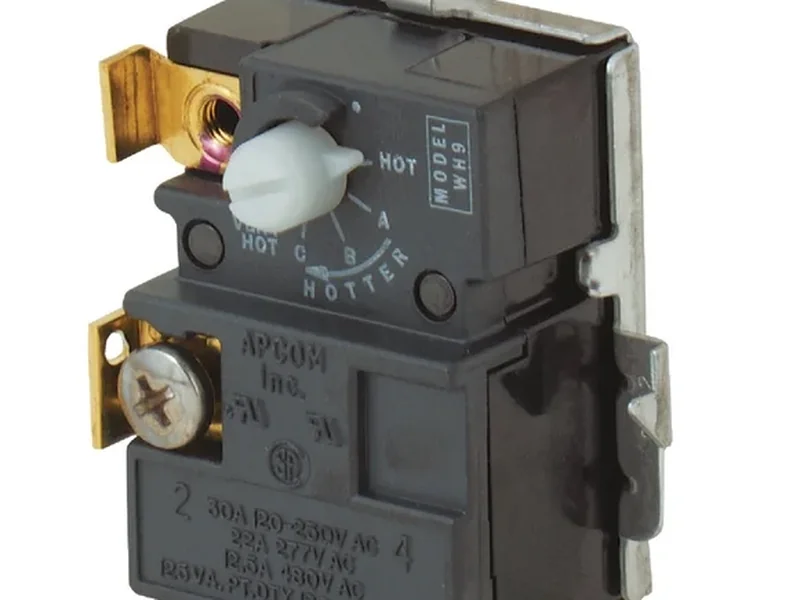
The thermostat is the small control that decides whether your shower is comfortable or dangerous — and in Awendaw, where U.S. 17 runs past the Francis Marion National Forest toward Bulls Bay, it's a part that works hard. Well water sediment, humid air corroding access panels, and older tanks in cottages and manufactured homes all push thermostats toward failure. When a thermostat fails, the symptoms are unmistakable: water hot enough to scald, water that runs lukewarm and then cold, or no hot water at all with the reset button tripped. This page explains how water heater thermostats work and how they fail, the scalding risks of a stuck thermostat and how to calibrate temperature safely, how to tell a thermostat problem from a heating-element problem, and what a replacement visit involves. If your water temperature is wrong or unsafe right now, call (833) 713-2101.
How Water Heater Thermostats Fail in Awendaw Homes
Most Awendaw homes run electric tank water heaters, and every electric tank has two thermostats — upper and lower — each controlling its own heating element. They work as a team: the upper thermostat heats the top of the tank first, then hands off to the lower thermostat for the rest. The upper thermostat also carries the high-limit reset button (often red), a safety device that trips when water gets dangerously hot. When any part of this chain fails, the symptoms show up at the tap.
A thermostat stuck in the "on" position is the dangerous failure. It keeps calling for heat after the water is already hot, driving temperatures toward scalding — 140 degrees and beyond. You'll notice water that's suddenly much hotter than the setting, steam or unusually hot water at the tap, or the reset button tripping repeatedly as the safety tries to intervene. This failure needs prompt attention: overheated water can cause serious burns, especially to children and older adults.
A thermostat stuck "off" is the inconvenient failure: the element never fires, and you get lukewarm water or none at all. A failed lower thermostat typically means hot water runs out fast — the top of the tank heats, the bottom never does. A failed upper thermostat often means no hot water period, since the lower element never gets its turn.
Awendaw's well water adds a local accelerant: sediment. Mineral sediment settling on the tank bottom insulates the lower element and thermostat from the water they're sensing, confusing the control and causing overheating cycles. Corrosion in humid utility spaces can also degrade the thermostat's contacts and wiring over time. When sediment is heavy, a thermostat replacement pairs naturally with a tank flush — fixing the control without addressing the sediment invites a repeat failure.
Too Hot, Too Cold: Temperature, Scalding, and Calibration
Water heater temperature is a safety setting, not a comfort preference — though it affects both. The widely recommended setting is 120 degrees Fahrenheit: hot enough for showers, dishwashing, and laundry, while keeping scalding risk low. The reason is burn time: at 140 degrees, a serious burn can occur in seconds; at 130 degrees, in roughly half a minute; at 120 degrees, it takes several minutes of exposure. Households with children or older adults should treat 120 as a ceiling, not a suggestion.
If your water is suddenly scalding and the thermostat dial hasn't moved, the thermostat may have failed in the "on" position — stop using the hot water for bathing until it's checked, and call (833) 713-2101. If the water is lukewarm despite a high setting, the thermostat may have failed "off," or sediment may be insulating the sensor. Either way, the tap is telling the truth and the dial is not.
Calibration is worth doing because thermostat dials are approximate. To check yours: run the hot tap nearest the heater for a minute, fill a cup, and measure with a kitchen thermometer. Compare the reading to the dial setting — differences of 5 to 10 degrees are common, and larger gaps mean the thermostat is drifting. Adjust the dial, wait several hours, and re-test. If the temperature won't stabilize at the setting, the thermostat needs replacement, not adjustment.
Gas water heaters use a combined gas control valve and thermostat with a dial marked in warm-hotter terms rather than degrees. The same 120-degree target applies, and the same test works. If the dial won't hold temperature or the burner runs constantly, the control valve assembly needs professional attention.
Thermostat or Heating Element? Getting the Diagnosis Right
Thermostat and heating-element failures share symptoms — no hot water, not enough hot water — so the diagnosis matters. Replacing the wrong part wastes a visit. Here's how a technician tells them apart, and what you can safely check yourself.
Start with the reset button. On an electric heater, remove the upper access panel (power off at the breaker first — always) and look for the red high-limit reset button on the upper thermostat. If it's tripped, press it firmly. If hot water returns and stays, the trip may have been a one-time overheat event. If it trips again within days, something is wrong — usually a thermostat stuck on, a failing element, or heavy sediment causing overheating. A repeatedly tripping reset is a symptom, not the problem; don't just keep resetting it.
- No hot water at all: often the upper thermostat or upper element — or a tripped reset.
- Hot water runs out very fast: often the lower thermostat or lower element.
- Water too hot / reset keeps tripping: often a thermostat stuck on.
- Lukewarm only: thermostat not calling for heat, or an element failed open.
The definitive test uses a multimeter: with power off, the technician checks each thermostat for proper switching and each element for correct resistance (a failed element reads open or shorted). Sediment gets assessed too — in Awendaw's well-water homes, a tank with inches of sediment can mimic thermostat failure, and the honest fix is a flush plus the control repair, not just the part swap.
One practical note: on electric heaters, thermostats mount against the tank surface under the access panels — replacing them doesn't require draining the tank. Elements do require draining. That difference affects the visit's scope, and a good diagnosis before draining saves real time.
What Thermostat Replacement Involves
Thermostat replacement is a focused repair, not a major project — but it involves 240-volt electricity on most electric heaters, so it's professional work. The visit follows a consistent pattern. First, power is shut off at the breaker and verified dead. The access panels and insulation come off, exposing the upper and lower thermostats mounted against the tank. The technician tests both — a failed upper thermostat often stresses the lower, and on electric heaters it's standard practice to replace them as a pair so the controls age together.
The new thermostats must match the heater: correct voltage, correct temperature range, and the right configuration for the model. Wiring is transferred one wire at a time to avoid miswiring, the thermostats are seated firmly against the tank surface (good thermal contact is essential for accurate sensing), and the temperature is set — 120 degrees is the standard recommendation. Then power is restored and the heater is run through a full heating cycle while temperatures are verified at the tap.
On gas heaters, the equivalent repair is the gas control valve/thermostat assembly — a single unit combining the thermostat, gas valve, and pilot/igniter controls. It's a more involved replacement (gas connections, not just wiring) and always professional work.
When does thermostat replacement stop making sense? When the tank itself is failing. If the tank is over 10 to 12 years old, shows rust, or is leaking, a new thermostat is lipstick on a failing tank — replacement of the whole heater is the honest recommendation. Similarly, if sediment is so heavy the tank can't be flushed clean, the underlying problem will keep killing controls. A technician should assess tank age and condition as part of the visit and tell you plainly which side of the line you're on. To schedule in Awendaw, call (833) 713-2101.
Local Insight
Awendaw's water heaters live the rural-coastal life: cottages and manufactured homes along U.S. 17, many on private wells, equipment in garages, carports, and crawlspaces where forest humidity and salt air both reach. The wells are the defining factor for thermostat longevity — sediment-heavy water buries lower elements and confuses lower thermostats, producing the classic Awendaw complaint of hot water that runs out halfway through a shower.
The housing mix matters too. Older cottages often have original tanks well past their prime, where a thermostat failure is really the tank's retirement notice. Manufactured homes have compact utility closets where access panels are hard to reach and tanks are often builder-grade. In both cases, the thermostat visit should include a tank-age and condition assessment — the control is only worth replacing if the tank deserves to keep running.
Distance is the practical note: Awendaw is a real drive from metro shops, so a thermostat call should be a one-trip resolution. Have the heater's brand, model, approximate age, and symptoms ready — water too hot, too cold, none at all, reset tripping — and note whether it's electric or gas. The more precise the symptoms, the more likely the right parts are on the truck.