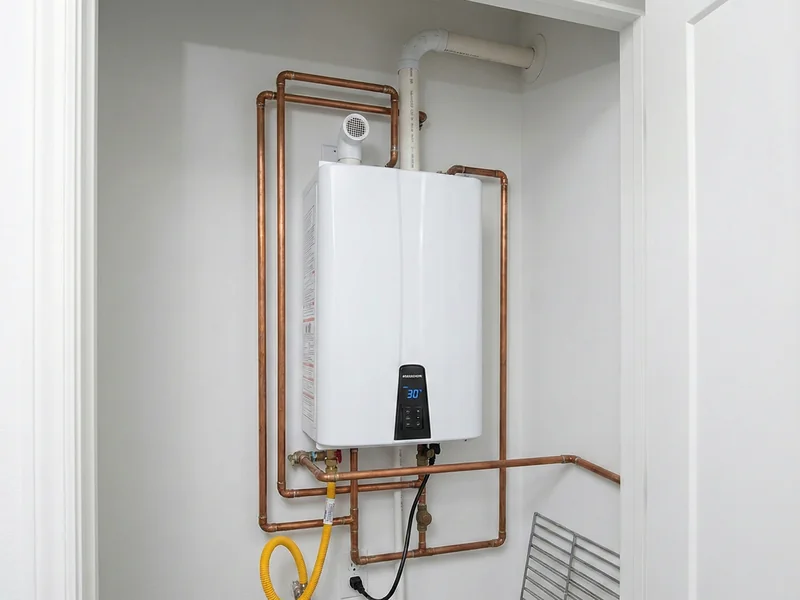
The 29485 ZIP is Summerville's growth edge — Nexton, Cane Bay, and the master-planned subdivisions spreading west and north, where most homes were built in the 2000s through today. These are young houses with young tankless water heaters: high-efficiency condensing units installed as original equipment, professionally vented, usually with isolation valves — a strong starting point for long service life. But even quality installations age into maintenance needs. Moderately hard water scales every heat exchanger, condensate drains clog, fittings loosen through firing cycles, and the first wave of 29485 units is now entering the window where neglected maintenance becomes visible leaks. This page covers leak sources in newer Summerville homes, early detection, descaling intervals, and repair-versus-replace decisions. For a leaking unit now, call (833) 713-2101.
Young Units, Real Maintenance Needs
Summerville's west side has the Lowcountry's youngest tankless population — condensing high-efficiency units in Nexton, Cane Bay, and the surrounding subdivisions, installed by professionals with proper venting and isolation valves. It's the ideal setup, and it breeds the ideal misconception: that a young, quality unit doesn't need maintenance. It does. Scale accumulates from the first gallon, and the moderately hard local water plates calcium and magnesium onto the heat exchanger year by year regardless of the installer's skill.
The first-decade failure modes here are maintenance failures, not equipment failures: condensate drains clogging with sediment (the mystery puddle in a healthy-looking unit), fittings weeping at valve packing nuts after thousands of cycles, relief valves dripping as pressure creeps or seats wear. None of these indicate a bad unit; all of them indicate a unit that's never been serviced.
Scale is the slow threat beneath the small stuff. Family homes in the new subdivisions run high hot-water volumes — multiple bathrooms, daily laundry, young families — so the mineral film builds steadily. The scaled coil over-fires, efficiency drops, and by the second decade the exchanger approaches the pinhole window. Annual flushing keeps the whole timeline on track; skipped flushing compresses it.
HOA communities add the design-standards wrinkle: exterior vent terminations and equipment placement must comply, occasionally producing longer vent runs that collect condensation in humid weather. A proper diagnosis distinguishes vent condensation from plumbing leaks before parts are ordered.
Early Detection in Newer Homes
New-home owners should start the checking habit early — monthly, two minutes: floor around the unit, every visible fitting for crust or staining, the relief-valve discharge pipe, the wall behind wall-mounted cabinets. In two-story homes, check the ceiling below any elevated unit. Check after the morning hot-water rush, when demand-dependent leaks appear.
The warnings in young units: a condensate outlet that's dry while the unit runs (clog upstream), white crust on a fitting (an early weep), hot-cold-hot shower swings (scale building), error codes for flow or overheating, energy use creeping up with steady habits. None of these are normal "new unit" behavior — they're all service prompts.
- Error codes — note the exact code; it aims the diagnosis.
- Dry condensate outlet on a running condensing unit — clear the line.
- Crust or staining on fittings and valves.
- Relief valve dripping steadily — pressure, temperature, or valve failure.
- Musty odors — moisture reaching drywall or framing.
New homeowners: record the brand, model, and serial number now (the serial gives the manufacture date), and establish the flush history — if the previous owner can't say, assume it needs one. The first professional service sets the baseline for everything that follows.
Descaling for 29485's Newer Units
The water serving west Summerville — CPW and county systems — is moderately hard, and the standard is the annual descale: isolate at the service valves, circulate food-grade white vinegar or commercial descaler through the heat exchanger with a pump for 45 to 60 minutes, flush clean, test. Most 29485 units have isolation valves from the original install, making this a routine service call.
Bundle condensate-line clearing with every descale. In a market dominated by condensing units, the five-minute drain check prevents the most common mystery puddle — and it's the maintenance item most often skipped, because homeowners don't know the line exists. Make sure your technician checks it.
Large young families should assess whether annual is enough. Scale tracks gallons, and a busy household with small children — baths, laundry, constant hot water — can multiply a smaller household's throughput several times. Creeping energy use or temperature swings signal a tighter interval; the second year's flush condition tells you definitively.
Calendar it like HVAC service. The 29485 units that develop problems are the ones whose owners assumed youth meant immunity. A dated service record per home is the cheapest warranty a tankless unit has — and the first question any future buyer, technician, or warranty claim will ask.
Repair or Replace on the Growth Edge
At these ages, repair is overwhelmingly the answer: valves, fittings, gaskets, condensate drains, sensors — replaceable parts, each a clean fix. A proper repair bundles descaling, pressure verification, and an installation check, so a young unit with a first problem leaves corrected and baselined. Most 29485 leak calls end here.
Replacement at this age is uncommon and usually means either a badly scaled exchanger on a unit that missed every flush, or a rare lemon with repeated failures. When it happens, it's the moment to verify sizing for the household as it is now — young families grow, additions happen — and to confirm gas-line capacity and venting rather than copying the original.
The sizing conversation matters because these homes are still evolving. A unit sized for a young couple may strain under a family of five with teenagers; tankless capacity is rated by temperature rise at flow, and while our warm groundwater (often around 70 degrees) helps, simultaneous demand is what sizes the unit. Recalculate before assuming the unit is failing.
A 29485 visit is efficient and thorough: utilities secured, leak traced with the unit running, pressure and venting verified, condensate cleared, part replaced, system descaled, hot water tested at multiple fixtures. You get a plain explanation and a maintenance schedule matched to your household's growth. Call (833) 713-2101 to schedule.
Local Insight
The 29485 ZIP is Summerville's future arriving — Nexton, Cane Bay, and the planned communities rewriting what Summerville looks like, all of it young: young families, young homes, young water heaters. The I-26 corridor feeds commuters to Charleston and North Charleston, and the subdivisions keep multiplying. It's the most new-construction-heavy service area in the region.
That youth is both the advantage and the trap. The tankless units here are professionally installed to a high standard — condensing, valved, vented right — which means failures are almost entirely maintenance stories, not equipment stories. The owners who start annual service early get twenty-year units; those who assume the new house handles itself get the compressed timeline.
HOAs govern much of 29485, with design standards covering exterior equipment and venting. Keep replacements like-for-like on the exterior to avoid review issues, and remember that the community's aesthetic rules occasionally shaped the original vent routing — worth knowing if vent condensation ever mimics a leak. It's a small wrinkle in an otherwise straightforward service picture.