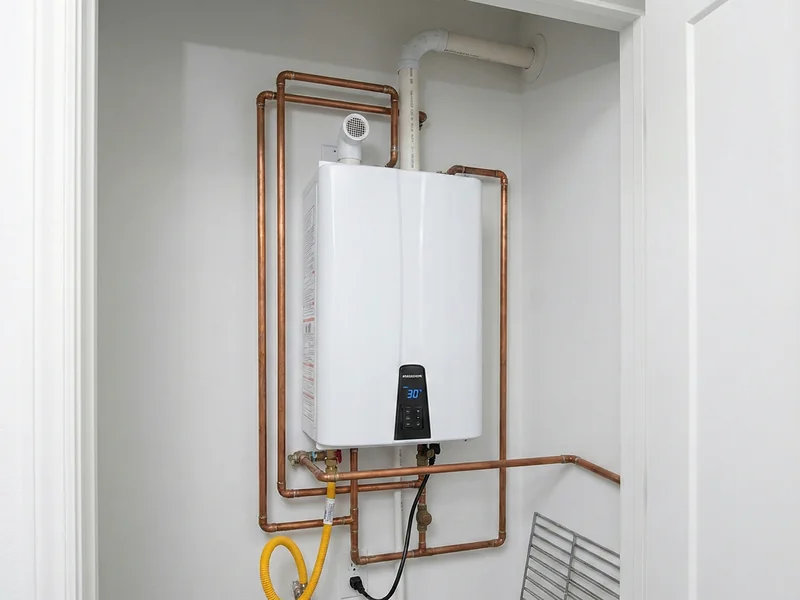
Summerville — the Flower Town in the Pines — pairs a historic downtown of early-1900s homes with mid-century neighborhoods, all of it shaded by pines and famous for azaleas. The 29483 ZIP holds the town's older half: original tank heaters in crawlspaces and small closets, and a growing number of tankless retrofits added during the renovations that Summerville's historic housing stock keeps generating. Those retrofits inherit old plumbing and tight original spaces — new technology threaded into houses built for tanks. As the retrofit wave ages, the Lowcountry pattern arrives: scale on moderately hard Summerville CPW water, fittings loosening in humid crawlspaces, relief valves weeping in laundry closets. This page covers where Summerville tankless leaks start, early detection in older homes, descaling, and repair-versus-replace decisions for 29483. For a leaking unit now, call (833) 713-2101.
Retrofits in Historic and Mid-Century Homes
Summerville's 29483 housing stock was built for tank water heaters, and nearly every tankless unit here is a retrofit — threaded into the closet, crawlspace, or garage corner where a tank used to sit. Retrofits inherit the house's plumbing history: aging galvanized or copper runs, dissimilar-metal joints, decades of pressure quirks, and spaces designed around a 50-gallon cylinder, not a wall-mounted cabinet.
The inherited joints are the first leak source. New brass or copper tankless fittings connected to old galvanized pipe form galvanic cells — dissimilar metals in water corrode each other — and Summerville's humid crawlspaces accelerate the process. The green-white crust at a transition joint is the tell. Many retrofits skipped dielectric unions; correcting that during a leak repair stops the cycle.
Scale is the second source and the great equalizer. Summerville CPW water is moderately hard, and a tankless coil concentrates that hardness onto a small area of hot metal. In family homes with daily laundry and multiple bathrooms, the gallons add up; the scaled coil over-fires; the metal fatigues; pinholes open. Unflushed retrofits typically enter the leak window at seven to twelve years.
Tight spaces complete the picture. Historic closets and crawlspace corners make service access difficult — which is partly why maintenance gets deferred — and they hide leaks well. A weep inside a closed crawlspace can run for months, staining joists and feeding mold, before anyone connects the musty smell to the water heater. In 29483, the leak check must include the hidden spaces, not just the visible unit.
Early Detection in Older Summerville Homes
Older homes reward the methodical check. Monthly: the floor and walls around the unit, every visible fitting for crust or staining, the relief-valve discharge pipe. Twice yearly: the crawlspace — with a bright light, looking for damp soil, stained joists, crust on fittings along the run, and musty intensification. Check after hot-water use, when demand-dependent leaks reveal themselves.
The age signs to read: green-white crust at dissimilar-metal transitions, orange-brown rust on old galvanized, paint bubbling on walls near the unit, baseboards softening in laundry closets. Behavior signs: hot-cold-hot shower swings, error codes for overheating or flow, longer hot-water waits, energy use creeping up with steady habits.
- Crust at transition joints — the galvanic corrosion tell.
- Error codes — note the exact code; it aims the diagnosis.
- Relief valve dripping steadily — pressure, temperature, or valve failure.
- Damp crawlspace or stained joists — hidden weeps in old runs.
- Musty odors — moisture reaching wood, drywall, or framing.
Historic-home owners: treat the building fabric as the priority. A pinhole weep that would merely stain a garage floor can destroy plaster and original woodwork here. Fast response to small signs is what separates a plumbing bill from a restoration bill.
Descaling on Summerville CPW Water
Summerville CPW delivers moderately hard water — the Lowcountry middle, entirely manageable with annual flushing. The standard service: isolate at the service valves, circulate food-grade white vinegar or commercial descaler through the heat exchanger with a pump for 45 to 60 minutes, flush clean with fresh water, test. One visit a year holds the coil near factory condition and the unit to its 15-to-20-year design life.
Many 29483 retrofits lack isolation valves — the installer tied into existing plumbing with minimal disruption and skipped them. Adding valves during any repair visit is the highest-value upgrade available: it converts every future flush from a plumbing project into a routine service call. While the system is open for a leak repair is the ideal moment.
The first descale on a long-neglected retrofit is diagnostic as well as therapeutic: what comes out reveals the exchanger's true condition. A coil that cleans up well is back on track; heavy baked-on scale that won't clear is information about remaining life. Either way, you know where you stand.
A sediment pre-filter on the cold inlet catches the rust and grit that aging neighborhood lines shed before it reaches the flow sensor and exchanger. And the dissimilar-metal transitions should be corrected to dielectric unions during service — it's the companion fix that stops the corrosion half of the leak equation while descaling handles the scale half.
Repair or Replace in Summerville's Older Homes
The decision weighs the unit against the aging system around it. A valve, fitting, or sensor repair on a younger unit is straightforward — but the smart 29483 repair also addresses context: the corroding transition, the missing valves, the pressure reading, the crawlspace run. Fixing the part without fixing the context schedules a callback.
Past twelve to fifteen years, or a breached exchanger on a never-flushed unit, replacement is usually the better money — and replacement in an older home is the chance to do the installation right: dielectric transitions throughout, isolation valves, verified pressure regulation, proper venting and condensate routing, and siting that allows future service access. A new unit on a renewed system starts clean.
Sizing should match the home as renovated: Summerville's historic homes gain bathrooms in remodels, and the original retrofit sizing may no longer fit. Tankless capacity is rated by temperature rise at flow; our warm groundwater (often around 70 degrees) stretches effective capacity. Correct sizing avoids short-cycling and perpetual strain alike.
A 29483 visit is a system visit: utilities secured, leak traced through unit and inherited plumbing, pressure read, transitions inspected, valves added where missing, part replaced, system descaled, full test. You get the whole picture, plainly explained — and advice that respects both the house and the budget. Call (833) 713-2101 to schedule.
Local Insight
Summerville's identity is the Flower Town in the Pines — azaleas, the Flowertown Festival, Azalea Park, and a historic downtown of early-1900s homes that the town protects and celebrates. The 29483 ZIP is the older half: historic houses, mid-century neighborhoods, pine shade everywhere. Water heaters here are retrofits layered onto history, and the service approach has to respect both the equipment and the building.
The pine environment is the quiet factor. Pine straw, pollen, and shade keep crawlspaces and utility areas damp and acidic; the shade that makes Summerville beautiful also keeps things from drying. Fittings corrode on schedule in that air, and leaks hide in dark, damp spaces. The twice-yearly crawlspace check isn't optional here — it's the maintenance habit the environment demands.
Summerville CPW — the Commissioners of Public Works — provides the water: moderately hard, consistent, and entirely typical of the region. There's nothing exotic about the chemistry; the story in 29483 is age — old houses, old pipes, retrofitted technology — and the renewal work (valves, transitions, pressure verification) that lets new equipment thrive in old buildings.