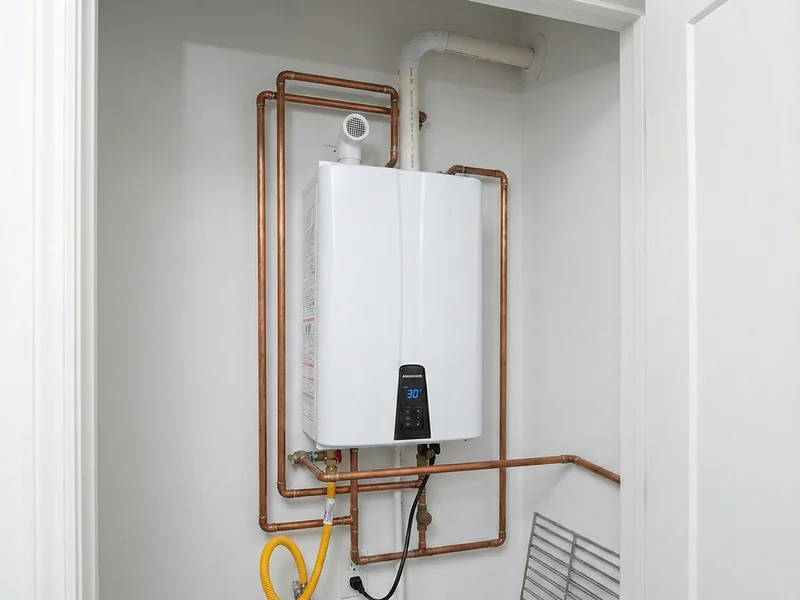
St. Stephen is a small town on Lake Moultrie's northern shore — rural Berkeley County, fishing and hunting country, where older homes, fish camps, and manufactured housing cluster around the town core and spread along the lake. Town water serves the center; private wells serve the outskirts, and lake-country well water is famously mineral-rich — hardness plus iron. Tankless water heaters fit the town's housing: compact for small utility spaces, efficient for full-time homes, with no tank to rust out between seasons. But the combination of hard well water, humid lake air, and equipment in crawlspaces and sheds produces the familiar rural leak pattern: scaled exchangers, weeping fittings, hardworking relief valves. This page covers St. Stephen leak sources, early detection, well-water descaling, and repair-versus-replace decisions. For a leaking unit now, call (833) 713-2101.
Lake-Country Water and Tankless Leaks
St. Stephen's water story is two-tiered: town water in the core, private wells outside it — and the wells are where the trouble concentrates. Lake Moultrie-area groundwater commonly runs hard with iron, the exact chemistry that scales tankless heat exchangers fastest. Inside the coil, flash-heating plates calcium, magnesium, and iron compounds onto the hottest metal; the insulating crust forces over-firing; the metal fatigues; pinholes open. On an unflushed well-water unit, this chain routinely completes within a decade.
Town-water homes aren't exempt — the municipal supply is moderately hard, and scale accumulates on every exchanger — but the timeline is gentler and the annual flush handles it. The well-water homes need the six-month schedule and the water test that sets it. Knowing which tier you're on is the first step; the descaling interval follows.
Well pressure adds stress across both tiers' rural edges. Pressure tanks set high to push water through long runs keep fittings strained and relief valves at the edge of weeping. Lake humidity keeps crawlspaces and sheds damp, accelerating corrosion on every joint. Seasonal camps add the idle-time factor: mineral-heavy water sitting stagnant in a hot exchanger scales faster than water in daily use.
The through-line: St. Stephen tankless leaks are water-chemistry leaks first and equipment leaks second. Address the chemistry — test, filter, flush on schedule — and the equipment lasts; ignore it, and even good equipment fails early.
Early Detection in Town and Lake Homes
In-town homes usually put the unit somewhere checkable — a utility room, garage, or carport. Monthly checks: floor around the unit, fittings for crust or staining, the relief-valve discharge pipe, the wall behind wall-mounted cabinets. Check after hot-water use, when demand-dependent leaks appear.
Lake and outskirts homes hide their units — sheds, crawlspaces, under raised camps — and leaks get a head start. Quarterly at minimum: white or orange crust on fittings, a discharge pipe that never dries, damp soil or stained joists below the unit, rust on the cabinet. Camps should be checked at season open and season close without fail.
- Error codes for overheating or flow — note the exact code.
- Hot-cold-hot shower swings — the scaled coil's signature.
- Relief valve dripping steadily — pressure, temperature, or valve failure.
- Iron staining at fixtures — the visible proof of hard well water.
- Musty smells — moisture reaching wood in sheds and crawlspaces.
Camp owners: a flush at season start and a drain-down for long idle stretches prevent the stagnant-water scaling that punishes seasonal units. And never leave a known weep through the off-season — small leaks don't pause while you're away.
Descaling: Town Annual, Wells Semiannual
The rule for 29479 is simple: town water, flush annually; well water, test then flush — annually for moderate wells, every six months for hard or iron-heavy ones. The procedure is the same: isolate at the service valves, circulate food-grade white vinegar or commercial descaler through the heat exchanger with a pump for 45 to 60 minutes, freshwater flush until clear, test.
Iron-heavy well scale sometimes needs a second pass or a purpose-made descaler — vinegar dissolves calcium carbonate readily, iron compounds less so. A technician reading the flush discharge knows what the water has been doing and can advise whether the interval or the approach needs adjusting.
Isolation valves and a sediment pre-filter are the priority upgrades. Valves make flushing a service call instead of a plumbing project — have them added at the next visit if missing. The filter stops well sand and grit from abrading the flow sensor and lodging in the exchanger. Together they're inexpensive and they transform the maintenance picture.
Time well-water flushes for spring and fall, and re-check pressure at the unit after any well pump or pressure tank service. Well work changes what the heater sees — the relief valve is usually the first to say so.
Repair or Replace in St. Stephen
Under ten years old, repair is the default: valves, fittings, gaskets, sensors, condensate drains — replaceable parts, each a clean fix. Bundle the repair with valve installation, a descale, and a pressure check, and even a blank-history unit leaves with a baseline and a plan.
A breached exchanger on an older, unflushed unit means replacement — and in St. Stephen the replacement must include the water plan matched to the tier: town-water homes get valves and an annual schedule; well-water homes get valves, filtration, a tested interval, and for the hardest wells, a softener conversation. New equipment on unaddressed water is a scheduled repeat.
Sizing should reflect the home: small town houses and fish camps don't need large units, and our warm groundwater (often around 70 degrees) stretches effective capacity — but a camp that hosts crowds on fishing weekends needs the peak demand counted honestly. Undersized strains and scales fast; the math takes minutes.
Plan single-trip visits: brand, model, age, town water or well, error codes by phone beforehand. On site: utilities secured, leak traced with the unit running, pressure read, venting and condensate verified, repair completed, system descaled, full test. Call (833) 713-2101.
Local Insight
St. Stephen is lake-country small-town life — the northern shore of Lake Moultrie, a historic town core, fishing and hunting woven into the calendar, and homes ranging from in-town houses to lake camps to manufactured homes on the outskirts. It's quiet country, and service here is a planned trip, which rewards the owners who maintain over those who react.
The two-tier water system defines the technical approach. In-town homes on municipal water live the standard Lowcountry maintenance story — annual flushing, moderate hardness, predictable. Outskirts homes on wells live the rural story — variable chemistry, harder water, six-month flushes, filtration. A service plan that doesn't ask which tier you're on isn't a plan.
The lake sets the rhythm: fishing seasons, camp weekends, the ebb and flow of seasonal occupancy. Camp owners should treat the water heater as seasonal equipment — flushed at open, drained at close, never left weeping through the idle months. The lake gives a lot; it asks only that you respect the water chemistry it sits on.