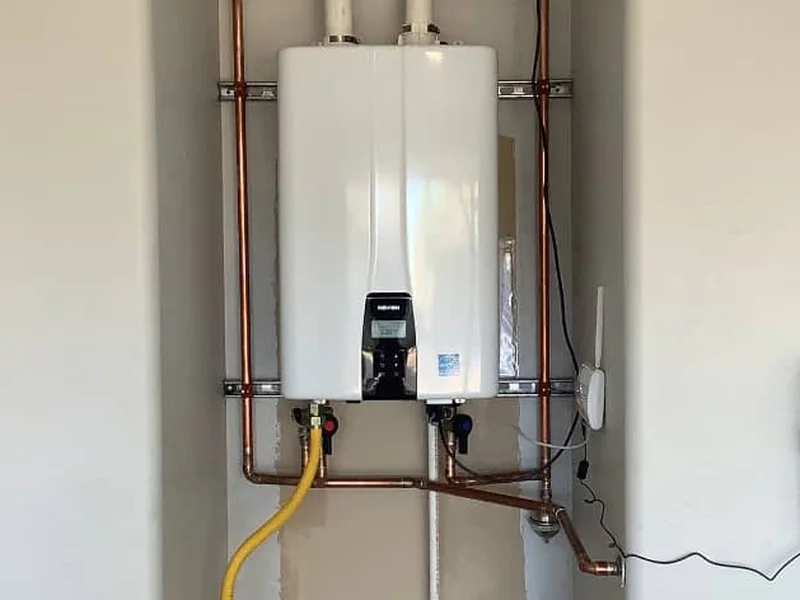
Ravenel is rural western Charleston County — farms, timberland, and manufactured homes on large lots along SC-165, with the Caw Caw Interpretive Center's swamps and rice-field history nearby. Private wells and septic systems dominate the 29470 area, and well chemistry here is mineral-heavy more often than not: hardness, iron, occasionally sulfur. Tankless water heaters suit the landscape — compact for manufactured-home closets, efficient for farm households — but the combination of aggressive well water, humid air, and equipment in sheds and crawlspaces makes descaling discipline the difference between a twenty-year unit and a ten-year one. This page covers where Ravenel tankless leaks start, early detection across acreage, well-water descaling, and repair-versus-replace decisions. For a leaking unit now, call (833) 713-2101.
Mineral-Heavy Wells: Ravenel's Central Fact
Everything about tankless service in Ravenel starts at the well. The groundwater in the 29470 area commonly carries significant hardness and iron — the pairing that scales heat exchangers fastest. Inside the tankless coil, flash-heating concentrates those minerals onto a small area of very hot metal: calcium and magnesium plate as scale, iron bakes into the layer. The insulating crust forces the burner or elements to over-fire, the metal cycles violently, and pinholes open. On an unflushed unit, this chain routinely completes within a decade.
Well pressure is the second factor. Pressure tanks set high to serve long runs and irrigation keep the whole domestic system at the upper edge — stressing fittings, working relief valves, finding weak joints. Sulfur, where present, announces itself as rotten-egg hot water and signals chemistry that needs upstream treatment, not just heater maintenance.
Placement completes the rural picture: sheds, carports, crawlspaces, manufactured-home utility closets — unconditioned spaces where humidity condenses on cool lines and fittings corrode. Agricultural activity stirs sediment that migrates into household plumbing. In Ravenel, the well, the pressure, and the placement are equal partners in every leak.
The encouraging truth: none of this defeats a tankless unit. Tested water, a matched flush schedule, isolation valves, and a sediment pre-filter neutralize nearly all of it. The Ravenel units that leak are the ones running on assumptions instead of numbers.
Finding Leaks on Farms and Acreage
Ravenel water heaters hide — in sheds, under manufactured homes, in far crawlspace corners — and leaks exploit the invisibility. Check quarterly at minimum, monthly for manufactured homes where compact construction turns small leaks into subfloor damage fast. Always check after hot-water use, when demand-dependent leaks appear.
Read the evidence: white mineral crust or orange iron staining on fittings, a relief-valve discharge pipe that never dries, damp soil or stained joists below the unit, rust streaks on the cabinet. Sulfur or metallic smells in hot water are the chemistry warnings that precede scale damage — act on them, don't accommodate them.
- Error codes for overheating or flow — scale's signature; note the exact code.
- Hot-cold-hot shower swings — uneven heat transfer through a scaled coil.
- Relief valve dripping steadily — pressure too high or a failed valve.
- Iron staining at fixtures — visible proof of exchanger-hostile water.
- Soft flooring near a manufactured-home utility closet — water already arrived.
Farm properties have one more check: the path from well head to house. Long buried runs can weep at joints, and irrigation cycling can swing system pressure — if the tankless leak correlates with irrigation schedules, pressure fluctuation is the suspect, and regulation is the fix.
Descaling Matched to Your Well
Start with a water test — hardness, iron, pH — then set the interval from the numbers. Moderately hard Ravenel wells can sometimes manage annually; hard or iron-heavy wells need every six months. The test is inexpensive and it removes the guesswork that ruins exchangers. Retest after any well work; chemistry shifts.
The flush: isolate at the service valves, pump food-grade white vinegar or commercial descaler through the heat exchanger for 45 to 60 minutes, freshwater flush until clear. Iron-heavy scale may need a second pass or a purpose-made descaler. What matters is the schedule, kept — the wells don't get softer with age.
Isolation valves and a sediment pre-filter are the two upgrades that pay back fastest. Valves make flushing a service call instead of a plumbing project — have them added at the next visit if missing. The filter stops well sand and farm-stirred grit from abrading the flow sensor and lodging in the exchanger. For sulfur wells, the upstream fix belongs with a water treatment professional.
Time the flushes for spring and fall — cooperative weather, moderate demand — and re-check pressure at the unit after any pressure tank or pump service. Well work changes what the heater sees, and the relief valve is usually the first to comment.
Repair or Replace in Ravenel
Distance makes durability the priority — every trip is long, so one thorough visit beats two quick ones. Under ten years old, component repairs are straightforward and worthwhile: valves, fittings, gaskets, sensors, condensate drains. Bundle the repair with valve installation, a descale, and a pressure check, and the unit leaves set up for simple future maintenance.
A breached exchanger on an older, unflushed unit means replacement — and the replacement must include the water plan: isolation valves, sediment pre-filter, tested flush interval, and for very hard wells, a softener conversation. A premium unit on brutal water with no plan is a scheduled repeat failure.
Sizing for rural households needs the real picture: farm families with mudrooms and heavy laundry, multi-generational homes, manufactured homes with compact plumbing. Tankless capacity is rated by temperature rise at flow; our warm groundwater helps, but simultaneous demand sizes the unit. Undersized strains perpetually and scales fast; the honest math takes minutes.
Make the visit single-trip: brand, model, age, well details, error codes, and access notes by phone beforehand. On site: utilities secured, leak traced with the unit running, pressure read against the well setting, venting and condensate verified, repair completed, system descaled, full test. Call (833) 713-2101 with details ready.
Local Insight
Ravenel sits in the agricultural west of Charleston County — SC-165 through farmland and timber, the Caw Caw Interpretive Center interpreting the rice-culture history of the surrounding swamps, and a community spread across acreage rather than gathered in subdivisions. The water heater might be in a shed behind the house, under a manufactured home, or in a crawlspace a long walk from the well head. Prevention beats reaction at these distances.
The wells are the technical story, and they're variable — one road over can mean different chemistry. That variability defeats generic advice and rewards testing. A Ravenel owner who knows the well's numbers and maintains to them has a fundamentally different ownership experience than one running on assumptions, and the difference shows up as years of exchanger life.
Farm life adds sediment dynamics: irrigation, equipment, and land work stir particulates that find household plumbing, and the pollen-heavy spring films outdoor equipment in moisture-trapping dust. The sediment pre-filter and the periodic inspection aren't optional extras here — they're the cost of doing rural water heating right.