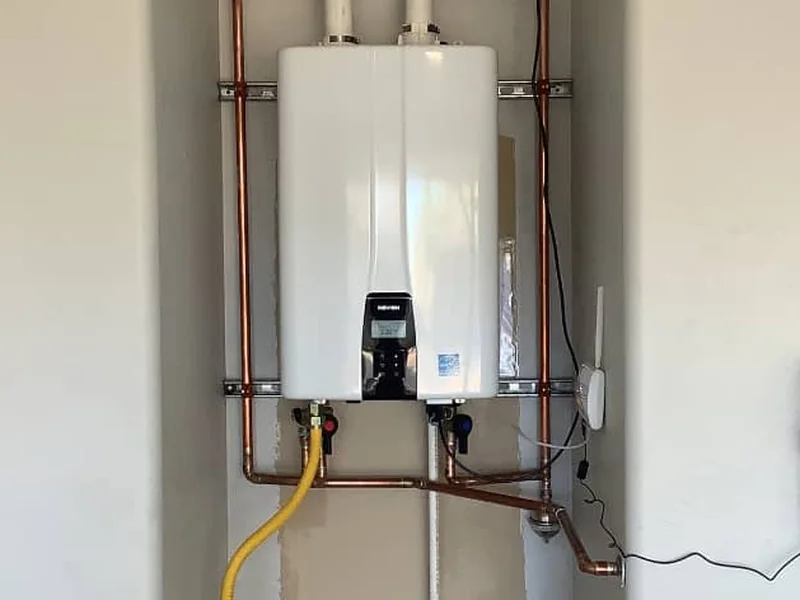
North Charleston's 29406 ZIP covers the city's northern half — industrial corridors, Boeing and logistics hubs, Tanger Outlets, and neighborhoods ranging from 1960s–70s subdivisions to brand-new apartment complexes. Tankless water heaters here are a mixed population: retrofits in older homes, builder units in new developments, and replacements in the area's many rental properties — where water heaters historically get replaced on failure, not on schedule. That replacement-on-failure pattern means 29406 sees tankless units run hard with thin maintenance histories: scaled exchangers on moderately hard water, fittings loosened in humid garages, relief valves weeping in utility closets. This page covers where North Charleston tankless leaks start, early detection, descaling, and repair-versus-replace decisions. For a leaking unit now, call (833) 713-2101.
Where 29406 Tankless Leaks Start
The 29406 tankless population splits three ways, and each has its leak profile. Retrofits in the 1960s–70s subdivisions inherit old plumbing — new copper or stainless on aging galvanized or copper, dissimilar-metal joints corroding in damp crawlspaces and garages, pressure quirks from old systems. These leak at fittings and transitions, typically in the seven-to-twelve-year window.
New-development units — the apartment complexes and subdivisions still going up — are professionally installed condensing models with isolation valves. They fail less and later, but the scale clock runs the same: moderately hard Charleston-area water plates calcium and magnesium onto every heat exchanger, and without flushing, the scaled coil over-fires, fatigues, and pinholes. Even good installs leak when maintenance is skipped.
Rental properties are the third population and the most leak-prone — not because the equipment differs, but because the maintenance history is usually blank. Tenants don't descale; many landlords don't either. A rental tankless unit with five unflushed years has the wear of a much older machine. When these leak, the diagnostic visit doubles as a baseline inspection establishing brand, age, flush condition, and installation details.
Across all three, the mechanisms are the Lowcountry constants: scale-driven exchanger pinholes, vibration-loosened fittings, weeping relief valves (pressure, temperature, or failed seats), and clogged condensate drains on condensing units backing water into the cabinet. The diagnosis is always the same first step — run the unit with the cabinet open and trace the water to its exact source.
Early Detection Across Homes and Rentals
For homeowners, the monthly check is simple: floor around the unit, every visible fitting for crust or staining, the relief-valve discharge pipe, the wall behind wall-mounted cabinets. Check after the morning hot-water rush, when demand-dependent leaks show themselves. The early warnings — white mineral crust (dried leak evidence), a discharge pipe that never dries, hot-cold-hot shower swings, error codes, musty smells — are the same ones that matter everywhere.
For landlords and property managers, detection runs through people: ask tenants to report water under the utility area, shower temperature swings, error codes on the display, and any relief-valve dripping. Put it in the lease welcome packet. A tenant report at the weep stage is a maintenance call; the same problem discovered at turnover is a flooring repair.
- Error codes — overheating and flow codes point at scale; note the exact code.
- Crust or staining on fittings, valves, vent joints.
- Relief valve dripping steadily — pressure, temperature, or valve failure.
- Reduced flow or longer waits — scale narrowing the coil.
- Musty odors — moisture reaching wood or drywall.
Industrial-adjacent homes near the corridors should also note water quality events — main breaks and construction can stir sediment into service lines, and a sediment pre-filter on the tankless inlet is solid protection against the grit that follows.
Descaling for North Charleston Water
The water serving 29406 — Charleston Water System and North Charleston infrastructure — is moderately hard: manageable with annual flushing, punishing without it. The standard service: isolate at the service valves, circulate food-grade white vinegar or commercial descaler through the heat exchanger with a pump for 45 to 60 minutes, flush clean with fresh water, test. One visit a year holds the coil near factory condition and the unit to its 15-to-20-year design life.
Rental properties should put every unit on the same annual rotation — ideally scheduled, not reactive. The per-unit cost of planned descaling is a fraction of one emergency leak call, never mind the tenant disruption and damage. A dated service log per property also answers the first question any technician asks.
Many 29406 retrofits lack isolation valves, having been tied into existing plumbing with minimal disruption. Adding valves during any repair visit is the highest-value upgrade — it converts every future flush from a plumbing project into a routine service call. New-development units typically have them already.
A sediment pre-filter on the cold inlet is smart anywhere in 29406, catching grit from aging lines and construction-disturbed mains before it reaches the flow sensor and exchanger. And the flush doubles as a diagnostic — what comes out reveals how the unit has been treated, which informs honest repair-versus-replace advice.
Repair or Replace in North Charleston
Under ten years old, repair is the default: relief valves, fittings, gaskets, condensate drains, flow sensors, igniters — replaceable parts, each a clean fix. A proper repair bundles descaling, pressure verification, and installation-detail checks, so even a blank-history rental unit leaves with a known baseline and a maintenance plan.
Past twelve to fifteen years, or a breached exchanger on an unflushed unit, replacement is usually the better money. The remaining scaled components are near end of life, and exchanger-replacement labor narrows the gap to a new unit with a fresh warranty and current efficiency. For rentals, the reliability calculation favors replacement sooner — downtime costs goodwill as well as dollars.
Sizing at replacement should reflect the actual household: multi-generational homes, shift workers, high-occupancy rentals. Tankless capacity is rated by temperature rise at flow; our warm groundwater (often around 70 degrees) helps, but simultaneous demand sizes the unit. An undersized unit strains perpetually and scales fast; oversized short-cycles. The calculation takes minutes.
A 29406 visit is built for resolution: utilities secured, leak traced with the unit running, pressure and venting verified, condensate checked, part replaced, system descaled, hot water tested. Homeowner or manager, you get a plain explanation and a maintenance interval. Call (833) 713-2101 to schedule.
Local Insight
North Charleston is the Lowcountry's working city — the port, Boeing's assembly plant, logistics corridors, Tanger Outlets, the coliseum — and 29406 is its northern half, where industry meets neighborhood. The housing mirrors that mix: 1960s–70s subdivisions with original footprints, new apartment complexes rising near the corridors, and a large rental stock serving the area's workforce. Water heaters here work for a living.
The rental density is the defining service factor. A large share of 29406 tankless units serve tenants, which means maintenance histories run blank and problems surface at turnover or as tenant complaints. Landlords who put water heaters on a scheduled rotation — annual descale and inspection, tenant reporting prompts in the welcome packet — spend far less than those who run to failure.
The industrial setting adds one more note: construction and utility work around the corridors periodically disturbs water mains, sending sediment pulses through service lines. A sediment pre-filter on the tankless inlet is particularly worthwhile here — it's the device that turns a main-break grit event from a flow-sensor failure into a filter cleaning.