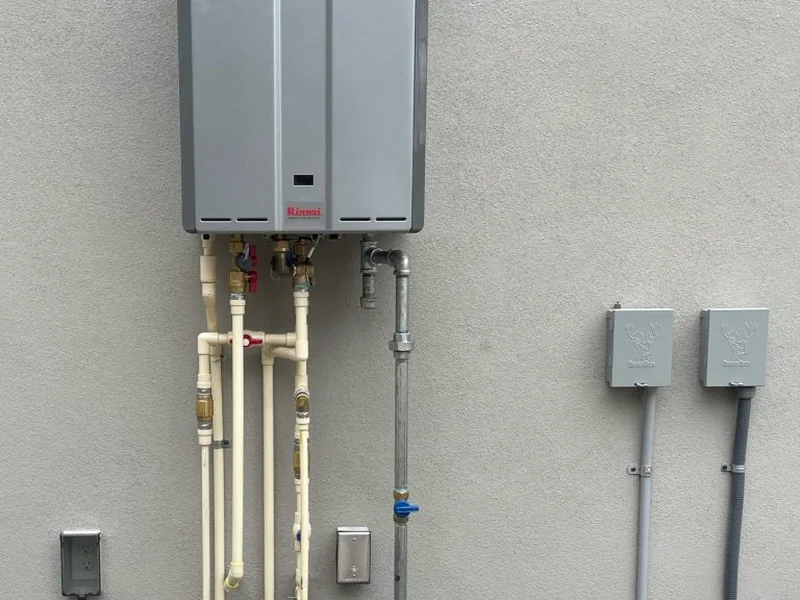
Mount Pleasant — across the Ravenel Bridge from downtown, stretching from the historic Old Village and Shem Creek to the sprawling new neighborhoods along Rifle Range Road — is the Lowcountry's upscale east side, and its water heaters reflect it: high-efficiency condensing tankless units in new construction, premium retrofits in remodeled homes, all serving households that expect flawless hot water. But premium equipment on Mount Pleasant Waterworks' moderately hard supply still scales, still loosens fittings through thousands of firing cycles, and still clogs condensate drains. And in homes with hardwood floors, custom cabinetry, and finished spaces throughout, even a minor tankless weep becomes a major restoration. This page covers where Mount Pleasant tankless leaks start, early detection that protects finishes, descaling intervals, and repair-versus-replace decisions for 29464. For a leaking unit now, call (833) 713-2101.
Where Leaks Start in Mount Pleasant Homes
Mount Pleasant's tankless population is premium: condensing high-efficiency units in new construction from Park West to Carolina Park, quality retrofits in the Old Village and renovated homes along the creek. The equipment is good; the failure modes are universal. Scale leads — Mount Pleasant Waterworks delivers moderately hard water, and in large homes with multiple bathrooms, the gallon counts are high. Calcium and magnesium plate onto the heat exchanger coil year by year; the scaled coil over-fires; the metal fatigues; pinholes open. The timeline is eight to twelve years without flushing, twenty with it.
Condensate management is the second issue, because condensing units dominate the new construction. Acidic condensate must drain freely, and long drain runs through finished garages to distant drains clog or sag over time. Backed-up condensate floods the cabinet from within — the mystery puddle in a unit whose plumbing all looks fine. Every service visit should include clearing that line.
Fittings form the third category. Thousands of firing cycles vibrate every threaded joint; isolation valve packing nuts weep with age; relief valves drip when pressure runs high or seats fail. In Mount Pleasant's finished garages and utility rooms, these small weeps land on drywall, cabinetry, and flooring — which is why detection speed matters more here than in an unfinished space.
HOA-governed communities add a wrinkle: exterior vent terminations and equipment placement must satisfy design standards, occasionally producing longer vent runs than ideal. Long vents collect condensation in humid weather, which can drip back toward the unit and mimic a plumbing leak. A proper diagnosis rules out vent condensation before ordering parts.
Finish Protection: Detecting Leaks Early
In Mount Pleasant, leak detection is finish protection. The monthly check: floor around the unit, every visible fitting for crust or staining, the relief-valve discharge pipe, the wall behind wall-mounted cabinets, and — in two-story homes — the ceiling below any elevated unit. Check after the morning hot-water rush, when demand-dependent leaks appear.
The earliest evidence is mineral: white crust on a fitting, green on copper, a discharge pipe that never dries. Then behavior changes: hot-cold-hot shower swings, longer hot-water waits, error codes for overheating or flow. Photograph any code — it aims the diagnosis.
- Discolored or soft drywall near the unit — water wicking into finished walls.
- Hardwood cupping or finish changes downhill of the heater.
- Musty odors in utility spaces — moisture in framing or drywall.
- Relief valve dripping steadily — pressure, temperature, or valve failure.
- Swelling cabinetry or baseboards near the installation.
Traveling owners should add the prevention stack: a leak-sensor shutoff valve on the heater's feed (closes automatically when its sensor gets wet) and, ideally, a Wi-Fi water sensor alerting your phone. In a home with premium finishes, these modest devices are the cheapest insurance available — a vacation drip becomes a cupful instead of a restoration.
Descaling on Mount Pleasant Waterworks Water
Mount Pleasant Waterworks supplies moderately hard water — the Lowcountry middle, manageable with annual flushing. The standard service: isolate at the service valves, circulate food-grade white vinegar or commercial descaler through the heat exchanger with a pump for 45 to 60 minutes, flush clean with fresh water, test. Yearly flushing holds the coil near factory condition and the unit to its 15-to-20-year design life.
Large households should consider a tighter interval. Scale tracks gallons, and a Mount Pleasant home with five bathrooms, a pool bath, and daily laundry can multiply a smaller household's throughput several times. Creeping energy use, temperature swings, or slower hot water signal that the interval should shorten.
Builder-installed units here virtually always have isolation valves, making flushing a routine service call. Condensate-line clearing should ride along with every descale — five minutes that prevents the most common mystery puddle in condensing units. A sediment pre-filter on the cold inlet is sensible insurance, catching grit before it reaches the flow sensor and exchanger.
Put the service on a calendar. The Mount Pleasant units that develop exchanger leaks are consistently the ones whose owners can't recall the last flush — and in homes with premium finishes, the flooring repair that follows a neglected leak dwarfs the cost of the maintenance that would have prevented it.
Repair or Replace in Mount Pleasant
On units under ten years old, repair is the default: valves, fittings, gaskets, sensors, condensate drains — replaceable parts, each a clean fix. A proper repair bundles descaling, pressure verification, and a corrosion and installation check, so the unit leaves with a known baseline. A maintained younger unit has another decade-plus ahead.
Past twelve to fifteen years, or a breached exchanger on an unflushed unit, replacement deserves a direct conversation. The remaining scaled components are near end of life, and the labor to replace a heat exchanger narrows the gap to a new unit with a fresh warranty and current efficiency. In HOA communities, keep the replacement's exterior footprint identical to avoid architectural review issues.
Replacement is the moment for honest sizing. Household needs evolve — additions, pool baths, multigenerational living — and the original unit may no longer match. Tankless capacity is rated by temperature rise at flow; our warm groundwater (often around 70 degrees) keeps the required rise modest. Correct sizing avoids short-cycling and perpetual strain alike.
A 29464 visit is thorough and tidy: utilities secured, leak traced with the unit running, pressure and venting verified, condensate cleared, part replaced, system descaled, hot water tested at multiple fixtures, work area left clean. You get a plain explanation of the failure and a maintenance schedule matched to your household. Call (833) 713-2101 to schedule.
Local Insight
Mount Pleasant is the east side's success story — from the shrimp boats and historic homes of the Old Village and Shem Creek to the master-planned sprawl of Carolina Park and Park West, all of it connected by the Ravenel Bridge to downtown. The housing is predominantly upscale and often new, which means the tankless population is young, premium, and professionally installed — a strong starting point for long service life.
Boone Hall Plantation anchors the area's historic identity, but the service reality is modern suburbia: HOAs with design standards, two-story homes with second-floor laundry, finished garages, and households that travel. The leak risks here are finish risks — hardwood, custom cabinetry, drywall — rather than equipment risks, which shifts the priority from repair cost to detection speed and prevention.
Water comes from Mount Pleasant Waterworks — moderately hard, consistent, entirely typical. There's nothing exotic about the water chemistry; the story here is volume (large homes, many bathrooms) and value at risk (premium finishes). Annual descaling plus the leak-sensor shutoff valve is the complete prevention program for most 29464 homes — simple, scheduled, and far cheaper than the alternative.