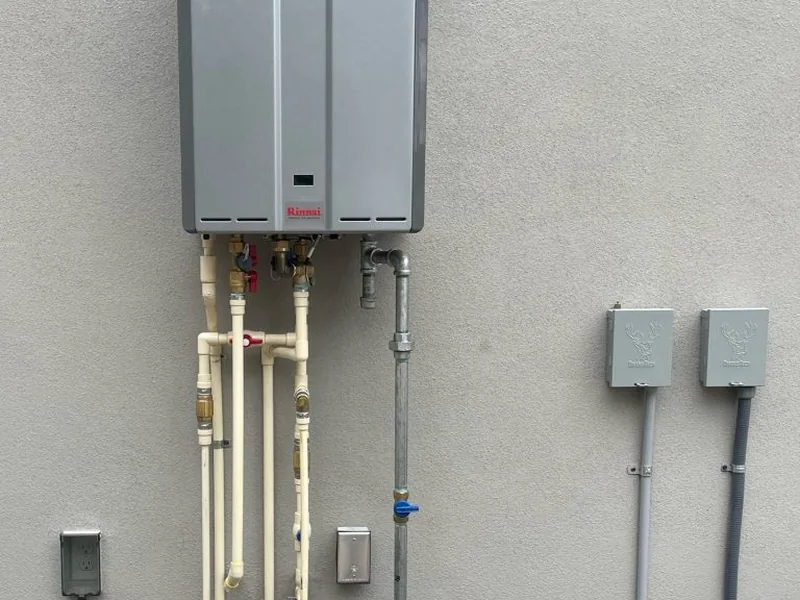
Moncks Corner — the Berkeley County seat on the Tailrace Canal below Lake Moultrie — is Santee Cooper country: Old Santee Canal Park preserving the canal era, lake recreation shaping weekends, and fast-growing subdivisions spreading around a historic small-town core. New construction here heavily favors tankless water heaters — efficient, compact, a selling point in modern floor plans — so 29461 has one of the area's youngest tankless populations. But young doesn't mean maintenance-free: moderately hard water scales every heat exchanger, condensing units need their condensate drains kept clear, and the construction boom's pace occasionally left installation details unfinished. As the first wave of boom-era units enters its second decade, the classic leak pattern is arriving on schedule. This page covers Moncks Corner leak sources, early detection, descaling, and repair-versus-replace decisions. For a leaking unit now, call (833) 713-2101.
Boom-Era Units Enter the Leak Window
Moncks Corner's subdivisions went up fast, and their tankless units went in fast with them — mostly high-efficiency condensing models, professionally installed, generally with isolation valves. That professional baseline is good news. The less-good news: boom-era pace occasionally skipped the finishing details — condensate lines with marginal slope, vent runs a little too long, fittings tightened to "good enough." A decade later, those details are where leaks start.
Scale is the universal factor regardless of install quality. The town and county water serving Moncks Corner is moderately hard, and family homes in the new subdivisions run high hot-water volumes — multiple bathrooms, daily laundry, the works. Thousands of gallons a year plate calcium and magnesium onto the heat exchanger coil; the scaled coil over-fires; the metal fatigues; pinholes open. The first boom-era units are now hitting the age where unflushed exchangers begin to weep.
Condensate drains deserve emphasis in a town full of condensing units. These models produce acidic condensate continuously while firing, and a drain line with a long horizontal run or a subtle sag clogs with sediment over the years. Backed-up condensate floods the cabinet from within — the classic mystery puddle in an otherwise healthy-looking unit. Annual clearing takes minutes and prevents it.
The historic core tells the retrofit story: older homes near downtown Moncks Corner with tankless units added during renovations, inheriting old plumbing and its dissimilar-metal joints, pressure quirks, and tight utility spaces. Different housing, same physics — scale, fittings, valves, drains.
Early Detection in New Subdivisions
New-subdivision homeowners often assume a young unit can't leak — and miss the early signs. Monthly checks take two minutes: floor around the unit, every visible fitting for crust or staining, the relief-valve discharge pipe, the wall behind a wall-mounted cabinet. Check after the morning hot-water rush, when demand-dependent leaks appear.
The warnings: white mineral crust on fittings (dried leak evidence), a discharge pipe that never fully dries, hot-cold-hot shower swings as the scaled exchanger struggles, error codes for overheating or flow, musty smells where moisture reaches drywall. In two-story homes, also check the ceiling below a second-floor laundry — the most expensive leak path in new construction.
- Error codes — note the exact code; it aims the diagnosis.
- Crust or discoloration on fittings, valves, vent joints.
- Relief valve dripping steadily — pressure, temperature, or valve failure.
- Condensate outlet dry while the unit runs — a clog upstream.
- Energy use creeping up — the scaled unit laboring.
New homeowners: find your unit's brand, model, and serial number now (the serial reveals manufacture date), and ask the builder or previous owner about the flush history. If nobody knows, assume it needs one — the first professional descale establishes the baseline everything else builds on.
Descaling for Moncks Corner Water
Moncks Corner's water is moderately hard — the Lowcountry middle, entirely manageable with routine care. The standard: a full descale once a year. Isolate at the service valves, circulate food-grade white vinegar or commercial descaler through the heat exchanger with a pump for 45 to 60 minutes, flush clean with fresh water, test. Annual flushing holds the coil near factory condition and the unit to its 15-to-20-year design life.
Most 29461 units have isolation valves from the original install — one benefit of professional new-construction work. That makes flushing a routine service call. If your unit somehow lacks them (some retrofits in the historic core), have them added during any repair visit; it's the highest-value upgrade for future maintenance.
Bundle the condensate line clearing with every descale. In a town full of condensing units, the five minutes to verify the drain runs clear prevents the most common non-plumbing "leak" in the area. Technicians servicing Moncks Corner units check it as routine — make sure yours does.
Large households should consider whether annual is enough. Scale tracks gallons, and a busy family can double a smaller household's throughput on the same water. Creeping energy use, temperature swings, or slower hot water are the signals to tighten the interval. The flush is also a diagnostic — what comes out tells the technician how the unit has really been treated.
Repair or Replace in Moncks Corner
Most Moncks Corner units are young enough that repair is the clear default: relief valves, fittings, gaskets, condensate drains, flow sensors, igniters — replaceable parts, each a straightforward fix. A proper repair bundles descaling, pressure verification, and an installation-detail check, so a boom-era unit with a rushed detail leaves corrected, not just patched.
Replacement is rare at these ages but not unheard of — usually a badly scaled exchanger on a unit that missed every flush, or a lemon with repeated control failures. When replacement happens, it's also the moment to fix siting and sizing: verify the gas line capacity, recalculate for the household's actual demand, and route condensate and venting properly instead of quickly.
Sizing for growing families deserves care. Moncks Corner households expand — additions, bonus rooms, teenagers — and the original builder unit may no longer match. Tankless capacity is rated by temperature rise at flow; our warm groundwater (often around 70 degrees) keeps the required rise modest. Correct sizing avoids short-cycling and perpetual strain alike.
A 29461 visit runs the full arc: utilities secured, leak traced with the unit running, pressure and venting verified, condensate line cleared, part replaced, system descaled, hot water tested at multiple fixtures. You get a plain explanation of the failure and a maintenance schedule. Call (833) 713-2101 to schedule.
Local Insight
Moncks Corner wears two hats: Berkeley County seat with a historic downtown, and one of the Lowcountry's fastest-growing suburbs. Old Santee Canal Park preserves the canal-building era that made the town, the Tailrace Canal and Lake Moultrie define its recreation, and the new subdivisions define its present — rooftops multiplying along every corridor. The tankless population reflects that growth: young, numerous, mostly condensing, mostly professionally installed.
Santee Cooper is the cultural backdrop — the lakes, the fishing, the public-power heritage — and lake humidity is the physical one. Summers are long and damp, and equipment in garages and utility rooms lives in that air. It's not salt air, but it's relentless moisture, and fittings corrode on schedule without maintenance.
The practical note for Moncks Corner owners: your unit is probably younger than you think the problem is. Boom-era installations are entering the leak window now — not because the equipment was bad, but because the flush schedule was never started. The owners who begin annual descaling at the first sign of trouble typically get the full design life; those who wait for the second sign often don't.