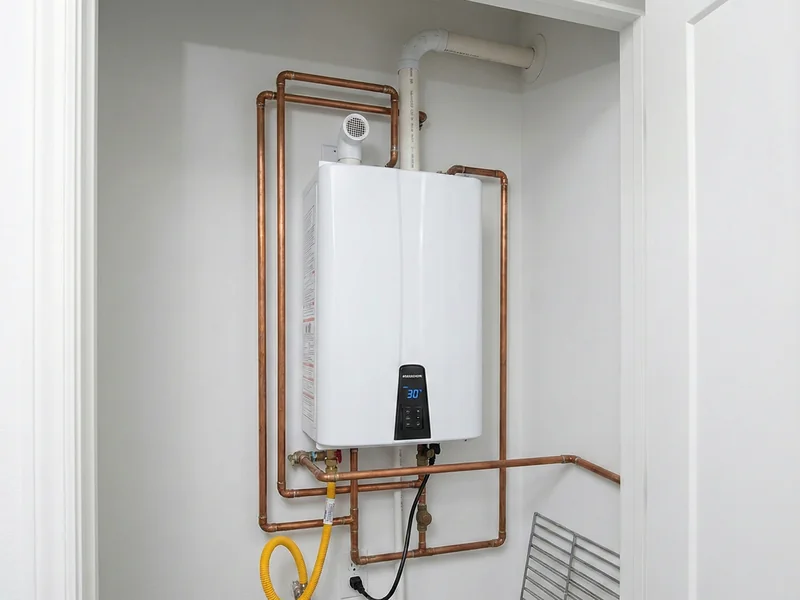
Ladson is the Lowcountry's commuter crossroads — I-26 and U.S. 78 meeting between North Charleston and Summerville, home to manufactured-home communities, older subdivisions, new apartments, and the Exchange Park fairgrounds that host the Coastal Carolina Fair. Tankless water heaters here are working equipment, not luxury upgrades: retrofits in manufactured homes prized for their compact size, builder-grade units in subdivisions, and replacements chosen for endless hot water in busy households. They develop the same Lowcountry problems as everywhere else — moderately hard water scaling exchangers, fittings loosening in humid garages and closets, relief valves weeping — but in Ladson the installations are often builder-grade and the maintenance histories often blank. This page covers leak sources, early detection, descaling, and repair-versus-replace decisions for 29456. For a leaking unit now, call (833) 713-2101.
Builder-Grade Units and Blank Histories
Ladson's tankless population skews builder-grade: units installed by subdivision builders and manufactured-home dealers to a price point, maintained — often — never. These are fundamentally decent machines; the problem isn't the equipment, it's the missing maintenance. A builder-grade heat exchanger on moderately hard water with no flush history scales exactly like a premium one does, and the scale-to-pinhole chain doesn't care what the unit cost.
Manufactured homes are a large part of the 29456 picture, and tankless units suit them — compact enough for the utility closet, no tank hogging the small footprint. But manufactured-home installations have tight quarters: short plumbing runs, compact closets, limited service access. A leak in these confines reaches flooring and subfloor fast. The fittings see the same vibration and thermal cycling as anywhere, in spaces that stay warm and humid.
Retrofits into older Ladson subdivisions inherit aging plumbing — new connections on old galvanized or copper, dissimilar-metal joints in damp crawlspaces, pressure quirks from old systems. The green-white crust at a transition joint is the tell, and it's repairable if caught before the joint fails.
Apartment-adjacent and rental-heavy blocks add the unknown-history factor: tenants don't descale, landlords often don't either, and the unit's maintenance record is a blank page. When these units leak, the diagnostic visit doubles as a baseline inspection — brand, model, age from the serial number, flush condition, installation details — establishing what the next owner or manager needs to know.
Catching Leaks in Working Households
Ladson households are busy — commuters on I-26, shift workers, multi-generational homes — and nobody has time for a water heater hobby. The good news: the checks take minutes. Monthly, look at the floor around the unit, scan visible fittings for crust or staining, glance at the relief-valve discharge pipe. Check after the morning rush, when demand-dependent leaks show.
The early warnings are the same ones that matter everywhere: white mineral crust on fittings (dried leak evidence), a discharge pipe that never dries, hot-cold-hot shower swings as the scaled exchanger struggles, error codes for overheating or flow, musty smells where water reaches wood or drywall. In manufactured homes, also watch the floor around the utility closet — soft spots mean water has already arrived.
- Error codes — note the exact code; it aims the diagnosis.
- Crust or discoloration on any fitting or valve.
- Relief valve dripping steadily — pressure, temperature, or valve failure.
- Reduced hot-water flow — scale narrowing the coil.
- Energy use creeping up — the unit laboring through scale.
Renters: report water heater symptoms to your landlord or property manager promptly — in writing. A weeping fitting reported early is a maintenance call; the same fitting reported after the subfloor softens is a much bigger problem for everyone.
Descaling on a Working Family's Schedule
The water serving Ladson — Berkeley and Dorchester county systems — is moderately hard, and the maintenance standard is the annual descale: isolate at the service valves, circulate food-grade white vinegar or commercial descaler through the heat exchanger with a pump for 45 to 60 minutes, flush clean, test. One visit a year keeps the coil near factory condition and the unit inside its 15-to-20-year design life.
Many Ladson units lack isolation valves — builder-grade installs and manufactured-home retrofits often skipped them. Adding valves during any repair visit is the single highest-value upgrade: it turns every future flush from a plumbing project into a routine service call. The incremental labor while the system is already open is minimal.
Busy households should treat descaling like an oil change — a calendar item, not a when-I-get-to-it item. The units that leak in Ladson are overwhelmingly the ones whose owners can't recall the last flush. A property manager with multiple units should put them all on the same annual rotation; the per-unit cost drops and nothing gets forgotten.
A sediment pre-filter on the cold inlet is the other practical addition, catching grit from aging service lines and construction-disturbed mains before it reaches the flow sensor and exchanger. It's inexpensive, and on builder-grade units with tighter-tolerance components, it prevents the sensor fouling that mimics bigger failures.
Repair or Replace in Ladson
On units under ten years old, repair is the sensible default: relief valves, fittings, gaskets, sensors, condensate drains, igniters — all replaceable parts. A proper repair bundles the preventive work — descale, pressure check, installation-detail verification — so a blank-history unit leaves with a known baseline and a maintenance plan. That's real value beyond the part itself.
Past twelve to fifteen years, or a breached exchanger on a never-flushed unit, replacement is usually the better money. The remaining scaled components are near end of life, and the labor to replace a heat exchanger narrows the gap to a new unit with a fresh warranty and better efficiency. For rental properties, the reliability math favors replacement sooner — a failed unit costs rent goodwill as well as repair dollars.
Sizing at replacement should be honest about the household: multi-generational homes, shift workers showering at odd hours, teenagers. Tankless capacity is rated by temperature rise at flow, and our warm groundwater (often around 70 degrees) helps — but simultaneous demand is what sizes the unit, not the bedroom count. An undersized unit strains perpetually and scales fast; the calculation takes minutes.
A 29456 visit is built for one-trip resolution: utilities secured, leak traced with the unit running, pressure and venting verified, part replaced, system descaled, hot water tested. You get a plain explanation of the failure, the unit's assessed condition, and a maintenance interval. Call (833) 713-2101 to schedule.
Local Insight
Ladson is the corridor community — I-26 on one side, U.S. 78 on the other, the fairgrounds hosting the Coastal Carolina Fair every fall, and a population that commutes to North Charleston, Summerville, and the port. The housing reflects the corridor: manufactured-home communities, older subdivisions, new apartment complexes, all of it working-class and practical. Water heaters here are appliances, not statements — and they get treated accordingly, which is why maintenance histories run blank.
The manufactured-home factor is significant. A large share of 29456 tankless units live in manufactured-home utility closets — tight, warm, humid spaces where a leak finds flooring fast. Owners of manufactured homes should check more often and respond faster than site-built homeowners; the damage curve is steeper in compact construction.
The fairgrounds are Ladson's landmark and a reminder of the area's rural roots — this was farmland within living memory, and some of the older properties still carry that history in their wells and plumbing. For the older subdivision homes on the edges, the retrofit story applies: new tankless on old pipes, with all the dissimilar-metal and pressure quirks that entails. Know which generation your installation belongs to, and maintain accordingly.