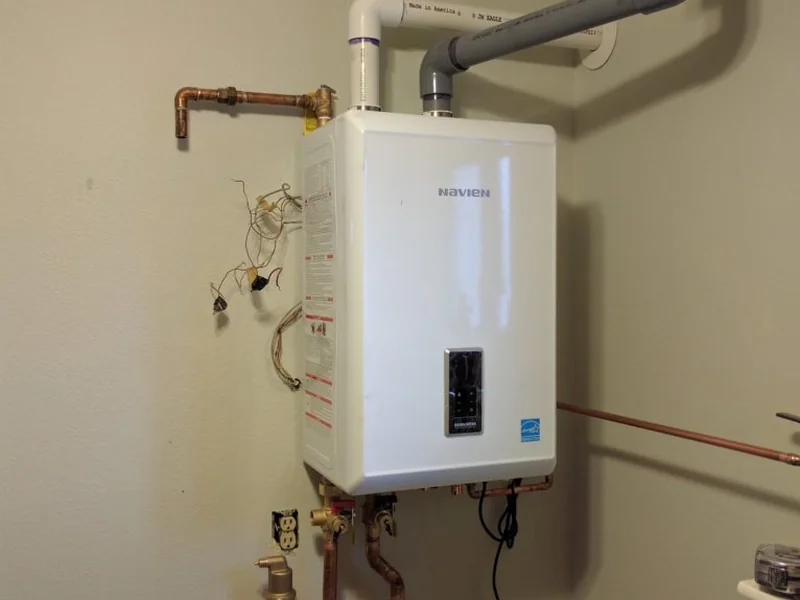
Johns Island is a place of contrasts — one of South Carolina's largest sea islands, home to the ancient Angel Oak, working farms, and quiet rural roads on its west end, plus some of the Lowcountry's fastest-growing suburbs along Maybank Highway on its east. Tankless water heaters span that divide: original-equipment condensing units in the new subdivisions, retrofits in older island homes, and compact units in cottages near the water. The island's water is equally split — St. John's Water Company serves much of the island while rural pockets run on private wells — which means descaling schedules and leak risks vary by address. This page covers where Johns Island tankless leaks start, how to spot them, descaling for both municipal and well water, and repair-versus-replace decisions. For a leaking unit now, call (833) 713-2101.
Two Islands, Two Leak Profiles
Johns Island's east and west ends produce different tankless problems. Along Maybank Highway and in the new subdivisions, units are typically original-equipment condensing models on St. John's Water — moderately hard municipal supply, professional installation with isolation valves, high-efficiency everything. These units fail on the standard timeline: scale accumulating year by year, condensate drains clogging, fittings loosening through firing cycles. The neglected ones leak at year eight to twelve; the maintained ones run twenty.
On the rural west end — the farms, the roads under the live oaks, the properties near the Angel Oak — private wells dominate, and well chemistry here varies widely. Hard, iron-bearing water scales exchangers far faster than the municipal supply, and equipment often sits in sheds, barns-adjacent garages, and crawlspaces in humid, rural air. A west-end tankless unit on an untested well is the highest leak-risk installation on the island, and the fix starts with a water test, not a wrench.
Across both ends, the heat exchanger's scale-to-pinhole chain is the universal failure mode: minerals plate onto the hot coil, the insulating crust forces over-firing, the metal fatigues, pinholes open. Fittings are the second source — threaded joints vibrating loose, dissimilar-metal transitions corroding in damp air. Condensing units add the condensate drain, which clogs with sediment and backs water into the cabinet.
Growth itself is a factor. Johns Island's rapid development means many units were installed during the construction boom by crews working fast — generally competent, occasionally rushed. Missing isolation valves, marginal condensate routing, and tight venting show up in boom-era installs. A first service visit that verifies the installation details pays for itself.
Spotting Leaks From Subdivisions to Farms
In the subdivisions, detection is straightforward: monthly checks of the garage or utility closet — floor, fittings, relief-valve discharge pipe, wall behind the unit. Check after the morning hot-water rush, when demand-dependent leaks appear. Mineral crust on a fitting, a discharge pipe that never dries, or a hot-cold-hot shower pattern are the early warnings.
On the rural west end, the unit is often remote — a shed, a crawlspace, an outbuilding — and leaks get a head start through invisibility. Quarterly checks are the minimum: white or orange crust on fittings, damp soil or stained joists below the unit, rust streaks on the cabinet, musty intensification in the crawlspace. Well owners should also watch for iron staining at fixtures and sulfur smells in hot water — the chemistry warnings that precede scale damage.
- Error codes — overheating and flow codes are scale's signature; note the exact code.
- Temperature swings at the shower — uneven heat transfer through a scaled coil.
- Relief valve dripping steadily — pressure, temperature, or valve failure.
- Reduced flow or longer hot-water waits — scale narrowing the coil.
- Rising energy use with steady habits — the unit laboring through scale.
New-construction owners: don't assume a young unit is a healthy unit. Boom-era installs sometimes skipped descaling from day one, and a five-year-old unit with five years of scale is already mid-life in wear terms. If you don't know the flush history, assume it needs one.
Descaling: Municipal East, Well Water West
The descaling procedure is the same everywhere — isolate at the service valves, circulate food-grade white vinegar or commercial descaler through the heat exchanger with a pump for 45 to 60 minutes, freshwater flush, test — but the interval follows the water. On St. John's Water in the east: annually for most households. On private wells in the west: test first, then schedule — moderately hard wells annually, hard or iron-heavy wells every six months.
East-end units usually have isolation valves from the original professional install, making flushing a routine service call. West-end retrofits and rural installs sometimes lack them; adding valves during any repair visit is the highest-value upgrade, converting every future flush from a plumbing project into simple maintenance.
Sediment pre-filters earn their keep on the west end, where wells carry sand and grit that abrades flow sensors and lodges in exchangers. On the east end they're optional but sensible, catching the occasional grit from construction-disturbed mains in the fast-growing zones. Either way, the filter is inexpensive insurance.
Calendar the flush by water source, not by memory. The island's leak calls come overwhelmingly from units whose last descale nobody can recall — east-end subdivisions included. A dated service record per property is the cheapest warranty a tankless unit has.
Repair or Replace on Johns Island
Under ten years old with a sound exchanger, repair: valves, fittings, gaskets, sensors, condensate drains are all replaceable, and a proper repair bundles descaling, pressure verification, and installation-detail checks. A maintained younger unit has another decade-plus ahead, east or west end.
Past twelve to fifteen years — or a breached exchanger on an unflushed unit — replacement deserves honest evaluation. On the west end, replacement must include the water conversation: valves, pre-filter, tested flush interval, and for very hard wells, a softener discussion. A new unit on brutal well water with no plan is a scheduled repeat.
Sizing should be recalculated at replacement, especially on the east end where additions and remodels are common. Tankless capacity is rated by temperature rise at flow; our warm groundwater (often around 70 degrees) keeps the required rise modest. Correct sizing avoids short-cycling (oversized) and perpetual strain (undersized) — both of which shorten life.
A 29455 visit covers the island arc: utilities secured, leak traced with the unit running, pressure read (against the well setting on the west end), venting and condensate verified, installation details checked, repair completed, system descaled, hot water tested at multiple fixtures. You get a plain explanation and a water-matched maintenance plan. Call (833) 713-2101.
Local Insight
Johns Island's split personality defines its plumbing. The east end — Maybank Highway, the new subdivisions, the commuter corridors to Kiawah and Seabrook — is the Lowcountry's growth frontier, with construction crews still active and many tankless units in their first decade. The west end — the Angel Oak, the farms, the rural roads — is older, quieter, and on wells. A service approach that works for one end fails for the other, which is why the first question on any Johns Island call is the address and the water source.
The Angel Oak is more than a landmark here; it's a reminder of the island's age and the live-oak canopy that shades much of the west end. That canopy keeps things damp — shaded crawlspaces, shaded sheds, shaded equipment — accelerating the corrosion half of the leak equation even as the wells drive the scale half. West-end units live the hardest combination on the island.
Growth brings its own quirks: construction-boom installs, disturbed water mains shedding grit, and new homeowners who've never owned a tankless unit before. If you're new to the island and new to tankless, the single most valuable thing you can do is schedule a baseline service — descale, inspect, verify installation details — and learn your unit's maintenance needs before the first problem.