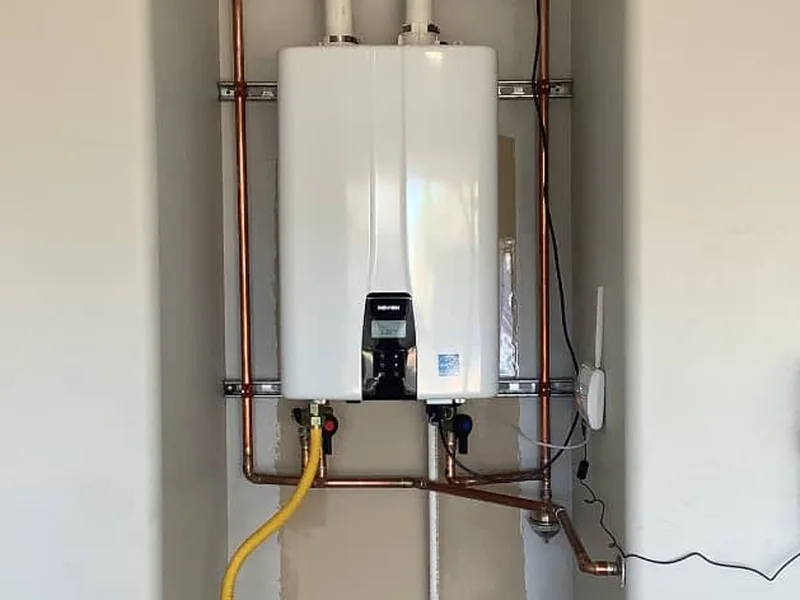
Isle of Palms pairs upscale beach living with a hard-working rental market — Wild Dunes resort homes, oceanfront estates, and condos where tankless water heaters run near-continuously through the season. These are premium units in premium homes: high-efficiency condensing models serving households and guests who expect endless hot water. But island conditions are relentless. Salt air corrodes fittings, vents, and cabinets. Elevated construction tucks heaters into vented space beneath the house, fully exposed to marine air. Rental turnover multiplies hot-water gallons — and scale — far beyond residential norms. And second-home owners often discover leaks weeks after they start, between visits. When an Isle of Palms tankless unit leaks, the response needs to be fast and the diagnosis exact, because the finishes at risk are expensive. This page covers island leak sources, detection, descaling, and repair decisions for 29451. For a leaking unit now, call (833) 713-2101.
Island Conditions That Cause Tankless Leaks
Isle of Palms subjects tankless units to a triple assault: salt, scale, and volume. Salt air is the constant — chlorides in the marine atmosphere pit brass fittings, corrode copper joints, and rust steel cabinets and venting around the clock. Under-house installations, standard in elevated island construction, place the unit directly in the path of wind-driven salt air. Fittings that would last a decade-plus inland weep years earlier here, and the green crust of marine corrosion is the island's universal early warning.
Scale is the second front, driven by volume. A vacation rental's tankless unit heats multiples of a residence's gallons — back-to-back guest showers, laundry turnover, outdoor rinse stations — and every gallon deposits minerals on the heat exchanger. Isle of Palms Water and Sewer Commission water is moderately hard; at rental volumes, moderate hardness scales like hard water does elsewhere. The scaled coil over-fires, the metal fatigues, pinholes open. Rental units that skip descaling live dramatically shorter lives.
Volume also punishes sizing mistakes. An undersized unit in a six-bedroom rental runs at maximum fire all season — accelerating scale damage and component wear — while guests complain about lukewarm showers when three bathrooms run at once. Many island leak calls trace, one step back, to a unit that was never big enough for the house's peak demand.
Absence is the final factor. Second-home owners discover leaks between visits — a weep that started in June found in August, with two months of damage. For unoccupied island homes, the prevention stack is: annual descaling, a leak-sensor shutoff valve, and a property manager or neighbor who checks the utility space regularly. The valve alone converts a vacation disaster into a minor repair.
Detecting Leaks in Beach Homes and Rentals
Rental detection runs through people: train cleaners and property managers to report the four tankless warnings — water under the utility space, hot-cold-hot showers, error codes on the display, a relief-valve discharge pipe that stays wet. Guests will mention the shower temperature; cleaners see the utility area. Both reports should trigger a service call, not a shrug.
Owner checks focus on corrosion and mineral evidence. Scan every visible fitting for green crust on copper and brass, orange on steel. Feel walls behind wall-mounted units for dampness. Check beneath elevated homes with a flashlight after heavy hot-water use — demand-dependent leaks show themselves then. Inspect the condensate drain outlet; a dry outlet on a running condensing unit means a clog upstream.
- Error codes — photograph the display; overheating and flow codes point at scale.
- Corrosion crust on any metal joint — the island's early warning.
- Relief valve dripping steadily — pressure, temperature, or valve failure.
- Rust streaks on the cabinet — the enclosure corroding in salt air.
- Musty odors in utility closets — moisture reaching finishes.
- Rising energy use — the scaled unit working harder.
For second homes, the between-visit check is everything. If no one is watching the house, install a leak-sensor shutoff valve and consider a Wi-Fi water sensor in the utility space — inexpensive devices that alert your phone. An inexpensive Wi-Fi water sensor can prevent extensive flooring damage.
Descaling for High-Use Island Units
The descaling procedure is standard — isolate at the service valves, circulate food-grade white vinegar or commercial descaler through the heat exchanger with a pump for 45 to 60 minutes, freshwater flush, test — but island intervals are aggressive. Rental properties: every six months, timed before and after the summer season. Owner-occupied homes with normal use: annually. The gallon counts, not the calendar, drive the schedule.
Corrosion inspection rides along with every flush on the island. The technician checks each fitting, the relief valve, vent joints, and the cabinet for marine corrosion, replacing suspect components before they weep. Dielectric transitions at dissimilar-metal joints are critical in salt air. Sand management matters too: a sediment pre-filter on the cold inlet stops abrasive grit from wearing the flow sensor and settling in the condensate drain.
For rental owners, the business case is simple arithmetic. A six-month descale-and-inspect visit costs a fraction of one emergency leak call during peak season — never mind the guest refunds, the flooring damage, and the complaint about cold showers. Put the unit on a recurring calendar like pool service: non-negotiable, scheduled in advance.
Second-home owners should schedule the annual service just before the season of heaviest use, and have the technician verify the leak-sensor shutoff valve and any Wi-Fi sensors at the same time. Arriving to a dry, working house is worth the planning.
Repair or Replace on the Island
Island age runs fast: salt air compresses every timeline, so a twelve-year-old Isle of Palms unit may present like a fifteen-year-old mainland one. Component repairs — valves, fittings, sensors, condensate drains — remain worthwhile where the heat exchanger is sound and the cabinet is solid. But widespread fitting corrosion plus a scaled exchanger on a unit past ten island years usually argues for replacement rather than another round of piecemeal work.
Replacement on the island is a materials and siting decision. Marine-rated stainless venting, corrosion-resistant fittings, and cabinets built for coastal exposure last measurably longer than standard components. Where feasible, sheltering the installation — moving from fully exposed under-house mounting to a protected position — cuts the corrosion rate for the unit's whole life. The incremental cost is small against the installed total.
Sizing must be honest about peak demand. Size for the full house on the busiest Saturday of the season — every shower, the laundry, the outdoor rinse — not for average use. Tankless capacity is rated by temperature rise at flow, and our warm groundwater helps, but an undersized rental unit lives at maximum fire, scales rapidly, and fails early. The sizing calculation is quick; the consequences of skipping it last a decade.
An island service visit runs the full checklist: utilities secured, leak traced with the unit running, corrosion survey of every joint, inlet pressure checked, condensate and venting verified, repair completed, system descaled, hot water tested at multiple fixtures. Expect a candid assessment of what the salt air has claimed. Call (833) 713-2101 to schedule.
Local Insight
Isle of Palms is the Lowcountry's upscale island address — Wild Dunes resort, oceanfront homes, a dense vacation-rental market, and the Isle of Palms Water and Sewer Commission serving it all. The housing runs from classic beach cottages to multi-million-dollar estates, but the water heaters share an environment: salt air, elevated construction, and — for the rentals — punishing hot-water volumes.
The rental economy dominates the maintenance picture. A large fraction of island tankless units serve guests, not owners, which means gallon counts run several times residential norms and problems get reported by strangers. Owners who treat the water heater as revenue infrastructure — on a six-month professional calendar like the pool and the HVAC — have dramatically fewer emergency calls than those who wait for guest complaints.
Second-home ownership is the other island signature. Unoccupied luxury homes with a slow tankless weep are a recurring disaster pattern: weeks of undetected dripping onto expensive finishes. The prevention stack — annual service, leak-sensor shutoff valve, Wi-Fi water sensor, someone local checking the house — is inexpensive against the value at risk. Every island owner should have it.