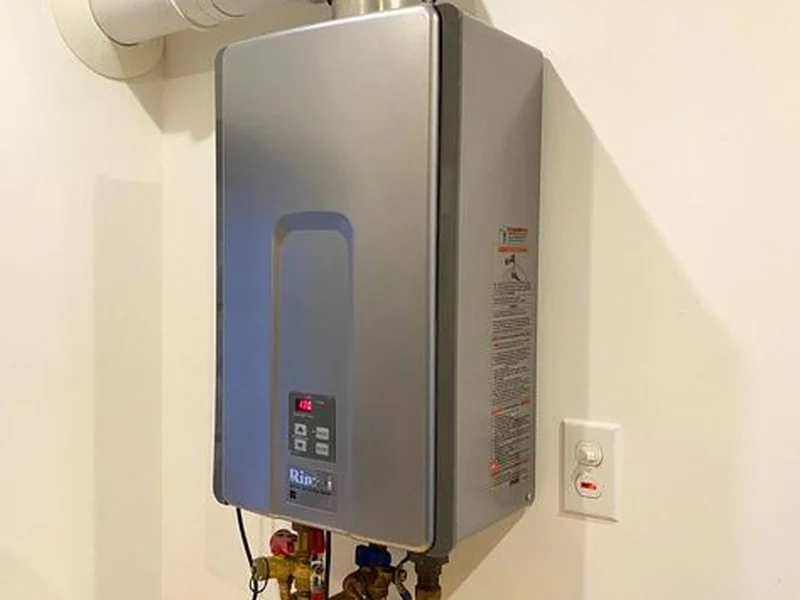
Hanahan sits just north of North Charleston, a commuter suburb where the Naval Weapons Station meets neighborhoods like Tanner Plantation and Otranto — a mix of 1970s–90s homes and fresh subdivisions, all within a few miles of the Goose Creek Reservoir. Tankless water heaters appear here in two generations: retrofits added to older homes during remodels, and original-equipment units in the newest builds. Both develop the familiar Lowcountry problems as they age: moderately hard Berkeley County water scaling heat exchangers, fittings loosening through thousands of firing cycles, and relief valves weeping in garage and laundry installations. When a Hanahan tankless unit leaks, the fix starts with an accurate diagnosis — exchanger, fitting, valve, or condensate drain — because each has a different repair and a different prevention plan. This page covers leak sources, early detection, descaling, and repair-versus-replace decisions for 29410. For a leaking unit now, call (833) 713-2101.
Tankless Leaks in Hanahan's Two Generations of Homes
Hanahan's housing tells two tankless stories. In the older neighborhoods — 1970s–90s homes in Tanner Plantation, Otranto, and the streets near the weapons station — tankless units are retrofits, threaded into garages and laundry closets where tank heaters used to sit. These inherit aging plumbing: new copper or stainless joined to old galvanized or copper, in spaces that stay humid much of the year. Dissimilar-metal joints corrode, threaded fittings work loose over thousands of firing cycles, and the relief valve inherits whatever pressure quirks the old system had.
In the newest subdivisions, tankless units are original equipment — typically high-efficiency condensing models with proper isolation valves and professional venting. These fail less often and later, but they are not immune: scale accumulates on every heat exchanger regardless of installation quality, condensate drains clog, and fittings still cycle. The difference is timeline — a maintained new-build unit reaches its second decade before issues appear, while a neglected retrofit can leak at year seven.
Scale is the common enemy across both generations. Berkeley County's water is moderately hard, and Hanahan's family households run high hot-water volumes — multiple bathrooms, daily laundry, teenagers. Thousands of gallons a year deposit calcium and magnesium on the exchanger coil; the scaled coil over-fires; the metal fatigues; pinholes open. The units that leak are overwhelmingly the ones that missed their flush schedule.
Condensing units add the condensate drain to every diagnosis. These models produce acidic condensate continuously while firing, and the drain line — often run across a garage to a distant drain — clogs with sediment or sags over time. Backed-up condensate floods the cabinet from within and corrodes the enclosure. It is a quick check during any leak call and a frequent culprit in newer-build mystery puddles.
Early Detection in Garages and Laundry Rooms
Most Hanahan tankless units live in garages or laundry rooms — visible, accessible, and easy to check. Make it a monthly habit: look at the floor under and around the unit, scan every visible fitting for crust or discoloration, and glance at the relief-valve discharge pipe. Check after the morning hot-water rush, since tankless leaks typically appear only on demand.
The mineral evidence is the earliest sign: white crust on a fitting, green tinge on copper, a damp ring that never fully dries on the discharge pipe. That crust is dried leak water — proof the weep has been happening longer than you think. Next come behavior changes: the shower running hot-cold-hot as the scaled exchanger struggles, longer waits for hot water, or an error code for overheating or flow flashing on the display.
- Error codes — note the exact code; it directs the diagnosis.
- Crust or staining on fittings, valves, or vent joints.
- Relief valve dripping steadily rather than occasionally.
- Musty smells in the laundry room — moisture in drywall or framing.
- Reduced hot-water flow — scale narrowing the coil.
Military families with frequent moves have a special case: if you bought a Hanahan home and don't know the water heater's history, assume the flush schedule is unknown and start fresh. A first-time descale plus a fitting inspection establishes the baseline — and often reveals whether the unit was maintained or merely present.
Descaling on Berkeley County Water
Berkeley County's water supply to Hanahan is moderately hard — the middle of the Lowcountry range, and entirely manageable with routine maintenance. The standard is a full descale once a year: isolate the unit at its service valves, circulate food-grade white vinegar or a commercial descaler through the heat exchanger with a pump for 45 to 60 minutes, flush clean with fresh water, and test at a hot tap. Annual flushing keeps the coil near factory condition and holds the unit to its 15-to-20-year design life.
High-use households should consider a tighter interval. Scale tracks gallons heated, and a busy family home — multiple bathrooms, daily laundry — can double a smaller household's throughput. If your energy use creeps up year over year with no change in habits, the exchanger is likely scaling and the interval should shorten.
Retrofits without isolation valves need them. Many Hanahan retrofits tied into existing plumbing with minimal disruption and skipped the service valves that make flushing simple. Adding them during any repair visit converts every future flush from a plumbing project into a routine service call — the highest-value upgrade available for a retrofit unit.
A sediment pre-filter on the cold inlet is the other smart addition, catching the grit that older neighborhood service lines occasionally shed before it reaches the flow sensor and exchanger. And put the flush on a calendar: the Hanahan units that develop exchanger leaks are, with remarkable consistency, the ones whose last descale nobody can remember.
Repair or Replace in Hanahan
On units under ten years old, repair is the default. The leak sources at that age are components — relief valves, gaskets, fittings, condensate drains, flow sensors, igniters — and each is a replaceable part. A proper repair also includes the preventive checks: inlet pressure, venting, condensate slope, and a descale while the cabinet is open. A younger unit repaired and put on a flush schedule has another decade-plus ahead.
Past twelve to fifteen years, or with a breached heat exchanger and no flush history, replacement deserves honest consideration. Heat exchangers can be replaced individually, but on a heavily scaled older unit the remaining components are degraded, and the labor narrows the gap to a new unit with a fresh warranty and current efficiency.
Replacement is also the moment for a sizing review. Hanahan households change — additions, finished bonus rooms, bathroom remodels — and the original unit may no longer match demand. Tankless capacity is rated by temperature rise at flow, and our warm incoming groundwater (often around 70 degrees) keeps the required rise modest. A correctly calculated unit avoids both short-cycling (oversized) and perpetual strain (undersized), and either extreme shortens life.
A 29410 service visit runs the full arc: utilities secured, leak confirmed with the unit running, pressure and venting verified, condensate line checked, failed part replaced, system descaled, hot water tested at multiple fixtures. You get a plain explanation of what failed and a maintenance interval matched to your household. Call (833) 713-2101 to schedule.
Local Insight
Hanahan's identity is the commuter suburb with a military neighbor. The Naval Weapons Station anchors the area's economy and fills its neighborhoods with service families; Tanner Plantation, Otranto, and the newer subdivisions off Rivers Avenue house the commuters heading to North Charleston, Goose Creek, and downtown. That turnover means Hanahan sees a steady stream of home sales — and every sale is a moment when a water heater's unknown history becomes the new owner's problem.
The Goose Creek Reservoir sits just north, and the area's low-lying terrain keeps water tables high and crawlspaces damp — relevant because many Hanahan retrofits put tankless units in garages and laundry rooms at grade, where humidity works on fittings year-round. Berkeley County water is moderately hard and entirely typical of the Lowcountry: manageable with annual flushing, punishing without it.
For military families and frequent movers, the practical advice is simple: when you buy in Hanahan, have the tankless unit serviced immediately — descale, inspect fittings, verify the installation details. It establishes the baseline, catches the previous owner's deferred maintenance, and costs far less than the leak that deferred maintenance eventually produces.