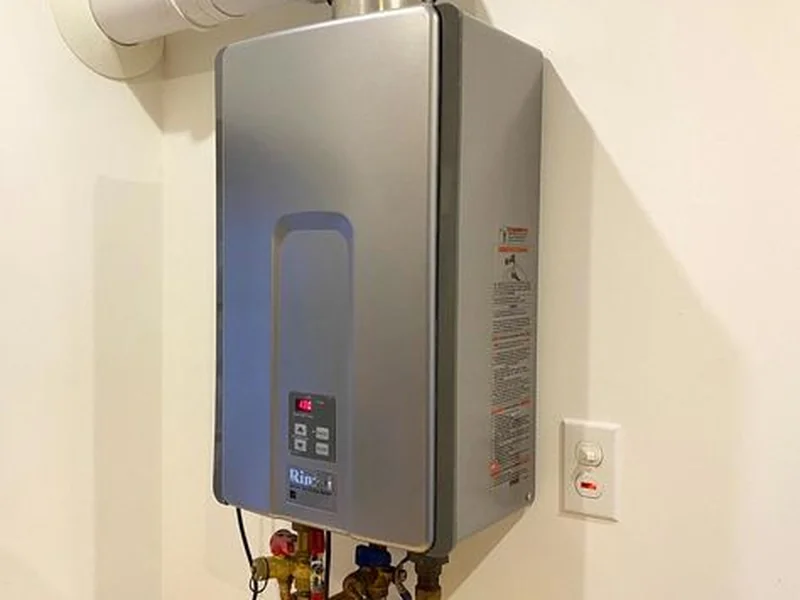
Daniel Island's master-planned neighborhoods are among the Lowcountry's newest — homes built from the 1990s through today, many with tankless water heaters as original equipment. These are premium installations: high-efficiency condensing units tucked into garages and utility closets, serving households that expect endless hot water on demand. But even new-construction tankless units age into their second decade now, and the classic problems arrive on schedule: Charleston's moderately hard water scaling heat exchangers year by year, fittings working loose through thousands of firing cycles, condensate drains clogging. In Daniel Island homes — hardwood floors, custom cabinetry, finished living spaces below every drip — a small tankless leak turns expensive fast. This page explains where those leaks start, the warning signs, descaling intervals for 29492 water, and repair-versus-replace decisions. For a leaking unit now, call (833) 713-2101.
Where Leaks Start in Daniel Island's Newer Units
Daniel Island tankless units are typically high-efficiency condensing models installed during original construction — quality equipment, professionally installed, now aging into the window where maintenance history decides everything. The first leak source is the one no installation quality prevents: scale. Charleston's moderately hard water deposits calcium and magnesium on the heat exchanger with every gallon heated, and in busy family homes the gallons add up fast. A unit flushed annually stays clean; a unit never flushed develops the insulating crust that drives over-firing, metal fatigue, and pinhole leaks.
Condensate handling is the second Daniel Island issue, precisely because condensing units dominate here. These units extract extra heat from exhaust, producing a constant trickle of acidic condensate that must drain freely. Builder-installed drain lines sometimes take the shortest route rather than the most reliable one — long horizontal runs, marginal slope, shared drains. A partial clog backs condensate into the cabinet, where it corrodes the enclosure and mimics a plumbing leak. Annual service should include clearing that line; it takes minutes and prevents the most common mystery puddle in condensing units.
Fittings and service valves form the third category. Thousands of firing cycles vibrate every threaded joint, and the isolation valves installed for flushing develop weeps at their packing nuts over time. These are small, accessible repairs — but in a Daniel Island garage with finished drywall and storage below, even a small weep finds something expensive. The relief valve rounds out the list: a valve dripping steadily points to high inlet pressure, a failed seat, or an overheating exchanger, and each cause has a different fix.
One planned-community wrinkle: exterior vent terminations and any outdoor equipment must satisfy HOA design standards, which occasionally pushed builders toward longer, more convoluted vent runs. Long vents collect condensation in humid weather, and that condensate can drip back toward the unit. A proper leak diagnosis on Daniel Island always rules out vent condensation before ordering parts.
Protecting Finished Spaces: Early Leak Detection
In Daniel Island homes, the water heater usually sits above or beside finished space — a garage with drywall and storage, a utility closet off the laundry room, sometimes a second-floor laundry with the unit in the attic-adjacent space. That means leak detection is really finish protection. Check monthly: the floor under and around the unit, the wall behind a wall-mounted cabinet, and the ceiling below if the unit is elevated.
The earliest evidence is mineral: a white crust on a fitting, a green tinge on copper, a damp ring on the relief-valve discharge pipe. Next comes behavior — the shower that runs hot-cold-hot as the scaled exchanger struggles, or an error code for overheating or flow restriction flashing on the display. Write down any code; it aims the diagnosis.
- Discolored or soft drywall near the unit — water wicking into finished walls.
- Hardwood cupping or finish dulling downhill of the heater location.
- Musty smells in the utility closet — moisture in drywall or framing.
- Relief valve dripping steadily rather than occasionally.
- Longer hot-water wait times — scale narrowing the coil and slowing flow.
Because many Daniel Island owners travel, consider the away-from-home scenario: a slow weep that starts on day two of a two-week trip. An automatic shutoff valve on the water heater feed — a modest device that closes when its sensor gets wet — is inexpensive insurance for a home with hardwood floors. Ask about it during any service visit.
Descaling Schedules for 29492 Water
Daniel Island is served by Charleston Water System's moderately hard supply — the middle of the Lowcountry range. For most households, the right interval is a full descale once a year: isolate at the service valves, circulate food-grade white vinegar or commercial descaler through the heat exchanger with a pump for 45 to 60 minutes, flush clean with fresh water, and test. Annual flushing keeps the coil near factory efficiency and the unit inside its 15-to-20-year design life.
Large households should consider tightening that to every nine months or so. Scale accumulation tracks gallons heated, and a Daniel Island home with four bathrooms, a busy laundry, and teenagers can push double the gallons of a two-person household. The hardness is the same; the throughput isn't.
The good news for this ZIP: builder-installed units here almost always have isolation/service valves, since they were part of the original professional installation. That makes flushing a routine service call rather than a plumbing project. If your unit somehow lacks them — some early-2000s installs cut corners — adding them during a leak repair is the obvious move.
Put descaling on a calendar, not on memory. The Daniel Island units that develop exchanger leaks are overwhelmingly the ones whose owners can't recall the last flush. An annual service visit that combines descaling, condensate-line clearing, and a fitting inspection costs far less than the flooring repair that a neglected leak eventually demands.
Repair or Replace on Daniel Island
Most Daniel Island units are young enough that repair is the default. Component failures — relief valves, gaskets, fittings, condensate drains, flow sensors, igniters — are replaceable parts, and a repair visit also delivers the maintenance the unit has been missing: descaling, condensate clearing, pressure verification. A ten-year-old condensing unit with a fitting leak and a clean bill of health otherwise has another decade in it.
Replacement enters the picture with a breached heat exchanger on an older or badly scaled unit, or when multiple components are failing in cascade. Here the planned-community factor matters: a replacement must satisfy HOA exterior rules for vent terminations and equipment placement, and gas-line sizing must be verified — some original installs were sized tightly, and a higher-capacity replacement needs the gas supply to match.
Sizing should be recalculated, not copied. Household needs change — additions, bathroom remodels, a pool bath — and the original unit may no longer match. Tankless capacity is rated by temperature rise at flow, and the Lowcountry's warm incoming groundwater (often around 70 degrees) keeps the required rise modest, so a correctly calculated unit usually covers the house without going oversized. Oversizing causes short-cycling; undersizing causes perpetual strain. The calculation takes minutes and prevents a decade of compromise.
A service visit on Daniel Island follows a thorough arc: utilities secured, leak traced with the unit running, inlet pressure and venting checked, condensate line cleared, failed part replaced, system descaled, and hot water tested at several fixtures. You get a clear explanation of the failure and a maintenance schedule for your household's usage. Call (833) 713-2101 to schedule.
Local Insight
Daniel Island is the Lowcountry's purpose-built community: master-planned streets, architectural review, homes mostly from the 1990s forward, and a population of professionals commuting via I-526 to downtown, North Charleston, and Mount Pleasant. The housing stock is young by local standards, which means the tankless units here are largely original-equipment condensing models — good hardware, now entering the maintenance-sensitive middle years.
HOA standards shape service work in ways worth knowing. Exterior vent terminations, equipment placement, and any visible changes must comply with community design rules, and the original builders sometimes routed vents and condensate lines for aesthetics as much as function. A technician working on Daniel Island should verify that a replacement or a venting correction will pass muster before the work starts, not after.
The finishes are the real story, though. Hardwood floors, custom built-ins, and finished garages are standard here, and they convert every minor leak into a major repair. Daniel Island owners have the most to gain from the boring habits: annual descaling, monthly visual checks, and a leak-sensor shutoff valve for travel season. Prevention is dramatically cheaper than restoration in this ZIP.