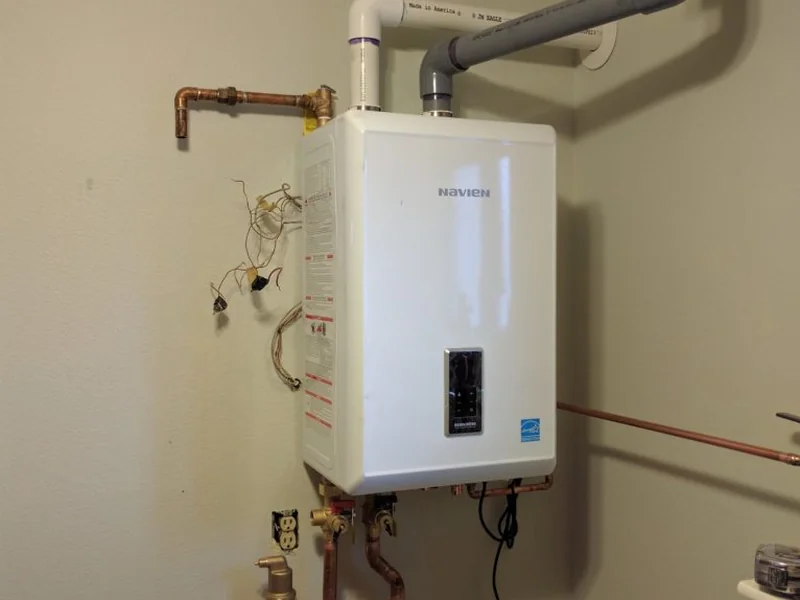
Cross is lake-country living at its most rural — scattered homes, fishing camps, and farms spread around Lake Moultrie's northern and eastern shores, where private wells are the water supply and the nearest plumbing shop is a real drive. Tankless water heaters suit this setting: no tank to rust out between seasons, efficient operation for full-time homes, and compact size for camps and small houses. But Cross well water is notoriously mineral-heavy — hardness plus iron is the local norm — and that chemistry is brutal on tankless heat exchangers without disciplined descaling. Add long plumbing runs, pressure tanks set aggressively, and equipment sitting in sheds and crawlspaces through humid summers, and you have the full recipe for tankless leaks: scaled exchangers, weeping fittings, and relief valves doing overtime. This page covers leak sources, early detection, well-water descaling, and repair decisions for Cross. For a leaking unit now, call (833) 713-2101.
How Cross Well Water Attacks Tankless Units
In Cross, the water is the story. Private wells around Lake Moultrie commonly produce hard, iron-bearing water — sometimes very hard — and a tankless heat exchanger is the worst possible place for that chemistry to concentrate. Every firing cycle flash-heats mineral-laden water across a small coil of copper or stainless steel. Calcium and magnesium plate out as scale on the hottest metal; iron compounds bake into the layer. Within a few years on an unflushed unit, the coil wears an insulating crust that forces the burner to over-fire.
Over-firing is what kills exchangers. The metal cycles hotter than designed, expands and contracts violently, and eventually develops pinholes — first one weep, then several. This is the dominant leak mode in the 29436 area, and it is almost entirely preventable: the same unit on a six-month flush schedule typically runs its full fifteen-to-twenty-year life without exchanger trouble.
Well systems add a second stressor: pressure. Pressure tanks in Cross are sometimes set toward the high end of their range to push water through long runs to the house, and tankless units feel every pound of it. High inlet pressure works relief valves harder, stresses fittings, and finds the weak point in any aging joint. A leak diagnosis here always includes a pressure reading at the unit — fixing a fitting without checking pressure is an invitation to repeat the call.
Finally, placement matters. Cross equipment often lives in sheds, carports, or crawlspaces — unconditioned spaces where summer humidity condenses on cool pipes and winter cold snaps (rare but real) threaten outdoor runs. Fittings in those environments corrode faster, and condensate drains on high-efficiency units are more likely to clog with the sediment that well water carries. The local lesson: in Cross, the installation environment is half the leak equation.
Finding Leaks in Spread-Out Lake Homes
Cross homes are spread out and their water heaters are often out of sight — in a shed behind the house, under a raised camp, or in a far corner of a crawlspace. Leaks get a head start here simply because nobody walks past the unit daily. Build a habit of checking quarterly, and check after the first hot-water use of the day, since tankless units only flow on demand.
What to look for: mineral crust (white, or orange-brown where iron is present) around fittings, the relief-valve outlet, and vent connections — dried evidence of an ongoing weep. Standing water that appears after showers but dries by evening. A relief discharge pipe that never fully dries. In sheds, look at the floor and the wall behind a wall-mounted unit; in crawlspaces, look for damp soil or stained joists beneath the heater's location.
- Error codes — overheating and flow-restriction codes are scale's signature; note the exact code.
- Hot-cold-hot shower swings — uneven heat transfer through a scaled coil.
- Iron staining at fixtures — your sign that the well water is hard on the exchanger.
- Musty or earthy smells near the unit — water reaching wood in sheds and crawlspaces.
- Pressure gauge creeping high — if you have one on the well system, watch it.
Seasonal homes and fishing camps deserve special mention. A unit that sits idle for weeks with mineral-heavy water inside it scales during the idle time — stagnant hot water precipitates minerals faster than flowing water. Camps should be flushed at the start of the season and ideally drained if left through freezing weather. The cheapest leak repair is the one a flush schedule prevents.
The Six-Month Flush: Descaling for 29436 Wells
For Cross well water, the standard advice gets an upgrade: flush every six months, not annually. The groundwater around Lake Moultrie is simply too mineral-rich for a yearly interval — by month nine, scale is already insulating the coil enough to raise firing temperatures. Two flushes a year keeps the exchanger near factory condition and is the single biggest factor in reaching a full service life.
The procedure: isolate the unit at its service valves, connect a submersible pump with hoses to the hot and cold service ports, and circulate food-grade white vinegar or a commercial descaler for 45 to 60 minutes. The solution dissolves the calcium carbonate scale; iron staining may need a second pass or a purpose-made descaler. Finish with a thorough freshwater flush until the water runs clear, then restore service and test at a hot tap.
Two accessories are close to mandatory in Cross. First, isolation/service valves — without them, every flush means cutting pipe. If your unit lacks them, have them installed at the next service visit; it is a one-time upgrade that pays back at every flush for the life of the unit. Second, a sediment pre-filter on the cold inlet. Well water carries sand and grit that abrades the flow sensor and lodges in the exchanger; a simple spin-down or cartridge filter stops it for very little money.
Consider a water test before setting your permanent schedule. A basic hardness and iron test tells you whether your well is average-hard or extreme, and the flush interval follows from the numbers. Wells vary enormously around the lake; the test removes the guesswork.
Repairing vs. Replacing in a Rural Setting
Rural logistics change the repair-or-replace math. Every trip to Cross costs time, so the goal of any visit is a durable fix, not a patch that needs a callback. On units under ten years old, component repairs — relief valves, fittings, gaskets, condensate drains, sensors — are straightforward and worth doing, especially when combined with valve installation and a descale that sets up easy future maintenance.
A breached heat exchanger on an older, never-flushed unit usually points to replacement. In Cross, replacement should also trigger a water-treatment conversation: if the well tests very hard, pairing the new unit with a softener or at minimum a rigorous flush schedule protects the investment. Installing a premium unit on brutal water with no maintenance plan just schedules the same failure a decade out.
Sizing for lake homes needs honesty about usage. A full-time residence and a weekend fishing camp have very different demand profiles, and tankless units are rated by temperature rise at flow — our warm groundwater helps, but a camp that hosts a dozen people on tournament weekends needs the fixture count done right. Undersized units run at maximum fire continuously, which accelerates scale damage; oversized units short-cycle. Neither pays off in the long run.
A Cross service visit is planned as a single-trip resolution: brand, model, age, and error codes gathered by phone beforehand so the truck carries the likely parts. On site: utilities secured, leak confirmed with the unit running, pressure checked against the well tank setting, venting and condensate verified, repair completed, system descaled, full test. Call (833) 713-2101 — and have your unit's details ready so the visit counts.
Local Insight
Cross is defined by Lake Moultrie and by distance. Homes are scattered around the lake's northern and eastern shores — fishing camps, farms, manufactured homes on acreage — and the water heater might be in a shed, a carport, or a crawlspace a hundred feet from the well head. Service here is a planned expedition, not a quick stop, which is why Cross homeowners benefit most from maintenance that prevents emergencies.
The wells are the technical story. Lake-country groundwater is famously hard and often iron-rich, varying well to well. That chemistry is the primary driver of tankless leaks in 29436: scale, over-firing, pinholes. No other factor comes close. A Cross tankless owner who tests the well, installs a sediment filter, and flushes every six months will simply have fewer problems than one who doesn't — the geology doesn't negotiate.
Seasonal use is the third local factor. Fishing camps that sit empty for weeks or months leave mineral-heavy water stagnant in a hot heat exchanger, which scales faster than water in daily use. Camp owners should flush at season start, consider draining for long idle stretches, and never leave a known weep unaddressed through the off-season — small leaks don't pause while you're away.