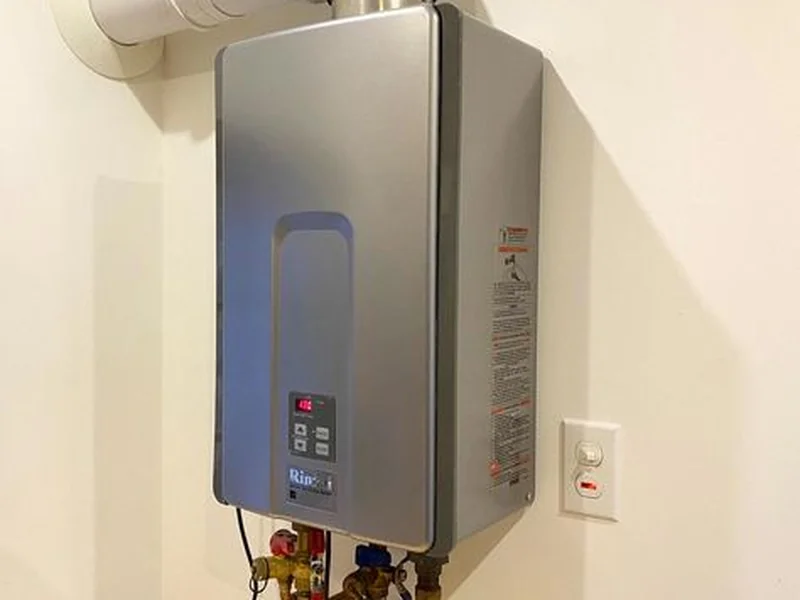
West Ashley's 29407 neighborhoods — the ranch-lined streets off Ashley River Road, the St. Andrew's area, the corridors around Citadel Mall — are full of homes at the age where water heaters become a recurring topic. Many of these 1950s–1970s houses still run their original-style tank heaters, but a growing number have been retrofitted with tankless units during remodels, prized for endless hot water and a footprint that fits a crowded garage. Those retrofits are now old enough to develop the classic tankless problems: scale-choked heat exchangers on Charleston's moderately hard water, weeping fittings where new copper meets old galvanized, and relief valves dripping in laundry-room closets. This page walks through where West Ashley tankless leaks start, how to catch them early, what descaling involves, and when repair beats replacement. If your unit is leaking now, call (833) 713-2101.
Why West Ashley Retrofits Spring Leaks
West Ashley is retrofit country. The 29407 housing stock went up decades before tankless heaters were common, so nearly every tankless unit here was added later — threaded into a garage, a laundry closet, or the space a tank heater vacated. Retrofits inherit the old plumbing, and that inheritance is where most leaks begin: new stainless or copper connections joined to aging galvanized or copper runs, in crawlspaces and garages that stay humid eight months a year.
The heat exchanger faces a different enemy: scale. Charleston's municipal water is moderately hard, and a tankless coil concentrates that hardness onto a small area of very hot metal. In West Ashley's family homes — multiple bathrooms, laundry running daily — annual gallon counts are high, so scale builds steadily. The scaled coil overheats, the metal fatigues, and pinholes open. Units that have never been flushed are the ones that leak first, usually between years seven and twelve.
Dissimilar-metal corrosion deserves special attention in retrofits. Where a brass or copper tankless fitting meets an old galvanized nipple, galvanic corrosion eats the joint from the inside, accelerated by West Ashley's damp crawlspace air. Dielectric unions or brass transitions prevent it, but many retrofits skipped them. A green-white crust at a transition joint is the tell — and it is repairable if caught before the joint fails outright.
Condensing units add the condensate drain to the checklist. High-efficiency models produce acidic condensate continuously while firing, and in garage installations the drain line often runs across the floor to a distant drain. Kinks, sags, and sediment plugs back water into the cabinet, where it corrodes from within. During any leak call, the drain line gets inspected end to end — it is a five-minute check that prevents a repeat visit.
Catching Leaks Early in Ranch Homes and Remodels
West Ashley's ranch homes hide water heaters in forgiving places — garages with floor drains, laundry rooms with tile — which means small leaks get ignored longer. The early signs are subtle: a darkening stain on the drywall behind a wall-mounted unit, a laundry-room baseboard that softens, or a garage floor that is damp in one spot every morning. Because tankless units only flow during hot-water demand, check after the morning shower rush, not at midnight.
Temperature behavior is the other early warning. A scaled heat exchanger telegraphs its distress as hot-cold-hot swings at the shower — the controls throttling back as sections of the coil overheat. If your shower has developed a rhythm of its own, the exchanger is telling you it needs descaling, and the leak risk is rising in parallel.
- Error codes on the display — overheating and flow codes point at scale; write the code down.
- White or green crust on fittings, the relief valve, or vent joints — dried leak evidence.
- Relief valve dripping steadily rather than occasionally.
- Musty odor in the laundry closet or garage — water reaching wood or drywall.
- Longer wait for hot water or reduced flow at hot taps — scale restricting the coil.
Remodeled homes have one extra check: the wall cavity. Retrofits sometimes bury the new connections inside a freshly drywalled chase for a clean look. If the wall around that chase feels cool, sounds dull when tapped, or shows paint bubbling, water may be weeping inside. A moisture meter reading takes seconds and settles the question before drywall has to open.
Descaling on Charleston's Moderately Hard Water
Charleston Water System's supply to West Ashley is moderately hard — enough to matter, not enough to panic about. What turns moderate hardness into a leak problem is volume and neglect: a busy family home pushes thousands of gallons a year through the coil, and without flushing, each year's mineral film adds to the last. The math is simple and unforgiving.
The fix is the annual descale: close the isolation valves, connect a pump and hoses to the service ports, and circulate food-grade white vinegar or a commercial descaler through the heat exchanger for 45 to 60 minutes. The acid dissolves calcium carbonate back into solution; a freshwater flush clears it out. Done yearly, it keeps the coil near factory condition and the unit inside its 15-to-20-year design life.
Many West Ashley retrofits lack isolation valves, because the installer tied into existing plumbing with minimal disruption. Adding them is the highest-value upgrade available — it converts every future flush from a half-day plumbing job into a routine maintenance visit. While the system is open for a leak repair is the ideal moment; the incremental labor is small.
Two more descaling notes for 29407. First, homes with water softeners can stretch the interval, but should not skip flushing entirely — softeners reduce hardness, they don't eliminate maintenance. Second, the flush is also a diagnostic: the color and volume of what comes out tells a technician how the unit has been treated, which informs honest advice about whether a repair or a replacement is the smarter money.
Repair or Replace: The West Ashley Calculation
For units under ten years old, repair is usually the answer. The leak sources at that age are components — relief valves, gaskets, fittings, condensate drains, flow sensors, igniters — and each is a replaceable part. A competent repair also includes the checks that prevent recurrence: inlet pressure, venting, condensate slope, and a descale while the cabinet is open.
Past twelve to fifteen years, or with a breached heat exchanger and no flush history, replacement deserves a serious look. Heat exchangers can be replaced individually, but on a heavily scaled older unit the neighboring components are degraded too, and the labor approaches the cost difference. A new unit resets the clock with a fresh warranty and current efficiency.
West Ashley replacements should always include a sizing review, because many retrofits were sized by guesswork. Tankless capacity is rated by temperature rise at a flow rate, and the Lowcountry's warm incoming groundwater — often around 70 degrees — means the required rise is modest. A properly calculated unit, neither oversized (short-cycling) nor undersized (perpetual strain), lasts longer and scales slower than a guessed one.
Expect a service visit to follow this arc: utilities secured, leak source confirmed with the unit running, pressure and venting verified, failed part replaced, system descaled, and a full hot-water test at multiple fixtures. You should leave with a clear explanation of the failure and a maintenance interval matched to your household's water use. To schedule in 29407, call (833) 713-2101.
Local Insight
West Ashley is Charleston's post-war suburb, and its plumbing shows it. The ranch neighborhoods off Ashley River Road and in St. Andrew's went up in the 1950s through 1970s, and while kitchens and baths have been remodeled many times over, the water heater location — garage, laundry closet, crawlspace — is usually original. Tankless retrofits into those footprints are now hitting the age where scale and fittings become issues, which is why 29407 generates a steady stream of tankless leak calls.
The area's water is Charleston Water System's moderately hard supply, and household demand runs high: these are family neighborhoods with multiple bathrooms and daily laundry. High gallons plus moderate hardness plus skipped flushing is the exact formula for mid-life heat-exchanger leaks. The encouraging news is that the same formula runs in reverse — start the annual flush habit and a West Ashley tankless unit will typically run its full design life.
One more local factor: the remodel economy. West Ashley flippers and renovators love tankless units for the space savings, but flip installations sometimes prioritize speed over details like isolation valves, dielectric transitions, and condensate routing. If you bought a remodeled ranch in 29407, it is worth having the installation details verified — the corrections are simple now and far more involved after the first leak.