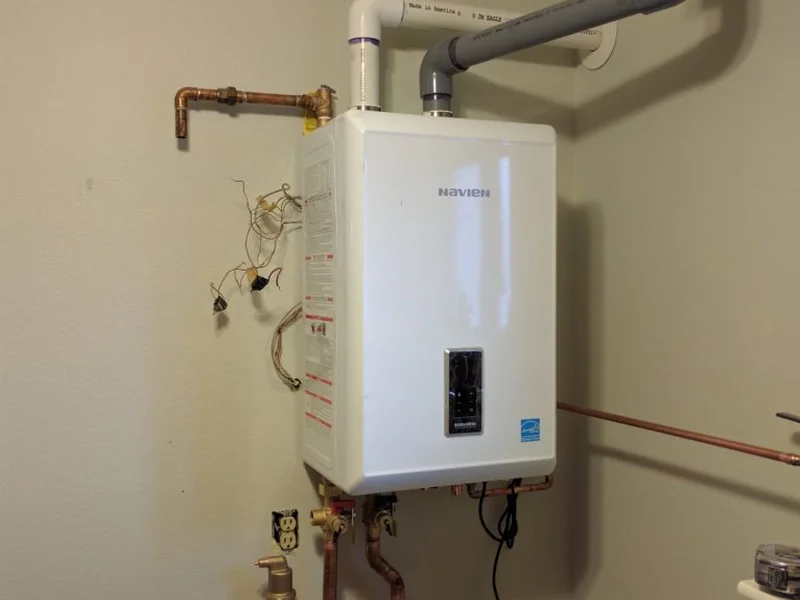
Downtown Charleston's 29401 peninsula packs three centuries of architecture into a few square miles — 1700s single houses, Victorian storefronts, and converted warehouses, many of them running tankless water heaters tucked into closets, carriage-house nooks, and rooftop utility spaces. In a historic district where every square foot counts, the compact tankless unit is a natural choice. But peninsula conditions are demanding: a high water table keeps crawlspaces damp, summer humidity rarely lets up, flood-zone rules shape where equipment can sit, and older plumbing meets new technology at every retrofit. When a tankless unit leaks downtown — weeping from a fitting behind a plaster wall, dripping from a relief valve in a carriage house, or showing error codes in a rental — the stakes include heart-pine floors and historic plaster, not just a wet garage floor. This page explains where tankless leaks originate, the early warnings, descaling for Charleston's water, and repair-versus-replace decisions. For a leaking unit now, call (833) 713-2101.
Where Tankless Leaks Begin in Peninsula Homes
Retrofits define downtown tankless work. Few 29401 buildings were designed around a tankless unit, so installations thread into tight closets, under stairs, and inside carriage houses — spaces where a slow leak soaks historic plaster or heart-pine flooring long before anyone notices. The leak sources themselves are the usual suspects, but the peninsula setting gives each one a local twist.
Heat-exchanger pinholes remain the number-one internal failure. Charleston's municipal water is moderately hard, and in a retrofit where the unit serves an inn or a multi-bath historic home, daily throughput is high — more gallons, more mineral deposited, faster scale. Scale insulates the exchanger coil, the burner over-fires to compensate, and the stressed metal eventually weeps. Units in short-term rentals, where guest turnover keeps hot water running all day, scale measurably faster than the same unit in a single-family home.
Fittings tell the historic-district story. Retrofits join new copper or stainless to old galvanized or copper runs, and dissimilar-metal joints in damp crawlspaces corrode at an accelerated pace. Add the vibration of thousands of firing cycles and you get weeping threaded joints — often hidden inside walls where the tankless unit's compact size tempted an installer to bury connections.
Two more peninsula-specific paths: condensate drains on high-efficiency condensing units, which must run to a proper drain through spaces never designed for one — a sagging or disconnected line floods the cabinet; and venting, where long retrofit vent runs through old chimneys or sidewalls collect condensation that drips back toward the unit in humid weather. A careful diagnosis distinguishes true leaks from vent condensation before any parts are ordered.
Early Warnings in Historic and Converted Buildings
Downtown, the first casualty of a tankless leak is usually a finish, not a floor drain. Watch for paint bubbling on the wall below or beside the unit, baseboards that swell or pull away, and plaster that feels cool or sounds hollow when tapped. In carriage houses and garden-level units, a musty smell that appears after heavy hot-water use — laundry day at an inn, back-to-back rental turnovers — often traces to a weeping fitting inside a wall cavity.
Because many 29401 units serve rentals or multi-unit buildings, the symptom reports come secondhand: a guest mentions the shower runs hot-cold-hot, or the water takes longer to arrive. Both point to a scaled exchanger or a failing flow sensor. Property managers should treat those reports as early warnings, not quirks — the scale causing the temperature swing is the same scale stressing the exchanger toward a leak.
- Error codes for overheating, ignition, or flow — write down the exact code; it directs the diagnosis.
- Mineral crust around fittings or the relief-valve outlet — dried proof of an ongoing weep.
- A relief valve that drips steadily instead of occasionally.
- Damp drywall or plaster near the unit, or flooring that cups beside a closet installation.
- Unexplained humidity in a small utility space that never used to feel damp.
One caution for historic buildings: never ignore a leak because the volume looks small. A pinhole weep inside a plaster wall can saturate lath and framing over weeks, and the repair bill for the building fabric quickly exceeds the plumbing fix. Early calls save historic material that cannot be replaced at any price.
Descaling Tankless Units on Charleston Water
Charleston Water System delivers moderately hard surface water to the peninsula — not the hardest in the Lowcountry, but more than hard enough to scale a tankless heat exchanger over time. In a downtown context, throughput is the multiplier: an inn, a restaurant with a tankless-fed kitchen, or a multi-bath home simply pushes more mineral-laden gallons through the coil each year than a typical suburban household, so scale accumulates faster even at moderate hardness.
The maintenance standard is a full descaling flush at least once a year: isolate the unit at its service valves, circulate food-grade white vinegar or a commercial descaler through the heat exchanger with a pump for 45 to 60 minutes, then flush clean with fresh water. High-use downtown properties — inns, rentals, restaurants — should treat that as a minimum and consider a six-month interval, because their gallons-per-year can easily double a residence's.
Retrofits sometimes skipped the isolation valves, since adding them meant opening more historic wall. If your unit lacks service valves, installing them during a leak repair is the single most useful upgrade you can make — it turns every future flush from a plumbing project into a routine service call. A sediment strainer on the cold inlet is the other smart addition, catching the grit that older peninsula service lines occasionally shed.
For property managers, the practical move is a maintenance calendar: descaling scheduled like HVAC filter changes, logged per property. The units that leak downtown are overwhelmingly the ones whose last flush nobody can remember. A dated service record also answers the first question any technician asks — and the first question a manufacturer asks about any warranty claim.
Repairing vs. Replacing a Downtown Tankless Unit
The repair-or-replace math downtown includes a factor suburban homes don't: installation complexity. Threading a new unit into a historic closet or carriage house — with venting routes, gas-line sizing, and historic-district exterior rules — costs more in labor than swapping a garage unit in the suburbs. That tilts the math toward repairing a younger unit and being deliberate about replacing an older one.
Straightforward repairs cover most leak calls on units under a decade old: relief valves, fittings and gaskets, condensate drains, flow sensors, igniters, and control boards. A leaking heat exchanger is the dividing line. On a younger unit with service records, exchanger replacement can be justified; on a unit past twelve to fifteen years with heavy scale and no flush history, the remaining components are suspect and full replacement is usually sounder.
Replacement in 29401 also invites a sizing review. Many downtown retrofits were sized by rule of thumb, and a unit that was marginal from day one has spent its life over-firing — which accelerates scale damage. Charleston's warm incoming groundwater (often near 70 degrees) actually helps: the temperature rise a unit must deliver is smaller than in colder climates, so a correctly calculated mid-size unit often serves a big historic home. Proper sizing, proper venting, isolation valves from day one, and a descaling calendar turn a replacement into a twenty-year solution instead of a repeat of the last unit's problems.
A service visit downtown runs like this: utilities secured, cabinet opened, unit run so the leak reveals itself, inlet pressure and venting checked, condensate drainage verified, then repair and descale with a full test. Expect the technician to flag access and ventilation issues unique to the building — in a 200-year-old structure, those details matter as much as the part being replaced. Call (833) 713-2101 to schedule.
Local Insight
The 29401 peninsula is unlike any other service area in the Lowcountry: three centuries of buildings, a high water table, flood-zone construction rules, and a historic district that governs what can change on a facade. Tankless units here live in carriage houses, garden-level closets, rooftop penthouses, and retrofitted utility nooks — and venting a gas unit through a historic structure is a design problem, not just a plumbing one. Long or convoluted vent runs are common, and they collect condensation in Charleston's humidity, which is why downtown leak diagnoses always verify venting before condemning parts.
Water use patterns are equally distinctive. A huge share of 29401 tankless units serve the visitor economy — inns, short-term rentals, restaurants — where hot water runs far more hours per day than in a residence. More gallons means more scale per year, which compresses every maintenance interval. If you manage a downtown rental property, assume your tankless unit ages in dog years and descale accordingly.
Finally, the finishes at risk are irreplaceable: heart-pine floors, lime plaster, original millwork. A slow leak that would merely stain a suburban garage floor can destroy historic fabric here. That asymmetry is the strongest argument for fast response and for the leak-detection habit — a monthly glance at the unit, the wall around it, and the floor beneath it.