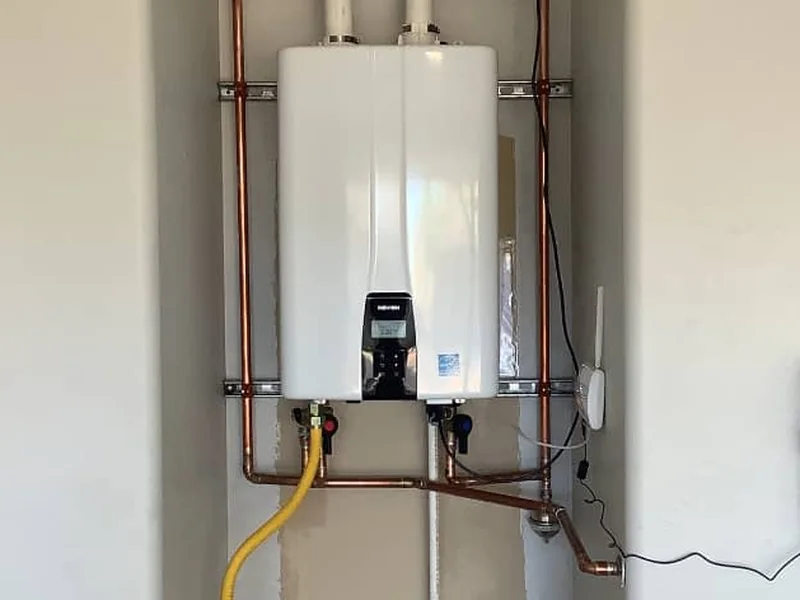
Bonneau sits on the shores of Lake Moultrie in the heart of Santee Cooper lake country, where fishing camps, older site-built homes, and manufactured houses share the shoreline with newer lake-view builds. Tankless water heaters have caught on here for good reasons — they sip energy and open up floor space in small utility rooms, and handle the on-demand hot water that lake weekends demand. But Bonneau's water is the catch: private wells dominate the 29431 area, and lake-country groundwater frequently runs hard with iron, the exact recipe for mineral scale inside a tankless heat exchanger. Scale overheats the metal, fittings corrode in the damp lake air, and eventually something gives — a weeping joint, a dripping relief valve, or a pinhole in the exchanger itself. This page covers where tankless leaks start, how to spot them early, why descaling matters more on well water, and how to decide between repair and replacement. For a leaking unit now, call (833) 713-2101.
How Tankless Leaks Develop on Lake Moultrie
Lake-country well water is the main character in most Bonneau tankless leak stories. The groundwater around Lake Moultrie commonly carries dissolved calcium, magnesium, and iron. Inside a tankless heat exchanger — where water flashes from cool to hot in seconds across a small coil of metal — those minerals precipitate out and bake onto the hottest surfaces. Layer by layer, scale insulates the coil. The burner fires longer and hotter to push heat through the crust, and the metal fatigues. Pinholes follow, and a unit that heated perfectly for years starts weeping water from inside the cabinet.
The second failure point is the plumbing around the unit. Bonneau homes often mount tankless heaters in garages, carports, or utility sheds where lake humidity hangs in the air most of the year. Threaded adapters and compression fittings expand and contract with every firing cycle, and in that damp air, brass and copper corrode faster than they would in a dry closet. A fitting that was snug at installation can begin to weep at year six or seven — first as a mineral stain, later as an active drip.
Condensing tankless models add a third path: the condensate drain. These high-efficiency units wring extra heat from exhaust gases, producing a steady trickle of acidic condensate that must drain away. In lakeside installations the drain line often runs a long horizontal distance to daylight, and any sag or sediment plug backs water into the cabinet. The fix is usually simple — clear and re-slope the line — but left alone, standing condensate corrodes the cabinet from the inside.
Finally, the temperature-and-pressure relief valve deserves a mention. It is a safety device, and a valve that drips constantly is telling you something: inlet pressure too high, a failed valve seat, or an overheating exchanger from the scale problem above. In Bonneau, where well pressure tanks sometimes run at the high end of their range, a quick pressure check is part of every leak diagnosis.
Spotting a Tankless Leak Before It Spreads
In a lakeside home, a slow tankless leak can hide for months — behind a water heater cabinet in a dim garage, or under a utility shed where nobody looks. The earliest sign is usually mineral evidence: a white crust or green-blue staining around a fitting, the relief valve outlet, or the vent collar. That crust is dried leak water, and it means the drip has been happening longer than you think.
Standing water is the next stage. Because a tankless unit only flows when a hot tap calls for heat, you may find the floor wet after morning showers but dry by evening. Note the pattern — it helps the diagnosis enormously. Check the wall behind a wall-mounted unit too; slow seeps wick into drywall and framing, and a soft or discolored patch of wallboard below the heater is a classic sign.
- Error codes for overheating or flow restriction — the unit's electronics often detect scale stress before you see water.
- Hot water that surges hot-cold-hot, a sign the scaled exchanger can't transfer heat evenly.
- Relief valve discharge pipe that stays wet between uses.
- Musty smells in the utility area, meaning water has reached wood or drywall.
- Rising energy use with no change in habits — the unit working harder through scale.
Lake Moultrie homes have one more tell: iron staining. If your fixtures show orange-brown iron stains, your well water carries the minerals that scale heat exchangers fastest. Iron-stained fixtures plus a tankless unit past five years without a flush is a strong prompt to schedule descaling before the first pinhole appears.
Descaling: Non-Negotiable on Bonneau Well Water
If there is one maintenance task that decides how long a tankless unit lasts in Bonneau, it is descaling. The area's well water is simply harder than what most tankless heaters were bench-tested on. Without regular flushing, scale accumulates on the heat exchanger at a pace that can cut years off the unit's life — and the failure mode is exactly the pinhole leak this page is about.
The industry standard is a flush at least once a year, moving to every six months where water is hard. In the 29431 area, homes on private wells should default to the six-month schedule unless a water test shows otherwise. The procedure itself is straightforward: the unit is isolated with its service valves, a small pump circulates food-grade white vinegar or a commercial descaler through the heat exchanger for 45 to 60 minutes, and the system is flushed clean with fresh water. Scale that took a year to build dissolves in under an hour.
Two installation details make descaling dramatically easier. First, isolation (service) valves on the hot and cold connections — without them, flushing requires cutting into the plumbing. If your unit lacks them, having them added during any repair visit pays for itself at the first flush. Second, a sediment pre-filter on the cold inlet, which is close to mandatory on Bonneau wells: it catches sand and grit before they reach the flow sensor and heat exchanger, and it is solid protection against the abrasive wear that lake-country groundwater delivers.
There is also a water-treatment conversation worth having. A whole-home softener changes the descaling math entirely, stretching flush intervals and protecting every fixture in the house. It is not required — disciplined flushing works fine — but for wells testing very hard, it is worth discussing with a water treatment professional alongside your leak repair.
When to Repair Your Tankless Unit — and When to Replace It
Age and leak location drive this decision. On a unit less than ten years old, most leaks are component failures: a relief valve, a fitting, a condensate drain, a flow sensor, or a gasket. Those are repairs — swap the part, check system pressure, descale while the cabinet is open, and the unit returns to service. Even a failed igniter or control board on a younger unit is usually worth fixing.
The calculus changes with a breached heat exchanger. Heat exchangers can sometimes be replaced, but on a unit over twelve to fifteen years old — especially one with no descaling history in hard well water — the rest of the scaled components are living on borrowed time. Replacing the whole unit then is typically the better value: you get a fresh warranty, current efficiency, and a clean start with isolation valves and a proper flush schedule from day one.
Sizing deserves attention in any Bonneau replacement. Tankless capacity is rated by temperature rise, and Lake Moultrie's groundwater stays relatively warm, which works in your favor — a mid-size unit often covers a whole house here. But lake homes with outdoor showers, multiple bathrooms, and guest traffic on fishing weekends need an honest fixture count. An undersized unit runs flat-out and scales faster; an oversized one short-cycles. Either mistake shortens life.
A repair visit follows a consistent pattern: water, gas, and power secured; the cabinet opened and the unit run so the leak shows itself; inlet pressure checked against the well pressure tank setting; venting and condensate drainage inspected; then the failed part replaced and the system descaled and tested. You should get a plain explanation of what failed and why, plus a maintenance plan that fits your water. To book, call (833) 713-2101.
Local Insight
Bonneau is lake life, full stop. The town hugs Lake Moultrie, Bonneau Beach draws anglers and boaters, and striped-bass stories are local currency. That setting defines the housing: fish camps and older cottages near the water, manufactured homes on big lots, and newer builds chasing lake views. Water heaters live wherever they fit — garages, carports, utility sheds, crawlspaces — and many sit in the open, humid air that rolls off the lake for much of the year.
The water story is wells. Outside the town core, private wells are the rule, and lake-country groundwater is famously mineral-rich — hardness plus iron is the common combination. It stains fixtures, spots dishes, and, most relevant here, scales tankless heat exchangers faster than municipal water does. Any tankless service plan in 29431 that ignores the well is incomplete; the descaling interval should be set from an actual hardness test, not a guess.
One practical note for lake residents: weekend and seasonal use patterns — a house full of guests for a fishing tournament, then quiet for weeks — cycle a tankless unit hard and then let water sit in it. Stagnant, mineral-heavy water in a hot heat exchanger scales faster than water in daily use. If your lake house sits empty between visits, a flush before the busy season is smart prevention.