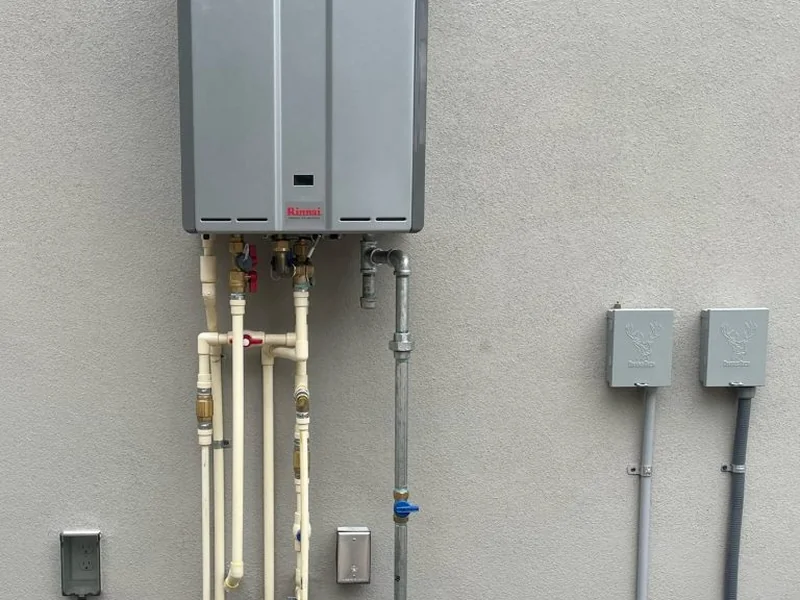
In Awendaw, where U.S. 17 runs past the Francis Marion National Forest toward Bulls Bay and the Cape Romain refuge, a tankless water heater is a practical fit — compact, efficient, and well suited to Lowcountry homes that never see a hard freeze. But the same coastal setting that makes tankless units attractive also works against them: humid salt air corrodes fittings, private well water lays mineral scale inside the heat exchanger, and summer storms stress every connection. When a tankless unit starts leaking — a puddle under the cabinet, water weeping from the pressure-relief valve, or a crust of minerals around a fitting — the cause is rarely random. Scale-driven overheating, loose connections, and condensate drainage problems account for most of the tankless leak calls around Awendaw. This page explains where those leaks start, the warning signs to watch for, how descaling protects your unit, and what a repair visit involves. If your unit is leaking now, call (833) 713-2101.
Where Tankless Leaks Start in Awendaw Homes
A tankless water heater has no storage tank to rust through, so its leaks come from a shorter list of places — but each one matters. The heat exchanger is the heart of the unit: a coil of copper or stainless steel that flash-heats water as it passes. In Awendaw, where many homes run on private wells, mineral scale builds up inside that coil year after year. Scale insulates the metal from the water it is trying to heat, so the burner or elements run hotter to compensate. That repeated overheating stresses the metal until pinholes and hairline cracks open, and water begins to weep through.
Fittings and connections are the second common source. A tankless unit vibrates slightly every time it fires, and over thousands of cycles, threaded joints and compression fittings can loosen — especially where installers used dissimilar metals. Salt air drifting in from Bulls Bay accelerates corrosion on brass and copper fittings in outdoor or garage installations, and a green crust of verdigris around a joint is often the first visible clue.
The temperature-and-pressure relief valve is designed to drip when pressure spikes, so occasional weeping can be normal. A relief valve that drips constantly, though, points to a failed valve, excessive inlet pressure, or overheating from a scaled heat exchanger. On condensing tankless models, the condensate drain is another leak path: acidic condensate must drain freely, and a clogged or improperly sloped drain line backs water up into the cabinet. Finally, venting connections on gas units can collect condensation that drips back down — in Awendaw's humid air, an uninsulated vent run sweats enough to mimic a real leak, so diagnosis starts by confirming where the water is actually coming from.
Warning Signs Your Tankless Unit Is Leaking
Tankless leaks rarely announce themselves with a dramatic flood. More often they start as small, easy-to-miss clues. The most obvious is standing water: a puddle beneath the wall-mounted cabinet, damp drywall behind the unit, or a wet spot on the garage floor that keeps coming back after you wipe it up. Because tankless units only move water when a hot tap is open, the puddle may appear only after showers or laundry — a pattern worth noting before you call.
Error codes are the unit's own way of reporting trouble. Most modern tankless heaters display codes for overheating, ignition failure, or restricted flow, and several of those trace back to scale buildup that is also stressing the heat exchanger toward a leak. If your display is flashing a code you have never seen, write it down; it shortens the diagnostic visit considerably.
- Mineral crust or white-green deposits around fittings, the relief valve, or the vent connection — dried evidence of a slow weep.
- A relief valve that drips steadily rather than occasionally, or a discharge pipe that is always wet.
- Fluctuating hot-water temperature — hot, then lukewarm, then hot again — which often accompanies a scaled, struggling heat exchanger.
- Musty or damp smells in the utility closet, a sign water has been seeping into drywall or framing.
- Rust streaks or corrosion on the cabinet, especially on outdoor units facing the salt air off Bulls Bay.
One more Awendaw-specific note: homes on wells sometimes notice a sulfur or metallic smell in hot water before any leak appears. That points to water chemistry that is also hard on the heat exchanger, and it is a good prompt to schedule descaling before a pinhole leak forces the issue.
Hard Water, Scale, and Descaling Around Awendaw
Scale is the slow-motion threat to every tankless water heater in the Lowcountry. Awendaw's municipal supply is moderately hard, and private wells in the 29429 area frequently run harder, sometimes with iron in the mix. Every gallon that passes through the heat exchanger leaves a trace of calcium and magnesium behind. In a tank heater that sediment settles to the bottom; in a tankless unit it plates directly onto the hottest metal in the system, forming an insulating crust exactly where heat transfer matters most.
The consequences build quietly. First the unit works harder and your energy use creeps up. Then flow drops and temperatures swing. Eventually the overheated metal develops the pinhole leaks described above, or the unit starts throwing error codes and shutting down. Manufacturers treat descaling as required maintenance, and most recommend a flush at least once a year — every six months for homes on hard well water.
A professional descaling service isolates the unit with its service valves, connects a pump and hoses, and circulates a descaling solution — usually food-grade white vinegar or a purpose-made descaler — through the heat exchanger for 45 to 60 minutes. That dissolves the scale without harsh chemicals. The system is then flushed clean with fresh water and returned to service. If your Awendaw unit was installed without isolation/service valves, adding them during a repair visit makes every future flush simpler and less expensive.
Well owners should also consider a sediment pre-filter on the cold-water inlet. It will not soften the water, but it keeps sand and grit out of the flow sensor and heat exchanger — two components that fail early in gritty well water. Pair that with a yearly flush schedule and a tankless unit in Awendaw can deliver its full 15-to-20-year service life instead of developing leaks at year eight.
Repair or Replace: Making the Call on Your Tankless Unit
Not every leaking tankless unit needs to be replaced. The decision comes down to age, the leak's location, and the unit's overall condition. A failed relief valve, a loose fitting, a clogged condensate drain, or a bad flow sensor on an otherwise healthy five-year-old unit is a straightforward repair — replace the part, verify pressures, descale while the system is open, and the heater goes back to work. Leaks at threaded connections and service valves fall in the same category.
A leaking heat exchanger is the harder call. On a unit under ten years old with a clean maintenance history, a heat-exchanger replacement can make sense if parts are available for that model. On a unit past fifteen years, or one that has never been descaled and shows heavy scale throughout, replacing the heat exchanger often just buys time before the next scaled component fails. At that point a new unit — properly sized, with isolation valves installed from day one — is usually the sounder investment.
Sizing matters in the Lowcountry more than many homeowners expect. Tankless units are rated by temperature rise at a given flow, and our warm incoming groundwater (often around 70 degrees) means a mid-size unit can serve a whole Awendaw home that would need a larger unit up north. An oversized unit short-cycles; an undersized one leaves showers lukewarm when two fixtures run. If replacement is on the table, a proper sizing calculation based on your fixtures and groundwater temperature is part of the job.
What does a repair visit look like? The technician shuts off water, gas or power, confirms the leak's exact source with the cabinet open and the unit running, and checks inlet pressure, venting, and condensate drainage at the same time — because fixing a fitting while ignoring the scale that caused the overheating just schedules a callback. Expect a clear explanation of what failed, what the repair involves, and what maintenance will prevent a repeat. To schedule, call (833) 713-2101.
Local Insight
Awendaw sits in a distinctive spot: a small town strung along U.S. 17 between the Francis Marion National Forest and the tidal creeks feeding Bulls Bay. That geography shapes every tankless service call here. Homes range from older fishing cottages and manufactured homes tucked under the pines to newer elevated builds near the water, and the water heater might live in a garage, a carport utility closet, or an outdoor cabinet — each location with its own exposure to humidity, salt air, and storm weather.
Water is the other local variable. The town core is on municipal water, but step outside it and private wells take over, and well chemistry in 29429 varies street by street — some wells run clean and soft, others carry the hardness and iron that scale a heat exchanger in a few short years. A technician who asks about your water source before quoting a descaling schedule is doing it right; the right interval for a well-water home near the forest can be twice as frequent as for a municipal-water home in town.
Finally, distance matters. Awendaw is a genuine drive from the Charleston metro shops, so when you call about a leaking tankless unit, have the brand, model number, and any error code ready — it lets the visit be stocked and resolved in one trip instead of two.