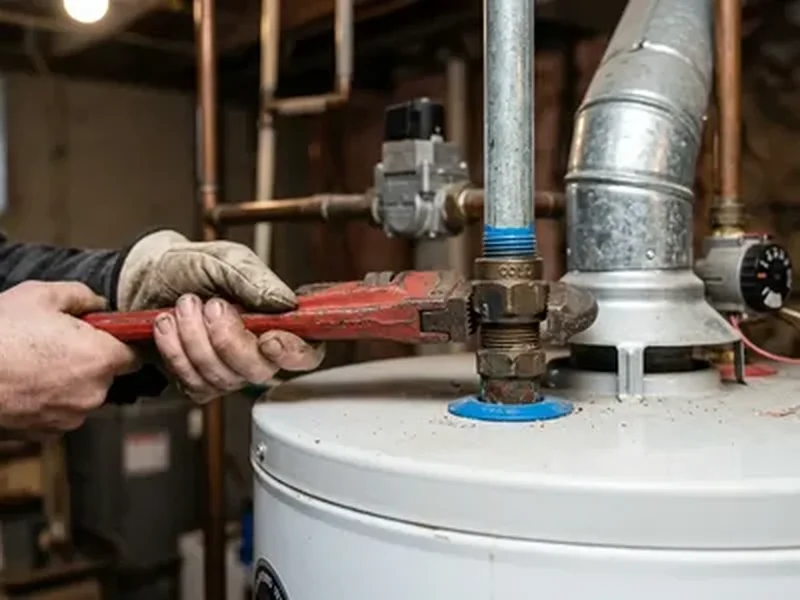
Summerville calls itself Flowertown in the Pines, and the 29483 lives up to it — azalea-lined streets downtown, towering pines over the subdivisions, and a housing stock that stretches from historic in-town homes to 1970s-2000s suburban waves. Its water heaters are just as varied: legacy units in crawl spaces under older homes, mid-life tanks in subdivision garages, and new builder-grade units in infill construction.
When a Summerville homeowner finds water around the heater, the setting often determines the story. A historic-district home might have a heater shoehorned into a retrofitted closet with original-era valves. A 1990s subdivision home might have a mechanically sound tank betrayed by a weeping drain valve. The leak looks the same from the hallway; the right fix depends entirely on reading the individual unit.
Our Summerville visits are built around that reading. We trace each leak to its actual source, assess the tank's age, condition, and water history, and deliver a verdict with visible evidence: repair the component, or replace the vessel. Flowertown homeowners appreciate straight talk about their houses — that is what we bring. Call (833) 713-2101 when water appears where it should not.
Where Summerville Tank Leaks Start: The Lineup
Summerville leaks come from the standard lineup of tank failure points — but in the 29483's mixed housing, each suspect shows up in characteristic settings. Here is what we check and where.
Supply connections. In historic-district homes, these joints may be decades old, corroded by humid air in retrofitted closets; in subdivisions, they are younger but still subject to thermal cycling. The leak starts at the top and runs down the shell, pooling at the base in a convincing shell-failure imitation. Upward tracing is the antidote to misdiagnosis.
T&P relief valve discharge. The side pipe drips when the valve relieves pressure or temperature — or when the valve is worn. Summerville's mix of old and new plumbing means pressure issues appear in both: aging PRVs in older homes, closed-system expansion in newer ones. Pressure gets checked before any valve is condemned.
Drain valve. Sediment from the area's moderately hard water plus damp air makes this the most frequently weeping component we encounter. It often starts after a flush disturbs years of buildup — or simply with age.
The shell verdict
Tank body seepage — bottom-seam moisture, base rust, wall pinholes — ends the repair discussion honestly. No component swap restores a breached shell. In Summerville's oldest units we inspect bases carefully, because decades of humid-air exterior corrosion can compound interior wear. When the shell has failed, we show you precisely where, explain why repair is off the table, and discuss replacement without pressure. Evidence leads; we follow.
Inside Your Summerville Leak Visit
Here is a Summerville leak visit exactly as it unfolds — the process behind the diagnosis.
Protection and background. Floor protection down first, then the questions: unit age, leak history, water treatment equipment, recent plumbing work, where water was first noticed. In the 29483, the answers split between historic-home and subdivision contexts, and they steer the investigation.
Source tracing. Dry the area, verify precisely where moisture returns — top connections, discharge pipe, drain valve, base seam. Water's traveling habit makes the puddle a hint, not a conclusion. We confirm the origin before discussing any fix, because everything downstream depends on this step.
Whole-unit assessment. Exterior corrosion, flush-water clarity, anode rod condition, house pressure, expansion provisions. Historic-district units often reveal legacy components and long maintenance gaps; subdivision units show the standard sediment-and-rod story. Both get read completely.
Verdict with evidence
We present the findings physically — the pulled rod, the water's color, the pressure reading, the leak point — and explain the recommendation plainly. Component failure on a sound tank: repaired on the spot in most cases, with drain-down, part swap, refill, purge, and a monitored test you can observe. Shell failure: an honest replacement discussion with options and timing. You will understand what happened and why before we leave your Summerville home.
Containment in Flowertown: Pans and Discharge Done Right
Summerville's housing history means containment is inconsistent — historic homes often have none, mid-era subdivisions have partial measures, and only newer builds reliably meet modern practice. A leak visit is the right moment to assess yours.
The pan rule admits no exceptions: a pan without a drain line is not protection. We find 29483 heaters with no pan at all, pans draining nowhere, and pans whose drain lines were disconnected during long-ago remodels. Correct practice sets a pan beneath the tank with a dedicated line to a floor drain, the exterior, or another approved termination — so even a major failure is carried away from the structure rather than into it.
The T&P discharge pipe needs the same verification: falling from the valve, terminating where discharge is visible but harmless. In Summerville's older homes we find pipes ending inside walls, discharging into crawl spaces unseen, or cut short during renovations. A safety device discharging where nobody looks is a warning system with the ringer disconnected.
Small corrections, lasting protection
Adding a drained pan or re-routing discharge piping is modest work against the damage an uncontained leak inflicts — and Flowertown's humidity ensures escaped water molds, not merely stains. We assess every installation we service, explain what current practice requires, and price corrections plainly. For historic homes, we also evaluate the shutoff valve and supply lines: original-era components nearing retirement deserve an honest mention, with reasoning attached rather than pressure applied.
Sediment in Flowertown Water: The Case for Annual Flushing
Summerville's moderately hard CPW water means sediment in every unflushed tank — and the 29483 has plenty of unflushed tanks. Here is the quiet accumulation at work.
Minerals precipitate out of heated water and settle as grit on the tank bottom: calcium, magnesium, sand, silt. Over years it builds an insulating blanket across the lower region where the burner or lower element works hardest. The heater fires longer and hotter to push heat through the mineral layer, wasting energy every cycle — while water trapped in the sediment bed flashes to steam, producing the rumbling and popping that owners eventually notice.
The damage accumulates thermally. Repeated stress cycles weaken the tank's base exactly where shells most often fail, and the drain valve — submerged in grit — clogs and corrodes until it weeps or seizes. We regularly flush Summerville tanks that run sediment-laden for gallons before clearing: visible proof of years of buildup.
The annual habit
A genuine flush drains substantially until water runs clear — not a token valve crack — and on Summerville's water, annual is the rhythm that keeps sediment from establishing itself. We inspect the drain valve during service, since a decade in grit often leaves it unable to reseal. Paired with periodic anode rod checks, annual flushing is the complete low-cost longevity program. It costs a fraction of the premature replacement it prevents — and in Flowertown's hard-water reality, "premature" arrives sooner than the owner's manual suggests.
Local Insight
Summerville's 29483 centers on the historic downtown — the Flowertown district with its azaleas, mature oaks, and homes spanning a century — radiating outward into the pine-forest subdivisions that define modern Summerville. Water heater installations track that history: retrofitted closets and crawl-space placements in older homes, garage and utility-room setups in the suburban waves, each era with its own plumbing practices and its own failure patterns.
The Summerville Commissioners of Public Works (CPW) supplies much of the area with moderately hard water — the sediment-building, rod-depleting profile familiar across the Lowcountry. Pine-forest humidity and high water tables keep crawl spaces and garages damp; pollen season coats everything, including the exterior of garage-kept heaters, in a film that traps moisture against fittings. It is a distinctive local combination: pine pollen plus humidity accelerating exterior corrosion.
Summerville's strong community identity means reputation matters enormously — neighbors talk, reviews travel, and a technician's honesty (or lack of it) becomes common knowledge fast. We operate accordingly: evidence-based diagnosis, fair scope, clean work, and explanations that respect the homeowner's intelligence.