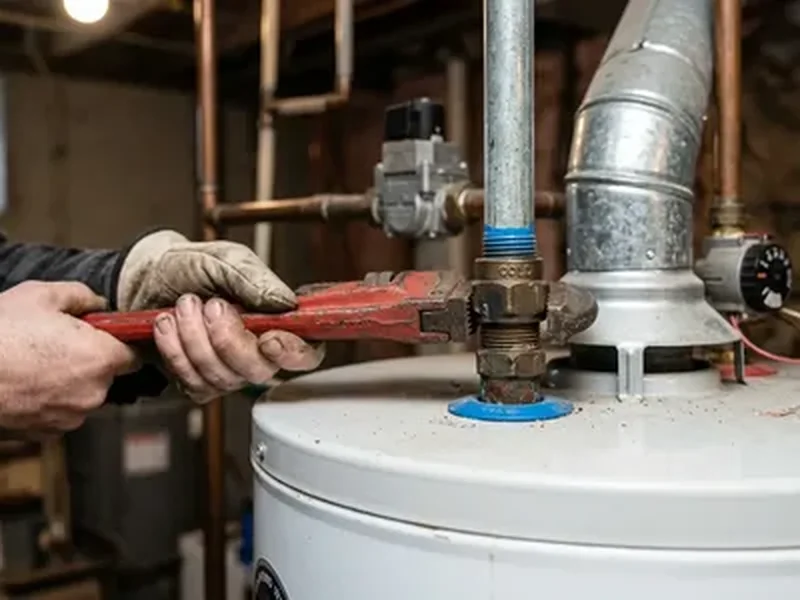
Moncks Corner wears two faces: the historic Berkeley County seat with its courthouse square and Old Santee Canal Park, and one of the Lowcountry's fastest-growing communities, with new subdivisions spreading toward Lake Moultrie and along US-52 and 17-A. Its water heaters wear both faces too — legacy units in older homes on the county's original streets, and builder-grade tanks in 2020s subdivisions, all breathing the same humid lake-country air.
When a Moncks Corner homeowner finds water around the heater, the question is never just "what's leaking" but "what's it worth." A six-year-old tank with a weeping drain valve is a repair — clearly, economically. A twelve-year-old tank seeping at the base seam is a replacement — equally clearly. The expensive errors happen in between, where a rushed judgment spends repair money on a dying tank or replacement money on a healthy one.
Our Moncks Corner visits are designed to eliminate that gray area. We trace the leak to its source, read the tank's condition like a record — rod, water clarity, base, pressure — and deliver a verdict backed by visible evidence. You will understand the "why" before you spend a dollar. Call (833) 713-2101 when water appears where it should not.
The Repair-or-Replace Framework for Moncks Corner
The repair-or-replace question has a right answer for every leaking heater in Moncks Corner — and it is written in the unit's condition, not in anyone's sales quota. Here is the decision framework we apply.
The case for repair rests on three pillars: the leak is in a component (T&P valve, drain valve, supply connection), the tank is under roughly eight years old, and the supporting evidence is clean — no base rust, clear flush water, a rod with life left. On those facts, replacing the failed part restores a heater with years of service ahead. This is the most common outcome in Moncks Corner's newer subdivisions.
The case for replacement is equally clear: moisture along the bottom seam, rust staining at the base, pinhole seepage through the shell — the pressure vessel itself has failed, and no component work reverses that. Supporting evidence includes advanced age, rusty water, heavy sediment rumbling, and a long-depleted anode rod. Spending repair money here only delays the inevitable at full price.
The Moncks Corner middle ground
Borderline cases — a nine-year-old tank with a valve leak and moderate wear — get decided by the complete picture: your water's aggressiveness, the rod's remaining life, pressure conditions, and your plans for the home. We lay out the honest probabilities rather than pushing either direction: "this repair buys likely years" versus "this tank is on borrowed time." The evidence is physical and we put it in front of you — the pulled rod, the water color, the base close-up. Informed beats pressured, every time.
Lake-Country Climate: The Two-Front Attack on Your Tank
Moncks Corner's lake-country climate is quietly aggressive toward water heaters, attacking from outside and inside simultaneously. Understanding the assault explains the area's leak patterns.
Outside: humidity is the constant enemy. Lake Moultrie air, high water tables, and Lowcountry summers keep garages, crawl spaces, and utility rooms damp most of the year. Moisture condenses on cooler tank surfaces and fittings, corroding drain valves, supply unions, T&P bodies, and base rings. We find Moncks Corner leaks regularly that are purely exterior in origin — a valve body rusted until it weeps, a union pitted until it drips — on tanks whose interiors remain perfectly sound.
Inside: area water carries the mineral load that shortens tank life from within. Sediment blankets the bottom, creating hot spots and base stress; dissolved minerals attack the glass lining at weak points; and the anode rod — the shell's sacrificial protector — depletes faster than its rating in aggressive water. Once the rod is spent, the shell stands alone, and pinhole leaks follow within a few years.
What the two-front war means for you
First, maintenance leverage is high here: annual flushing and periodic rod checks buy proportionally more life in aggressive conditions than in gentle ones. Second, diagnosis must consider both fronts — an exterior-origin leak on a healthy tank is a repair, while the same drip on an internally worn tank may signal the end. We read both fronts on every visit, because Moncks Corner tanks live or die on the combination.
Sediment in Lake-Country Water: Flush Annually or Pay Eventually
Moncks Corner's water — moderately hard with real mineral content — makes sediment buildup a matter of when, not if, in unflushed tanks. Here is what accumulates while nobody is watching.
Dissolved minerals precipitate out of heated water and settle as grit on the tank bottom: calcium, magnesium, sand, silt. Over years it forms an insulating blanket across the lower region where the burner or lower element works. The heater fires longer and hotter to push heat through the mineral layer, wasting energy on every cycle — and superheating the sediment bed itself.
That superheating does the damage. Water trapped in the sediment flashes to steam — the rumbling and popping owners eventually notice — battering the tank's base with thermal stress it was never designed to absorb. The bottom weakens precisely where shells most often fail. The drain valve, submerged in the same grit, clogs and corrodes until it weeps or seizes.
Flushing as routine, not rescue
A proper flush drains substantially until water runs clear — not a token valve crack — and on Moncks Corner's water, annual is the cadence that prevents sediment from ever establishing itself. We check the drain valve during service, since a decade in grit often leaves it unable to reseal. Paired with anode rod checks every few years, annual flushing is the complete low-cost longevity program: a fraction of the premature replacement it prevents. In lake-country water, "premature" arrives earlier than the manual's fine print suggests.
Leak Service Across Moncks Corner's Full Range of Installations
Moncks Corner heaters live in the full range of Lowcountry placements: crawl spaces over sandy soil, garage corners, utility sheds, low compartments in older homes, and modern utility rooms in new subdivisions. Leak service across that range is a planning discipline.
Tracing leads. In dark, damp spaces, water migrates along pipes and shells and pools misleadingly — a top-fitting drip presents at the base like shell failure. We trace upward with lighting and dry testing before condemning anything, a habit that has saved many Moncks Corner homeowners from replacements they did not need.
Execution follows: hose routing for drain-downs, compact tools for overhead work in low clearances, protection for finished spaces we transit. Older installations contribute seized original valves and corroded fittings as a matter of course; we arrive expecting them, with the penetrating treatment and techniques to free them without damage.
Access, stated upfront
Severely restricted access can add labor time — we will tell you before starting, not as a mid-job discovery. During replacements, relocating the heater to a more serviceable position is occasionally the wisest long-term move, and we will raise it plainly with the trade-offs attached. Whatever the space, the work gets done carefully and the area gets left clean. Difficult access is our routine; surprises are not.
Local Insight
Moncks Corner's 29461 sits at the junction of old and new Berkeley County. The town core holds historic homes and long-established neighborhoods where water heaters occupy crawl spaces, utility rooms, and garage corners on installations spanning decades of practice — original valves, legacy piping, and the occasional long-forgotten heater still chugging along. Meanwhile, growth corridors toward the lake and along the highways fill with new subdivisions on modern systems.
Water here reflects the lake country: municipal supplies serving the town and growth areas run moderately hard with mineral content that builds sediment and consumes anode rods, while rural fringes still use wells with iron and heavier sediment loads. Humidity is a constant — lake air, high water tables, and Lowcountry summers keep crawl spaces and garages damp enough to corrode exterior fittings year-round.
As the county seat, Moncks Corner also hosts rental stock serving the area's workforce — duplexes, single-family rentals, workforce housing — where water heater leaks become landlord-tenant matters. We work those calls with the documentation property owners need: written findings, photos, and straight recommendations.