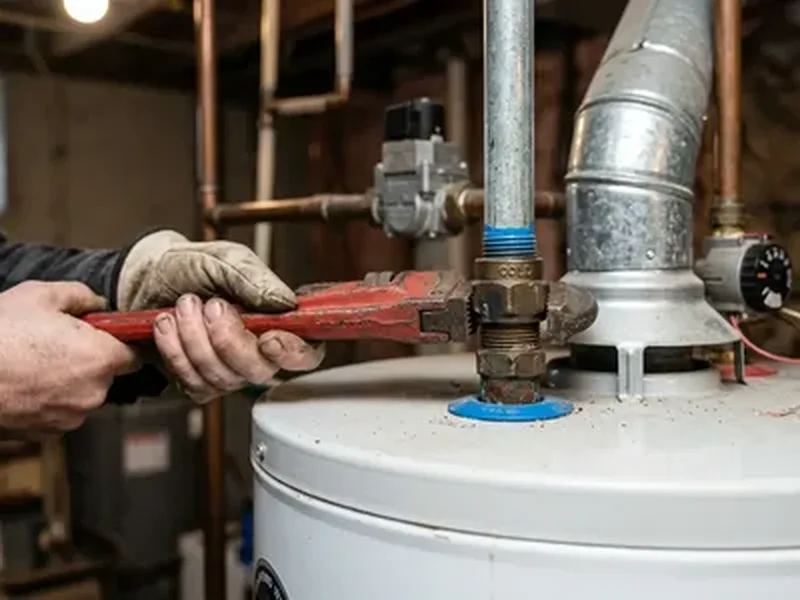
Huger is where the Lowcountry stays wild — the Francis Marion National Forest pressing in on one side, old rural communities and new Cainhoy-area growth on the other. Water heaters in the 29450 live accordingly: in crawl spaces over sandy soil, utility sheds, manufactured-home compartments, and garage corners, nearly all fed by private wells carrying the forest country's mineral-heavy groundwater.
When a Huger homeowner finds water around the heater, the setting complicates everything. The leak might be a weeping drain valve clogged with well sediment — a straightforward repair. It might be a supply connection corroded by years of humid air — also repairable. Or it might be the tank shell itself, thinned from the inside by aggressive water and finally giving way at the bottom seam — which no repair can honestly fix. The puddle does not say which; diagnosis does.
Our Huger visits are built around that distinction. We trace moisture to its actual origin, assess the tank's real condition — rod, water clarity, base, pressure — and deliver a verdict with visible evidence. Fix the part when the tank is sound; replace the tank when the shell is done. Either way you will understand exactly why. Call (833) 713-2101 at the first sign of water.
Tracing a Huger Leak to Its Actual Source
A Huger leak investigation starts with the lineup of usual suspects — each with its own signature, each pointing to a different fix.
Supply connections at the top. Hot and cold lines meet the tank through unions or flex connectors that endure thousands of thermal cycles. In humid crawl-space and shed air, these joints corrode and loosen; the leak starts at the top and runs down the shell, pooling at the base where it impersonates a tank failure. Tracing upward separates the impostor from the real thing.
T&P relief valve discharge. The side pipe drips when the valve relieves pressure or temperature — or when the valve itself is worn. On Huger well systems we also check the pressure switch and pressure tank early, since pressure irregularities are a common island-of-their-own cause here.
Drain valve. The base spigot lives in sediment and damp air — the two things that kill valves fastest. Well grit wears the seat; humidity corrodes the body. A weeping drain valve is one of the most common genuinely repairable leaks we find in the 29450.
The shell verdict
Tank body seepage — moisture along the bottom seam, rust at the base, pinholes in the wall — means internal corrosion has won, and no component swap changes that. The Huger-specific caution: forest-country well water can thin a shell faster than the nameplate suggests, so we inspect the base with particular care on older well-water units. When the shell has failed, we show you exactly where and why, and the conversation moves honestly to replacement.
Pressure vs. Leakage: A Distinction That Saves Money
Not every drip from a Huger water heater is a leak — some are the plumbing system crying for pressure relief, and the fix is entirely different.
Every heating cycle expands the water in the tank slightly. In older open systems that expansion breathed back toward the supply. But check valves, pressure-reducing valves, and backflow preventers — increasingly common even in rural Huger — close the system, trapping the expansion. Pressure climbs with each cycle until the T&P relief valve does its job and weeps. The homeowner sees the discharge pipe dripping and reasonably blames the valve.
Well systems add their own pressure drama. A waterlogged pressure tank or a misadjusted pressure switch sends house pressure swinging, which can make the relief valve work overtime and mimic a leak convincingly. We have seen Huger homeowners replace the T&P valve twice before anyone checked the pressure — and the dripping continued, because the valve was never the problem.
Fixing the cause, not the symptom
Pressure gets measured on every one of our leak visits. Sustained readings above 80 psi mean the "leak" is really a pressure event, and the lasting correction is a thermal expansion tank on the cold-water line — a small vessel that absorbs each cycle's expansion — plus any needed correction at the well pressure tank or switch. Solve the pressure and the dripping stops for good, protecting the tank, valves, and fixtures throughout the home. If your discharge pipe drips despite a relatively new T&P valve, pressure is the prime suspect.
Sediment on Well Water: Why Huger Tanks Must Be Flushed
In Huger, sediment is not a theoretical concern — it is the gritty reality of well water, and unflushed tanks here accumulate it faster than their municipal-water cousins.
The mechanics are simple: dissolved minerals precipitate out of heated water and settle. Huger wells supply generous raw material — iron, calcium, sand, silt — and in a never-flushed tank it builds into a thick insulating blanket over the tank's bottom. The burner or lower element must then fire longer and hotter to heat through the mineral layer, wasting energy with every cycle.
The damage is thermal. Water trapped inside the sediment bed flashes to steam — the rumbling, popping, and crackling owners notice — hammering the tank's base with stress cycles it was not designed for. Year after year, the bottom weakens exactly where tank shells most often fail. Meanwhile the drain valve, submerged in grit, clogs and corrodes until it weeps or seizes solid.
The Huger maintenance rhythm
On forest-country well water, annual flushing moves from "recommended" to "essential." A proper flush means draining substantially until water runs clear — not a token crack of the valve — and inspecting the drain valve afterward, since a decade in sediment often leaves it unable to seal again. Pair that with anode rod checks every couple of years, and a Huger tank gets its fair shot at a full lifespan despite the water it drinks. Skip both, and the well water collects its tax early — usually as a base-seam leak that ends the tank.
Rentals in Huger: Old, New, and Leaking — What to Do
Huger's rental landscape mixes older rural homes, manufactured-home rentals, and new-construction rentals in the Cainhoy growth area — and a leaking water heater in any of them needs clear responsibilities and quick action.
Tenants: if it is safe, close the cold-water valve above the tank, contain water with towels, and notify your landlord or property manager immediately — in writing, with photos and dates. Do not commission major repairs yourself; the heater belongs to the property owner. Documented, timestamped notice protects you if damage spreads.
Landlords and managers: in Huger's humid climate, delay converts a weeping valve into subfloor damage and mold with remarkable speed. Fast, documented response is cheaper than remediation and keeps the tenancy intact. For new-construction rentals, remember that builder-grade heaters still need their rods and valves checked — "new" does not mean "maintenance-free."
What we deliver for rentals
We handle Huger rental calls with property-owner needs in mind: rapid diagnosis, written findings with photos, a straight repair-or-replace recommendation, and scheduling that respects occupied homes. Owners with multiple units — old or new — benefit most from periodic checks: rod condition, T&P function, pan drainage, pressure. Catching a minor problem on a schedule beats discovering a major emergency from a tenant's emergency call, every single time.
Local Insight
Huger occupies the rural corridor between the Francis Marion National Forest and the Wando River, in the path of the Cainhoy area's rapid new development. That split defines the 29450's water heaters: older homes and manufactured housing on private wells with classic Lowcountry groundwater — iron, sediment, tannins from forest soils — alongside brand-new construction on modern municipal-style systems. We diagnose both, and the well-water units get extra scrutiny for internal wear.
The forest sets the climate terms. Humidity runs high year-round, high water tables keep crawl spaces damp, and the organic, slightly acidic character of forest-influenced groundwater can be tougher on tanks and anode rods than ordinary well water. Heaters in sheds and crawl spaces breathe this air constantly, corroding exterior fittings while the water works inside.
Growth adds a practical wrinkle: new Cainhoy-area homes have modern, accessible installations, while older Huger properties have heaters in spots that prioritize "out of the way" over "serviceable." We are equipped for both — and for the rural distances involved, we come prepared to diagnose and usually repair in a single trip, because a callback drive through the forest is nobody's idea of efficiency.