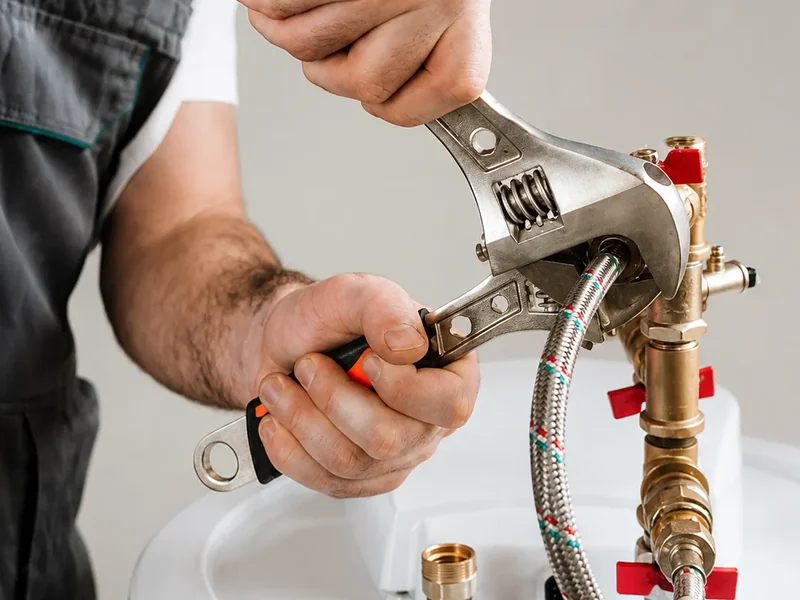
A leaking tank water heater rarely announces itself politely. In Awendaw, where homes sit on large wooded lots along the Highway 17 corridor and many water heaters hide in garages, utility sheds, or low crawl spaces, a leak can run quietly for days before anyone spots the puddle. By the time water appears on the floor, it has often been working on fittings, valves, or the tank shell itself — and in the Lowcountry's damp air, every extra day gives rust and mold a head start.
Here is the good news most Awendaw homeowners do not expect: a leak does not automatically mean you need a new water heater. Temperature-and-pressure relief valves, drain valves, and inlet/outlet connections are all repairable, and they account for a large share of the leaks we see across the 29429 ZIP. The trick is knowing which kind of leak you have, because a failing tank body is a different story entirely — one that calls for replacement, not repair.
That is where an honest diagnosis earns its keep. Our technicians trace every Awendaw leak to its actual source before recommending anything, explain what they find in plain language, and fix what is fixable. If your tank is the problem, we will tell you that too — straight, with the evidence in front of you. Call (833) 713-2101 when you spot water where it should not be.
Where Tank Water Heater Leaks Actually Start
When a technician walks up to a leaking tank water heater, the first job is not reaching for a wrench — it is playing detective. Tank leaks come from a short list of usual suspects, and each one tells a different story about what your heater needs.
The temperature-and-pressure (T&P) relief valve sits near the top of the tank with a discharge pipe running down its side. If that pipe drips, the valve may be doing its job against excessive pressure or temperature — or the valve itself may be worn out. Either way, it is a safety device, and a dripping T&P valve deserves attention rather than a bucket underneath it.
The drain valve at the tank's base is another common culprit, especially on older units and well-water systems where sediment and mineral grit chew up the valve seat. These valves often start weeping after a flush or simply with age. Then there are the inlet and outlet connections on top — hot and cold supply lines joined to the tank with dielectric unions or flex connectors that can loosen or corrode over years of thermal cycling.
The one leak that changes everything
Finally, there is the tank body itself: pinholes or seepage along the bottom seam, the base, or the welded side wall. This is corrosion from the inside out, and it is the one leak that repair cannot honestly fix. No sealant or patch restores a compromised steel shell. When we find tank-body failure, we say so plainly and shift the conversation to replacement — because spending repair money on a dying tank helps no one.
One more thing worth knowing: not every puddle is a leak. In Awendaw's humid air, a cold-water inlet pipe can sweat with condensation heavy enough to pool on the floor, mimicking a real leak. Part of our diagnosis is ruling out the impostors before recommending any work at all.
Why Lowcountry Conditions Are Especially Hard on Water Heater Tanks
The Lowcountry is beautiful, but it is quietly rough on water heaters. Awendaw's combination of heat, humidity, salt-tinged air, and mineral-heavy well water creates something close to a perfect storm for tank corrosion — and understanding why helps explain both the leaks we see and the maintenance that prevents them.
Start with the air. A water heater sitting in a garage, shed, or crawl space in the 29429 breathes warm, moisture-laden air most of the year, with a salt edge drifting in from Bulls Bay and the coast. That moisture condenses on the tank's cooler surfaces and works on exterior fittings, the base ring, and the drain valve from the outside. We regularly see exterior corrosion on Awendaw tanks that looks worse than the tank's actual age would suggest.
Then there is the water inside. Private wells around Awendaw commonly carry iron, sulfur compounds, and sediment, plus pH levels that run slightly acidic in places. That chemistry eats through the tank's glass lining at weak points and then attacks the steel, while sediment blankets the bottom of the tank and creates hot spots that stress the metal. Municipal water is not innocent either — it is moderately hard and, in some systems, aggressive enough to deplete anode rods years ahead of schedule.
The anode rod factor
Every tank ships with a sacrificial anode rod whose entire job is to corrode so the tank does not. In gentle water it lasts years; in Awendaw well water it can be consumed far faster. Once the rod is gone, the tank has no protection left, and that is when pinhole leaks begin. This is why two identical heaters can have wildly different lifespans here — the one whose rod was checked and replaced on time keeps going, while the neglected one springs a seam leak years early.
What to Do the Moment You Spot Water Around Your Heater
Finding water around your heater is unsettling, but a few calm steps in the first minutes can limit damage and make the repair visit smoother. Here is what to do, in order.
First, stop the water. Every tank water heater has a cold-water shutoff valve on the inlet pipe above the tank — usually a lever or a round handle. Turn it clockwise (lever perpendicular to the pipe) to stop fresh water feeding the leak. If you cannot find it or it is seized from years of disuse, the main house shutoff works too; in many Awendaw homes it is near the well pressure tank or where the water line enters the house.
Second, cut the energy. For an electric heater, switch off its dedicated breaker in the panel — a leaking tank and live 240-volt elements are a combination you do not want. For gas, turn the control knob to pilot or off. If water has reached the burner area or electrical components, do not touch the unit at all until a technician arrives.
Third, contain and document. Towels and a bucket catch active dripping; if the heater sits over finished flooring, move what you can. Snap a few photos of where the water is appearing — top, side, or base — because that detail helps the technician bring the right parts on the first trip.
What not to do
Do not plug, cap, or crimp the T&P discharge pipe — that valve is a safety device, and blocking it is dangerous. Do not pour sealants or leak-stop chemicals into the tank. And do not assume a small drip can wait for the weekend; in this climate, standing water feeds mold fast, and a seeping tank shell can fail suddenly. Call (833) 713-2101, describe what you see, and we will guide you from there.
The Anode Rod: The Quiet Part That Decides Your Tank's Lifespan
Inside every tank water heater hangs a humble metal rod that quietly decides how long the tank will live. The anode rod — usually magnesium or aluminum — is more reactive than the steel tank around it, so corrosion attacks the rod first. It is sacrificial by design: it dissolves so your tank does not.
The problem is that nobody sees it happening. The rod works silently for years, and when it is finally consumed, corrosion simply moves on to the next available metal — the tank shell. That transition is invisible until the first pinhole leak appears at the base or along a seam. By then, the damage is done.
In Awendaw, this timeline runs faster than the manuals suggest. Well water loaded with iron, sulfur, and sediment can consume a standard rod in a fraction of its rated life, and water softeners — common here for taming iron — make water more conductive, which accelerates rod depletion further. A rod rated for five years on paper may be gone in two or three on a 29429 well.
Making the rod work for you
The fix is gloriously simple: have the rod inspected every couple of years and replaced when it is depleted. A fresh rod restores the tank's protection and can add years to a mid-life heater — it is a high-return maintenance move in home plumbing. We check rod condition as part of leak assessments too, because a leak on a tank with a long-dead rod tells us the shell has been unprotected, which factors into the repair-or-replace call.
If your Awendaw heater is past year five and the rod has never been touched, assume it needs attention. One inspection now beats one emergency replacement later — especially on a rural road where a swap is never a quick errand.
Local Insight
Awendaw sits where the suburbs give way to the Francis Marion National Forest, and that geography writes the rules for every water heater we service in the 29429. Private wells dominate outside the small Highway 17 commercial strip, and Lowcountry well water runs heavy with iron, sulfur, and sediment — chemistry that clogs drain valves, accelerates tank corrosion, and shortens the life of steel tanks compared with municipal water. When we assess a leaking Awendaw heater, the well is always part of the calculation.
Housing here adds its own wrinkles. Between older wood-frame cottages, manufactured homes, converted hunting camps, and newer builds on multi-acre wooded lots, water heaters end up in places textbook manuals never imagined: low crawl spaces with damp sandy soil, detached utility sheds, garage corners open to humid salt air. High water tables keep crawl spaces moist year-round, which corrodes exterior fittings and pans from the outside while aggressive well water works from the inside.
Distance is the third factor. Awendaw is a long haul from most shops, so a failed tank here is not a quick afternoon swap — it is a logistics event on a rural road. That makes early leak diagnosis unusually valuable in this ZIP: catching a valve drip now beats an emergency replacement later, and knowing honestly whether your tank is worth saving beats guessing.