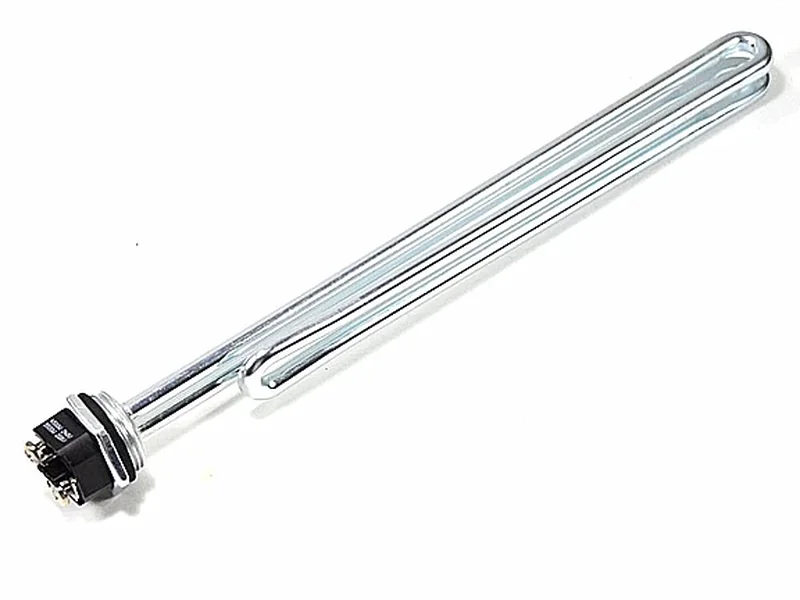
Summerville's electric water heaters work in Flowertown's distinctive conditions — moderately hard CPW water, pine-pollen summers, and humidity that keeps every garage and utility space damp. When a heating element fails in the 29483, it usually fails the Lowcountry way: buried in sediment that accumulated over years of never being flushed, overheated, and finally burned out on an ordinary Tuesday morning.
The symptoms are unmistakable once you know them: showers that never quite reach hot, a tank that runs out of hot water in half its normal time, or the dedicated breaker tripping and refusing to stay reset. Each points toward the elements — but only electrical testing proves it, because thermostats fail in identical disguise.
Our Summerville element service is built on that proof. We test both elements and both thermostats electrically, assess the tank's overall condition honestly, and then perform the right repair: a clean element replacement with the correctly rated part when the vessel deserves it, or a straight replacement recommendation when the tank's story is over. Most visits complete the same day. Call (833) 713-2101 when the hot water turns unreliable.
Hard Water's Slow Execution of Heating Elements
Summerville's water does not just heat in your tank — it deposits, and those deposits are the heating element's executioner. Here is the full mechanism.
CPW supply carries dissolved calcium and magnesium at moderate hardness. Heated water sheds these minerals as precipitate, which settles directly onto the lower heating element and the tank floor around it. Without flushing — the 29483's near-universal history — the accumulation compounds yearly: first a film, then a crust, eventually a mineral sarcophagus around the element.
The entombed element faces impossible thermodynamics. Engineered to shed its wattage into surrounding water, wrapped instead in insulating deposits, its sheath temperature climbs catastrophically beyond rating. Metal fatigues, pits, breaches; water meets the internal resistance coil; the element shorts or burns open and the breaker trips. Extracted lower elements from unflushed Summerville tanks are often unrecognizable — the water's multi-year autograph in mineral.
The defense is simple
Annual flushing defeats the entire mechanism: substantial drain-downs until water runs clear, removing sediment before it can insulate. It is high-return maintenance any electric tank owner can perform — a brief service protecting years of element life. Every Summerville element replacement we do includes flushing the deposits that killed the original, and we set the going-forward cadence explicitly. Flowertown's water chemistry is fixed; the maintenance response is the variable, and it changes the outcome completely.
The Summerville Element Visit, Start to Verified Finish
Here is the Summerville element visit exactly as it unfolds — transparent from arrival to verified hot water.
Diagnosis. Breaker off, verified dead by meter — never by panel label. Resistance measurements across both elements; switching tests on both thermostats; terminal and wiring inspection (pollen-season corrosion gets checked here). The readings pinpoint the failed component: upper element, lower element, thermostat, or a combination. You see the numbers; the diagnosis is demonstrated.
Preparation. Water supply closed; tank drained below the element ports. On Summerville's sediment-loaded tanks, drain-down becomes the first stage of a genuine flush — clearing the mineral mass that killed the old element so the new one begins in a clean tank.
Replacement. The failed element extracts — penetrating treatment when scale has seized it — and the correctly rated new element installs: voltage, wattage, and type matched to the unit, fresh gasket, proper seating. Thermostats are handled per testing and age, with the reasoning laid out plainly.
Refill, re-energize, prove
Complete refill, air fully purged from hot lines, water confirmed at the element level — then power returns, because dry-firing annihilates a new element in seconds. A monitored heating cycle verifies correct current draw, steady temperature climb, and a breaker that holds firm. Hot water, proven and working, before we leave — usually within a couple of hours of arrival. That is the complete Summerville standard.
Element or New Heater? Reading the Whole Summerville Tank
A failed element always raises the larger question in Summerville homes — and the answer comes from reading the entire tank, not just the dead component.
Replace the element when the vessel warrants it: under roughly ten years, clean base with no rust or seepage, clear flush water, a serviceable anode rod. On those facts the tank has real life remaining, and the element swap is the economical, correct repair — the most common outcome across the 29483's subdivision tanks.
Replace the tank when the shell speaks: rust staining at the base, moisture along the bottom seam, rusty water, or advanced age with a complete maintenance void. No element, however correctly installed, rehabilitates a breached shell — and installing one spends money on the way to an unavoidable replacement. We show you the shell evidence directly and recommend honestly.
Reading Flowertown tanks fairly
Our assessment covers the full picture: pulled rod condition, flush-water clarity and sediment volume, base integrity, thermostat age, pressure behavior. In the 29483's mixed housing — historic retrofits to new infill — the evidence varies, but the method does not: physical facts, plainly presented, driving a recommendation you can trust. Borderline cases get honest probabilities, not sales pressure. Summerville homeowners expect straight dealing about their houses; the element-or-tank decision receives exactly that.
What Determines Element Lifespan in Summerville
Element lifespan in Summerville is not luck — it is the predictable result of water chemistry meeting maintenance habits. Here is the honest accounting.
A quality element in a flushed, maintained tank delivers several years of dependable service. The identical element in a never-flushed 29483 tank may fail in a fraction of that time — entombed in CPW-water sediment, overheated, burned out. Same part, same town, radically different outcomes: the variable is maintenance, and it dominates everything else.
The lifespan levers, ranked by impact: annual flushing — removing sediment before it buries the lower element, the single decisive factor; thermostat settings — moderate temperatures reducing scale formation and cycling stress; anode rod condition — a protected tank providing a healthier operating environment; element type — fold-back low-watt-density designs running cooler and accumulating scale slower in hard water.
Installing for longevity
We fit correctly rated quality elements — and where Summerville's sediment justifies it, we recommend the fold-back upgrade with the reasoning demonstrated, not merely claimed. Then we establish your maintenance rhythm explicitly: flushing cadence, settings guidance, warning signs, when to call. A Summerville element installed correctly and maintained consistently should outlast its neglected predecessor by years. That is not a promise about a part — it is the physics of clean tanks versus dirty ones, and it holds every time.
Local Insight
Summerville's 29483 takes its water from the Summerville Commissioners of Public Works — moderately hard supply that deposits sediment in electric tanks as reliably as anywhere in the Lowcountry. Lower-element burial is the signature failure across Flowertown: historic-district retrofits, 70s-through-90s subdivision tanks, and newer infill units alike, wherever flushing has been deferred (which is nearly everywhere).
The pine-forest setting adds a local wrinkle: heavy pollen seasons coat garage-kept heaters in film that traps humidity against terminals and fittings, accelerating the electrical-connection corrosion that contributes to element-circuit faults. It is a small factor, but in a town famous for its pines, it is a real one — and part of why we inspect terminals, not just elements, on every visit.
Summerville's community character — neighbors who talk, reputations that travel — means our service model fits naturally: evidence-based diagnosis with meter readings shown, correct parts, fair scope, clean work, and explanations that respect the homeowner. In Flowertown, the technician who diagnoses honestly gets recommended; we intend to be that technician.