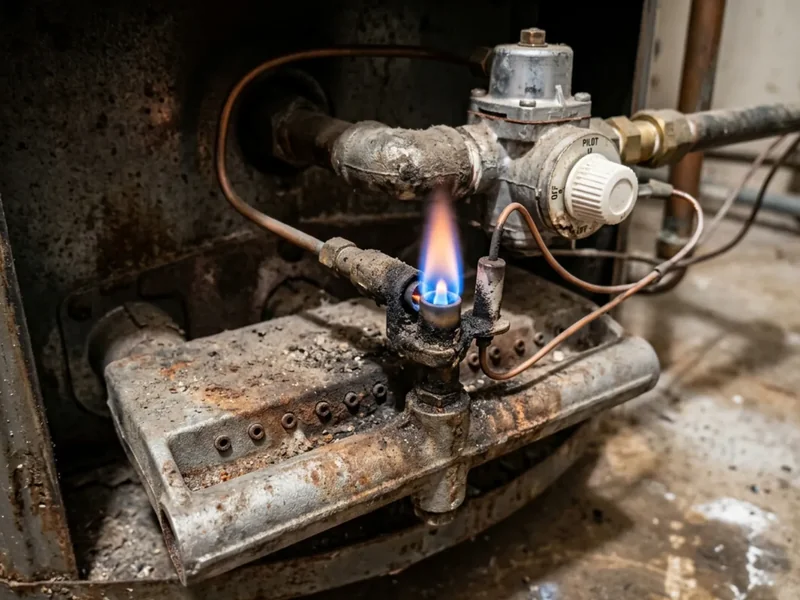
Moncks Corner wears two faces: the Berkeley County seat with its historic downtown and older homes near the Santee Canal, and the fast-growing town absorbing subdivisions like Foxbank and Carnes Crossroads along Highway 17-A. In the 29461 ZIP, that means two generations of gas water heaters — older units in town homes with decades of Lowcountry wear, and newer subdivision units whose valves are failing early from humidity and sediment rather than age. The gas control valve does the same job in both: metering fuel to the burner, proving the pilot flame, and shutting everything down on failure. Our technicians serve Moncks Corner across that whole span, diagnosing the true failure — valve, thermocouple, regulator, or supply — before recommending parts, then replacing confirmed-failed valves with fuel-matched components and complete verification.
Old Town and New Growth: Two Failure Patterns
In-town Moncks Corner — the neighborhoods around Main Street, the older streets near the Berkeley County Courthouse — holds heaters with real age on them: 15-to-25-year-old natural gas units in garages, carports, and crawlspaces, with valves failing on the classic schedule of thermostat drift, pilot instability, and final failure. These systems often carry companion wear: original gas shutoffs that no longer pass full pressure, sediment traps full of pipe scale, flues with years of accumulation. Our in-town calls routinely become fuel-path restorations, not just valve swaps, because the valve is one aging component among several.
The growth corridors tell a different story. Subdivisions built from the 2000s onward — Foxbank, Carnes Crossroads, the developments along 17-A — have heaters barely 10 to 15 years old whose valves are failing early. The culprits are environmental rather than age: Lowcountry humidity corroding pilot assemblies in garage air, sediment from never-flushed tanks overheating thermostats, and in some cases, installation shortcuts from the boom years — marginal venting, tight utility closets with poor combustion air. Early failure on a young heater is frustrating, but the fix is the same: diagnose precisely, replace the valve, and correct the environmental cause so the new valve reaches full life.
Santee Cooper's presence as the region's electric utility is worth noting for fuel context: many Moncks Corner homes are all-electric, so when we get a gas valve call here, confirming fuel type and system history matters — some heaters were converted, some properties mix fuels. We verify from the data plate every time, because the valve must match the actual fuel, not the assumed one.
Diagnosis: Separating Valve Failure From Everything That Mimics It
Our diagnostic sequence is identical for a 25-year-old town heater and a 10-year-old subdivision unit: your description of the failure timeline, thermocouple or flame-proving millivolt output, inlet and manifold gas pressure under load, pilot assembly and burner inspection, flue draft verification. What differs is what we expect to find. In-town, the suspects skew toward cumulative wear — weak thermocouples, corroded pilot orifices, tired shutoffs. In the subdivisions, toward environmental causes — fouled pilots, sediment-driven overheating, combustion-air restrictions in tight closets.
The tests that matter most are the pressure readings. Manifold pressure wrong with inlet pressure correct points at the valve; inlet pressure sagging under load points upstream — at the shutoff, the regulator (on propane), or the utility supply. A strong thermocouple signal paired with a pilot that still will not hold proves the valve's internal safety magnet has failed; a weak signal points at the thermocouple itself. These are measurements, not opinions, and we show them to you before recommending anything.
This matters especially in Moncks Corner because the wrong diagnosis wastes money in both directions: a valve installed on a heater with a supply problem leaves you with the same symptoms and a lighter wallet, while a full heater replacement recommended for a simple thermocouple failure is overkill by an order of magnitude. Our technicians are paid to diagnose, not to sell parts — and it shows in the recommendations.
Safe Replacement Across Both Generations
The replacement procedure holds constant regardless of the heater's age: gas off at the service valve, pilot verified out, tank drained below the valve port, gas union / pilot tube / thermocouple lead disconnected, burner assembly drawn out, old valve unthreaded with port threads cleaned and inspected. On older in-town tanks we work threads with extra patience; on newer subdivision tanks the ports usually cooperate. The new valve matches fuel type, BTU rating, and model dimensions exactly, sealed with gas-rated compound and torqued to specification.
Where the generations differ is in the companion work. In-town jobs often include replacing a failing original shutoff or clearing a packed sediment trap — we price these transparently as part of the quote, because a new valve downstream of failing infrastructure is incomplete work. Subdivision jobs more often include correcting environmental issues: improving combustion air to a starved closet, noting the sediment load that drove the early failure, advising on the annual flushing the builder never mentioned.
Verification is identical and uncompromising: every disturbed joint leak-tested with solution and a combustible-gas detector, manifold pressure set to data-plate spec and confirmed under firing, burner cycled for clean blue combustion and correct thermostat operation, flue draft checked, temperature-pressure relief valve tested, thermostat set to 120 degrees. Hot water restored the same visit, with documentation of the diagnosis, parts, and test results — and, for subdivision owners, the maintenance briefing that prevents the next premature failure.
Storm Season and the Canal Town's Water Reality
Moncks Corner's relationship with water is older than the town — the Old Santee Canal, the Cooper River, Lake Moultrie just north — and low areas flood in tropical systems. The gas safety rule for flooding is absolute: any control valve that has been submerged must be replaced, never dried and reused. Floodwater destroys the valve's internal safety shutoff invisibly, and a valve that seems to work afterward can fail to shut off gas weeks later. If water has ever reached your heater's burner compartment, tell us before diagnosis; we treat the valve as compromised and assess burner, flue, and tank together.
Know your heater's gas shutoff location before hurricane season, and verify the shutoff actually turns — older in-town shutoffs seize, and discovering that during storm preparation helps no one. Keep a carbon monoxide detector on each level, tested monthly; a failing valve can elevate CO through incomplete combustion, and the detector is the only warning. Keep the area around the heater clear of stored paints, fuels, and chemicals — a particular temptation in carport and garage installations.
For subdivision owners, add one more habit: annual tank flushing. The early valve failures we see in the growth corridors are overwhelmingly sediment-driven — young tanks with thick scale blankets overheating their valves' thermostats. A yearly flush is the cheapest life extension a water heater gets, and it is the single habit that would have prevented most of the premature failures we replace in the newer neighborhoods.
Local Insight
Moncks Corner's 29461 is the county seat growing into a suburb — historic downtown around the courthouse and the Old Santee Canal Park, older neighborhoods with deep roots, and the explosive growth along Highway 17-A where Foxbank, Carnes Crossroads, and successive subdivisions have added thousands of homes since 2000. That two-generation housing stock is the defining fact for gas valve service: in-town heaters aging out on the classic 15-to-25-year schedule with companion infrastructure wear, and subdivision heaters failing early at 10-15 years from humidity, sediment, and boom-era installation shortcuts.
Natural gas from Dominion Energy serves the town and most subdivisions, keeping fuel matching straightforward, though the area's Santee Cooper electric heritage means all-electric homes are common and fuel verification stays mandatory. The local wear pattern splits cleanly: in-town, cumulative age across the whole fuel path — shutoffs, traps, valves, burners wearing together; in the growth corridors, environmental premature failure — sediment-choked young tanks cooking their valves' thermostats, tight closets starving burners of air. Our Moncks Corner service runs both diagnostics fluently: full fuel-path assessment for the older systems, environment-correcting replacement for the newer ones, and verification to the same standard across both.