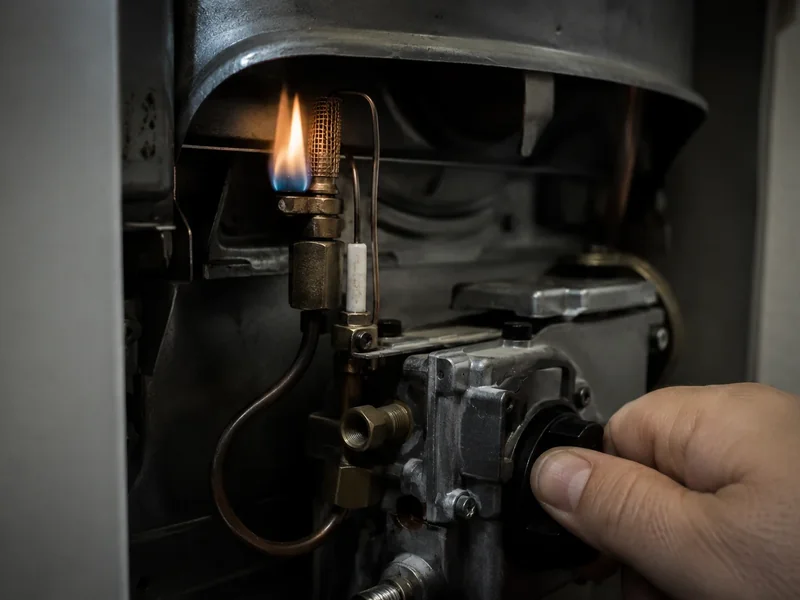
West Ashley's 29407 ZIP is the peninsula's mid-century counterpart: brick ranch homes from the 1950s through the 1980s spread across neighborhoods like Byrnes Downs, South Windermere, Avondale, and the streets off Savannah Highway and Ashley River Road. These are solid houses with mature oaks — and with original-era or second-generation gas water heaters sitting in garages, laundry rooms, and crawlspaces. After 40 to 70 years of Lowcountry humidity, the gas control valves on these units are prime candidates for failure: the thermostat drifts, the pilot safety weakens, and eventually the burner will not fire at all. Because Dominion Energy natural gas mains run throughout West Ashley, most of these heaters burn natural gas, which simplifies parts matching but never simplifies safety. Our technicians replace gas control valves across 29407 with full diagnosis first, fuel-matched parts, and rigorous leak testing on every connection.
Why Mid-Century West Ashley Heaters Lose Their Valves
The ranch homes of 29407 were built in an era when gas water heaters were installed as lifetime appliances — and many of them nearly were. A heater installed in 1985 or 1995 has a control valve that has cycled its thermostat tens of thousands of times, held its pilot magnet engaged for decades, and breathed humid Lowcountry air through every one of those years. The failure pattern in West Ashley is remarkably consistent: first the water temperature gets temperamental, then the pilot starts dropping out on humid nights, then one morning there is no hot water at all and the pilot will not stay lit no matter how carefully you follow the relight instructions.
Garage installations, common in these ranch floor plans, create a specific wear pattern. Garages breathe outdoor air freely, which means the valve and burner assembly experience every humidity swing and temperature cycle the Lowcountry produces. In summer, condensation forms on the cool valve body; in winter cold snaps, the pilot works harder and the thermocouple ages faster. Crawlspace installations fare worse — the enclosed dampness under a 1960s ranch is essentially a corrosion chamber, and we regularly find burner assemblies in West Ashley crawlspaces rusted to the point where the valve replacement must include burner attention too.
Sediment compounds everything. West Ashley's municipal water is only moderately hard, but over 15 or 20 years without flushing, even moderate hardness builds a thick insulating blanket over the burner zone. The burner then runs longer and hotter to heat through that blanket, and the valve's thermostat probe — sitting right in the overheated zone — cooks. We see valves in 29407 that failed years early purely because the tank beneath them was never flushed. When we replace your valve, we will tell you honestly what the tank's sediment situation looks like, because a new valve on a tank choked with scale is a short-lived repair.
The Diagnostic Visit: Finding the Real Failure
We treat every "bad valve" call in West Ashley as a diagnosis first, because the valve is the priciest of the common culprits and the others are frequent. The visit starts with the pilot story: when did it start dropping out, does it fail more on damp days, will it hold at all now? Then we measure. Thermocouple or thermopile output in millivolts tells us whether the flame-proving circuit is healthy. Manifold pressure readings tell us whether the valve is delivering gas correctly when it does fire. A visual inspection of the pilot assembly, burner, and flue completes the picture — corrosion, soot, and blockage each leave signatures.
What we often find in 29407: thermocouples at end of life (a cheap fix), pilot orifices partially clogged with corrosion (a cleaning fix), or flues with years of accumulated debris restricting draft (a maintenance fix). Any of these can perfectly mimic a failed valve. We also check the gas shutoff valve upstream — original 1960s-era shutoffs sometimes no longer pass full pressure, starving the burner in a way that looks exactly like valve failure. Only when the tests point past all of these to the valve itself do we recommend replacement, and we explain the readings in plain terms.
This discipline matters because a misdiagnosed valve replacement wastes your money twice: once on the unnecessary part, and again when the real problem persists. Our technicians would rather sell you a thermocouple and earn your next call than sell you a valve you did not need. That approach has built our reputation across West Ashley one honest diagnosis at a time.
Safe Replacement, Start to Finish
Once diagnosis confirms the valve, replacement follows a strict sequence. Gas off at the heater's service valve, pilot confirmed out. The tank drains below the valve port — the valve threads into the tank wall, so the water level must clear it. We disconnect the gas union, pilot tube, and thermocouple lead, draw the burner assembly out, and unthread the old valve, cleaning and inspecting the tank port threads. On older West Ashley tanks we work these threads gently; a damaged port on an aging tank can turn a valve job into a heater replacement, and patience here is professionalism.
The new valve is matched to your unit's fuel — natural gas for the vast majority of 29407 — plus its BTU input rating and model-specific thread and shank dimensions. We seal with thread compound rated for gas service and torque to specification. The burner assembly is reseated with the pilot positioned to fully engulf the thermocouple tip, because a misaligned pilot will plague you with dropouts no new valve can fix.
Then verification, which is non-negotiable: every disturbed joint leak-tested with detection solution and a combustible-gas detector, manifold pressure set and confirmed against the data plate, pilot lit and observed, burner fired through full cycles to verify clean blue combustion and correct thermostat cut-in and cut-out. We check flue draft, test the temperature-pressure relief valve, and set the thermostat to 120 degrees. Before leaving, we walk you through the work, the test results, and the simple maintenance — annual flushing, basically — that will give this valve its full lifespan.
Gas Safety Every West Ashley Homeowner Should Know
Natural gas is safe when its system is sound, and dangerous when it is not — there is no middle ground, which is why safety habits matter. Learn the smell: the mercaptan odorant smells like rotten eggs, and it is deliberately impossible to ignore. If you ever smell it near your water heater, do not try to find the leak, do not relight the pilot, and do not operate light switches or garage door openers. Leave the house and call 911 and Dominion Energy's gas emergency line from outside. Garage-installed heaters deserve extra respect here, because an attached garage shares air — and potentially migrating gas — with the living space above and beside it.
Keep a carbon monoxide detector on each level of the home and within earshot of sleeping areas, and test it monthly. A failing valve that delivers incorrect gas pressure can produce elevated carbon monoxide through incomplete combustion, and CO is colorless and odorless — the detector is your only warning. Replace detector batteries on a schedule you will actually keep, and replace the detector itself per its printed lifespan.
Finally, know the flood rule. West Ashley has low-lying streets that pond in tropical downpours, and some 29407 neighborhoods sit in mapped flood zones. Any gas control valve that has been submerged must be replaced — drying it out is not an option, because water destroys the internal safety shutoff invisibly. If storm water ever reaches your heater, call us before relighting. We will assess the valve, burner, and flue together, because flood damage is never limited to one component.
Local Insight
West Ashley's 29407 is Charleston's great mid-century suburb — the neighborhoods built as the peninsula filled up: Byrnes Downs and South Windermere with their 1950s brick ranches under live oaks, Avondale's bungalow streets, the subdivisions stretching out Savannah Highway toward the Stono River. These homes were built from the 1950s through the 1980s, overwhelmingly on slabs or low crawlspaces, and their mechanical systems have aged together as a cohort. That is why gas valve failures arrive in waves here: whole streets of heaters installed in the same decade are wearing out their valves in the same years.
Natural gas infrastructure is mature throughout 29407 — Dominion Energy mains serve nearly every neighborhood, so parts matching is straightforward and propane conversions are rare. The local wear factors are humidity and time: garage and crawlspace installations breathing decades of Lowcountry air, tanks that in many cases have never been flushed, and original gas shutoffs upstream that are themselves aging out. When we work in West Ashley, we expect the cohort pattern and plan for it — diagnosing the full fuel path from the old shutoff to the burner tip, not just the valve in the middle. Homeowners here tend to stay for decades, which makes the honest-repair approach pay off: fix what's broken, maintain what's left, and replace only when the math says so.