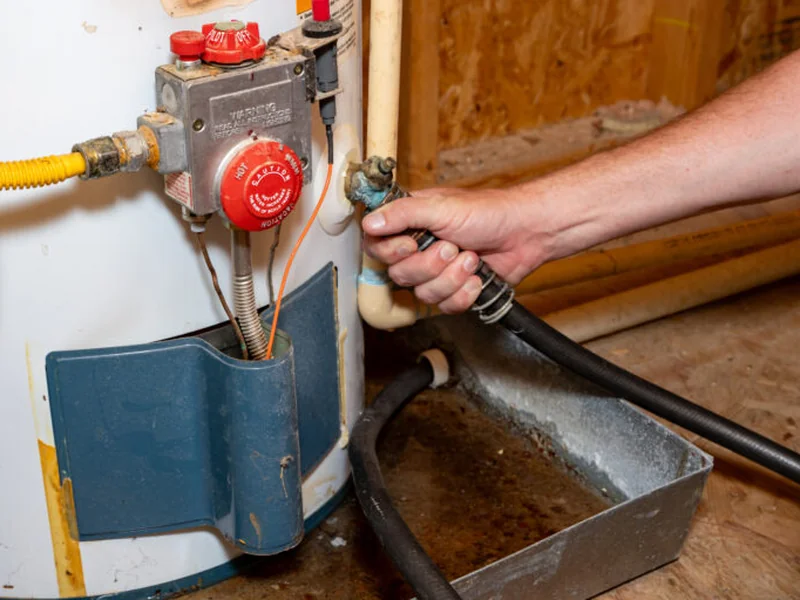
That little spigot at the base of your water heater — the drain valve — does more work than any other fitting on the tank, and in Summerville, SC 29483, it fails more often than most homeowners expect. It drips. It seizes. It clogs with sediment until the annual flush becomes impossible. When any of that happens to the heater in a crawlspace, garage, or closet, the fix is a drain valve replacement: a focused, affordable service that restores full flushing ability and stops the weep for good.
We replace failed plastic and corroded brass drain valves with full-port brass ball valves — the kind that actually open when you need them and seal tight when you don't. Most replacements in Summerville take under two hours, and your heater never has to leave a crawlspace, garage, or closet.
This page explains how to tell your drain valve is failing, exactly what our replacement involves, why Lowcountry water is so hard on these valves, and what a proper valve means for the remaining life of your heater.
Signs Your Drain Valve Is Failing in Summerville
Visible corrosion tells the story before the leak starts. Green-white crust on a brass valve, rust streaks running down from the valve body, or a plastic valve that's gone brittle and discolored from heat — all of it means the valve's remaining life is measured in months. In salt-air zones, we've seen exterior corrosion eat through valve handles while the tank itself was still sound.
Sediment-clogged valves announce themselves during a flush attempt: you open the valve and get a trickle, or nothing at all, while the tank clearly holds forty-plus gallons. That clog is the sediment bed — sand, mineral scale, and rust particles — packed against the valve opening. A clogged valve doesn't just prevent flushing; it traps the sediment that's actively shortening your tank's life.
Rumbling, popping, or banging from the tank during heating cycles is the drain valve's indirect distress signal. Those sounds are steam bubbles fighting through a thick sediment blanket at the tank bottom — the same sediment that's clogging your valve. When homeowners in the Lowcountry describe their heater as 'making noise,' the drain valve is almost always part of the problem and part of the solution.
Water pooling at the base of the heater with no obvious source deserves a close look at the drain valve first. Slow valve weeps run down the tank's curve and collect at the bottom, mimicking a tank rupture. We've saved many Summerville homeowners from an unnecessary full replacement by tracing a 'tank leak' back to a five-dollar valve failure — diagnosis before dollars, every time.
In Summerville, pine pollen and fine sediment are infamous here, and the historic homes add legacy plumbing to the mix. — which is exactly why drain valves here fail the way they do. Sandy water grinds seals, mineral-heavy water scale-welds gates, and iron-rich water packs valves into concrete. When we diagnose your valve, we're reading those local signatures, not just looking at the drip.
How We Replace a Water Heater Drain Valve
Every replacement starts with a safe shutdown: the cold-water inlet closed, the fuel source off — gas control to PILOT/OFF or the electric breaker switched off — and the tank allowed to cool if it's been actively heating. Working on a pressurized, scalding-hot tank is how injuries happen; the fifteen minutes of patience here is non-negotiable, and it's built into every job we do.
With the tank safe, we drain it through the old valve if it still flows, or through the T&P relief valve line with a pump if the drain valve is fully clogged. Draining matters because the new valve threads into the tank at its lowest point — you can't cleanly swap a valve under forty gallons of water. We run the drain to a floor drain, utility sink, or outside, protecting floors along the way.
Removing the old valve is the surgical part. Plastic valves get carefully backed out; corroded brass valves may need controlled heat and the right wrench technique to break the thread seal without twisting the tank's welded spud. This is where DIY attempts go wrong — too much torque on a corroded valve can crack the tank fitting and total the heater. Our technicians have done this hundreds of times and know exactly how much persuasion a fitting can take.
The new valve is a full-port brass ball valve — not another plastic spigot, not a gate valve. Full-port means the opening is the full diameter of the pipe: sediment actually exits during a flush instead of packing against a restriction, and the quarter-turn ball mechanism seals positively every time. We wrap the threads with high-temperature sealant, torque to spec, and orient the handle for easy access.
Summerville installations keep us adaptable: a layered stock: 1800s Victorians and bungalows downtown, 1960s–80s subdivisions beyond. Heaters live in crawlspaces, garages, and closets. We carry the hose routing, lighting, and compact tooling for a crawlspace, garage, or closet jobs, and we protect floors and finishes along the whole drain path — because a service that fixes a valve but stains a carpet isn't a service done right.
Why Lowcountry Water Destroys Drain Valves in Summerville
Heat cycling fatigues cheap materials. The drain valve sits at the hottest, most sediment-buried point of the tank, cycling through expansion and contraction thousands of times a year. Factory plastic valves go brittle under that thermal punishment — we've removed plastic valves in the Lowcountry that crumbled like chalk. Brass handles the cycling; plastic merely endures it for a while.
Exterior corrosion finishes what interior wear starts, especially near the coast. Salt air attacks brass fittings and steel valve bodies from the outside, while constant garage and crawlspace humidity keeps everything damp. A valve can look intact and still have paper-thin walls — which is why we pressure-check and visually inspect rather than trusting appearances.
Neglect multiplies every factor above. The drain valve is the one component that needs periodic operation to survive — opening it yearly clears sediment before it packs solid. But industry-wide, maybe one heater in twenty gets flushed on schedule. In Summerville, where the sediment load runs high, a never-flushed valve is essentially a countdown timer, and its failure usually announces the tank's own decline.
Water chemistry varies street by street here, which is why replacement is only half the service. When we install your new valve, we assess what your water is actually doing to the tank — sediment depth, scale severity, anode condition — and give you a flushing schedule matched to it. A valve replacement without that context is just a part swap; with it, it's a life-extension plan.
The local water report for Summerville 29483: Pine pollen and fine sediment are infamous here, and the historic homes add legacy plumbing to the mix. Every valve we install here is chosen, and every flushing schedule we set is calibrated, against that reality — not against a generic national average.
What a New Full-Port Drain Valve Does for Your Heater
Future service gets cheaper and simpler. A working full-port valve means the next flush is a DIY-friendly ten-minute job instead of a service call, and it means we — or you — can actually drain the tank if a bigger repair ever comes up. The valve is infrastructure: unglamorous, and the thing everything else depends on when it matters.
It pairs naturally with an anode rod check. While the tank is drained for the valve swap, inspecting the anode rod — the sacrificial component that actually prevents tank rust — takes minutes and can reveal whether the tank deserves more investment. If the rod is gone and the tank is twelve years old, we'll tell you straight that the valve is a bridge to a planned replacement, not a resurrection.
The math favors the valve on any tank with real life left. A drain valve replacement costs a fraction of a new heater and, combined with annual flushing, routinely adds years to a mid-life tank. On a tank that's already rusting through at the base, we'll say so honestly and quote the replacement instead — we'd rather lose a valve job than sell you false hope.
The immediate win is a working flush. With a full-port ball valve, a proper tank flush takes minutes and actually moves sediment — you'll see the water run cloudy, then sandy, then clear. That single maintenance act, done yearly, removes the insulating sediment blanket that forces burners and elements to overwork. Less overwork means less steel fatigue, which means more years before the tank itself fails.
For a Summerville heater sitting in a crawlspace, garage, or closet, a working drain valve changes the maintenance math completely. The flush goes from an impossible service call to ten minutes with a garden hose — and in 29483's water conditions, that difference is what decides whether your tank reaches its full lifespan or dies of sediment at year nine.
Local Insight
Summerville's famous pine pollen contributes a fine organic sediment you don't see in other ZIPs — it combines with mineral scale into a particularly stubborn sludge at the tank bottom. Flowertown's historic homes add the access challenge: tight crawlspaces where flushing is awkward and valves get ignored for decades. For 29483, the valve replacement often includes repositioning or extending the drain setup so future flushes are actually feasible — a valve you can't reach might as well be a seized one.
A final practical note for this area: never force a stuck valve. Every year we get calls where a homeowner snapped a plastic valve body trying to flush before guests arrived, converting a $200-range service into an emergency. If the valve won't turn with moderate hand pressure, stop — that's the valve telling you it needs replacement, not persuasion.