If your water heater's drain valve drips constantly, won't budge when you try to flush the tank, or crumbles at the touch, you're looking at one of the most common — and most fixable — water heater failures in North Charleston, SC 29420. Modest mid-century homes and rentals, with heaters often original to 1970s–80s builds, sitting in utility rooms and carports. Across all of them, the story is the same: factory plastic valves and aging brass gate valves give up long before the tank does.
A drain valve replacement swaps that failed valve for a full-port brass ball valve built to handle Lowcountry water. The service includes draining the tank, removing the old valve without damaging the tank threads, installing and sealing the new valve, refilling the system, and test-flushing to prove it works.
Below: the failure signs to watch for, our step-by-step replacement process, why North Charleston's water eats drain valves, and how the new valve extends your heater's service life.
Signs Your Drain Valve Is Failing in North Charleston
The classic symptom is the slow, endless drip from the valve spout — a few drops an hour that never quite stop, no matter how firmly you close it. That drip means the valve's internal seal has failed, usually from sediment grinding against it or mineral scale preventing a full close. It's also quietly wasting hot water around the clock, which shows up on the energy bill long before most homeowners connect the two.
A valve that won't open is just as failed as one that won't close. Factory plastic drain valves seize when sediment packs around the stem, and older brass gate valves freeze when mineral scale welds the gate in place. If your valve hasn't been opened in five-plus years — the norm, not the exception — assume it's seized until proven otherwise. Forcing it is how plastic valve bodies snap off at the tank threads, turning a service call into an emergency.
Visible corrosion tells the story before the leak starts. Green-white crust on a brass valve, rust streaks running down from the valve body, or a plastic valve that's gone brittle and discolored from heat — all of it means the valve's remaining life is measured in months. In salt-air zones, we've seen exterior corrosion eat through valve handles while the tank itself was still sound.
Sediment-clogged valves announce themselves during a flush attempt: you open the valve and get a trickle, or nothing at all, while the tank clearly holds forty-plus gallons. That clog is the sediment bed — sand, mineral scale, and rust particles — packed against the valve opening. A clogged valve doesn't just prevent flushing; it traps the sediment that's actively shortening your tank's life.
In North Charleston, aging infrastructure is the theme: many heaters are past expected service life with heavy sediment from decades without a single flush. — which is exactly why drain valves here fail the way they do. Sandy water grinds seals, mineral-heavy water scale-welds gates, and iron-rich water packs valves into concrete. When we diagnose your valve, we're reading those local signatures, not just looking at the drip.
How We Replace a Water Heater Drain Valve
Every replacement starts with a safe shutdown: the cold-water inlet closed, the fuel source off — gas control to PILOT/OFF or the electric breaker switched off — and the tank allowed to cool if it's been actively heating. Working on a pressurized, scalding-hot tank is how injuries happen; the fifteen minutes of patience here is non-negotiable, and it's built into every job we do.
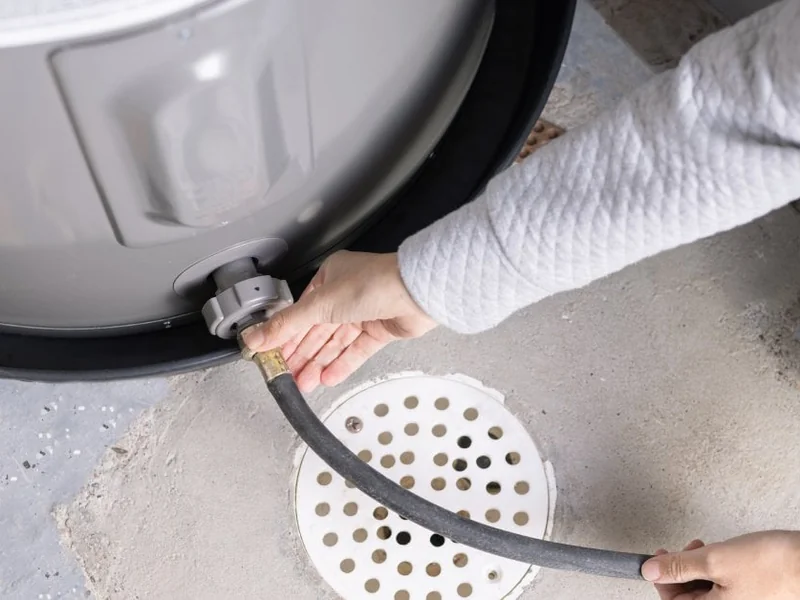
With the tank safe, we drain it through the old valve if it still flows, or through the T&P relief valve line with a pump if the drain valve is fully clogged. Draining matters because the new valve threads into the tank at its lowest point — you can't cleanly swap a valve under forty gallons of water. We run the drain to a floor drain, utility sink, or outside, protecting floors along the way.
Removing the old valve is the surgical part. Plastic valves get carefully backed out; corroded brass valves may need controlled heat and the right wrench technique to break the thread seal without twisting the tank's welded spud. This is where DIY attempts go wrong — too much torque on a corroded valve can crack the tank fitting and total the heater. Our technicians have done this hundreds of times and know exactly how much persuasion a fitting can take.
The new valve is a full-port brass ball valve — not another plastic spigot, not a gate valve. Full-port means the opening is the full diameter of the pipe: sediment actually exits during a flush instead of packing against a restriction, and the quarter-turn ball mechanism seals positively every time. We wrap the threads with high-temperature sealant, torque to spec, and orient the handle for easy access.
North Charleston installations keep us adaptable: modest mid-century homes and rentals, with heaters often original to 1970s–80s builds, sitting in utility rooms and carports. We carry the hose routing, lighting, and compact tooling for a utility room or carport jobs, and we protect floors and finishes along the whole drain path — because a service that fixes a valve but stains a carpet isn't a service done right.
Why Lowcountry Water Destroys Drain Valves in North Charleston
Neglect multiplies every factor above. The drain valve is the one component that needs periodic operation to survive — opening it yearly clears sediment before it packs solid. But industry-wide, maybe one heater in twenty gets flushed on schedule. In North Charleston, where the sediment load runs high, a never-flushed valve is essentially a countdown timer, and its failure usually announces the tank's own decline.
Water chemistry varies street by street here, which is why replacement is only half the service. When we install your new valve, we assess what your water is actually doing to the tank — sediment depth, scale severity, anode condition — and give you a flushing schedule matched to it. A valve replacement without that context is just a part swap; with it, it's a life-extension plan.
Sediment is the primary killer. Lowcountry water — whether municipal or well — carries fine sand, mineral scale, and rust particles that settle into a permanent bed at the tank's lowest point, exactly where the drain valve lives. Every heating cycle stirs that bed against the valve's seal and stem. Plastic valves get ground down from the inside; brass valves get packed until they can't move. It's a slow abrasion that no valve design fully escapes, but full-port brass survives it years longer.
Mineral scale is the second attacker, and it's worse on well water. Dissolved calcium, magnesium, and iron precipitate out as water heats, coating the valve's internal passages with rock-hard deposits. Gate-style valves are especially vulnerable — scale welds the gate to its seat until the handle snaps before the valve moves. Ball valves resist this far better because the wiping action of the ball shears deposits with each quarter-turn.
The local water report for North Charleston 29420: Aging infrastructure is the theme: many heaters are past expected service life with heavy sediment from decades without a single flush. Every valve we install here is chosen, and every flushing schedule we set is calibrated, against that reality — not against a generic national average.
What a New Full-Port Drain Valve Does for Your Heater
The math favors the valve on any tank with real life left. A drain valve replacement costs a fraction of a new heater and, combined with annual flushing, routinely adds years to a mid-life tank. On a tank that's already rusting through at the base, we'll say so honestly and quote the replacement instead — we'd rather lose a valve job than sell you false hope.
The immediate win is a working flush. With a full-port ball valve, a proper tank flush takes minutes and actually moves sediment — you'll see the water run cloudy, then sandy, then clear. That single maintenance act, done yearly, removes the insulating sediment blanket that forces burners and elements to overwork. Less overwork means less steel fatigue, which means more years before the tank itself fails.
Energy efficiency recovers measurably. A sediment-buried tank can take significantly longer to heat the same water, because heat has to punch through inches of mineral insulation first. Homeowners routinely notice faster hot-water recovery after a proper flush through a new valve — the heater isn't working less hard by magic, it's finally heating water instead of heating rock.
Noise disappears. The rumbling and popping that keep Lowcountry homeowners up at night are steam bubbles exploding through sediment, and a functioning drain valve is the tool that removes the sediment causing them. Post-replacement, the first full flush is often dramatically loud with escaping grit — and then the tank goes quiet. That quiet is the sound of years being added back.
For a North Charleston heater sitting in a utility room or carport, a working drain valve changes the maintenance math completely. The flush goes from an impossible service call to ten minutes with a garden hose — and in 29420's water conditions, that difference is what decides whether your tank reaches its full lifespan or dies of sediment at year nine.
Local Insight
The 29420's aging heater fleet has the region's worst flush discipline — decades in some cases — which means drain valves here don't just fail, they fossilize. Replacing a valve on a tank that's never been flushed requires patience: the sediment bed can be deep enough to need extended flushing, and we assess honestly whether the tank underneath is worth the investment. Many are, surprisingly — steel tanks are tougher than their valves. But when the base is rusted through, we say so plainly. This ZIP gets our most candid assessments, because false hope is expensive here.
The broader Lowcountry lesson: drain valves are wear items here, not lifetime parts. Between sediment, minerals, heat cycling, and humidity, even good valves have a finite life — and the cheap factory plastic valves have a short one. Budget for a replacement every 5 to 8 years, flush annually, and the valve stops being a failure point and starts being what it was designed to be: a maintenance tool.