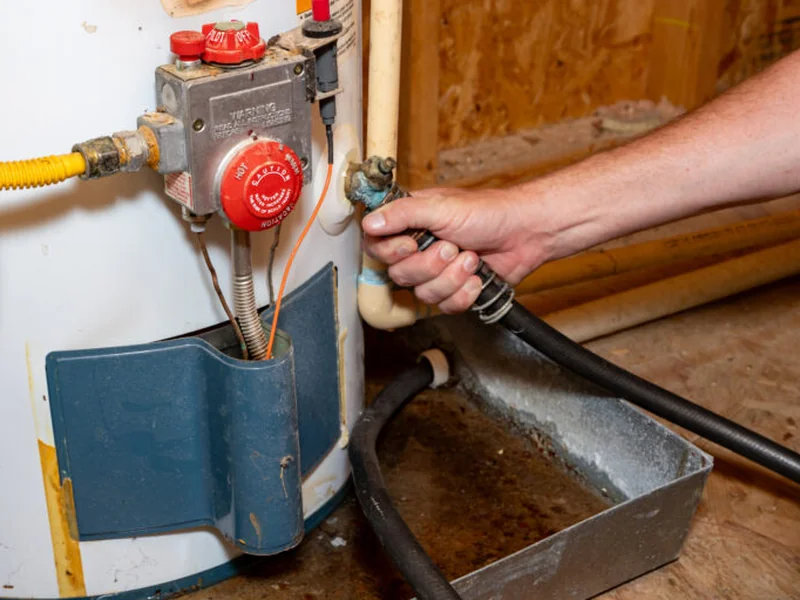
The drain valve is the small spigot at the base of your water heater — meant for flushing sediment and draining the tank, and almost always the cheapest plastic component the factory could install. In Hollywood, where farm-area wells carry iron, sand, and sediment, that plastic valve is outmatched from the day the tank goes in.
The rural failure pattern is consistent. Iron sediment and sand pack the valve's narrow passage until flushing produces a trickle. The plastic handle strips when forced against the clog. The valve body cracks with age and heat cycling in sheds and utility rooms, starting its slow drip onto the floor. Or mineral scale welds the valve shut entirely — and the tank can never be properly drained again.
We come out to Hollywood with full-port brass ball valves — the upgrade the factory should have installed. The straight-through brass opening flows sediment instead of trapping it, the metal body will not crack, and the lever works positively every time. Every replacement includes a full tank flush, because a new valve deserves a clean tank behind it.
How Hollywood Well Water Defeats Factory Drain Valves
The factory drain valve is a plastic boiler-drain style valve: small orifice, twist handle, minimal cost. On Hollywood well water, it fails in a predictable sequence — and each stage points to the same upgrade.
Clogging comes first, as iron sediment and sand pack the narrow passage until water barely trickles. Stripping follows when the plastic handle is forced against the clog. Cracking arrives with age and heat cycling in unconditioned sheds and utility rooms — the slow drip begins. Freezing is the final stage: mineral scale welds the valve shut, and the tank can never be properly drained again.
Why brass ball valves win on well water
A full-port brass ball valve replaces the narrow twist passage with a straight-through opening nearly the pipe's full diameter. Iron and sand that would pack a plastic valve flow straight through brass. The metal body does not crack, the lever does not strip, and quarter-turn operation is positive — fully open or fully closed. For Hollywood's iron-heavy farm wells, brass is not a luxury; it is the correct valve for the conditions.
- Iron sediment: packs plastic passages until they trickle or seal shut
- Sand and particulate: score plastic seats so valves never fully close
- Heat cycling: cracks aging plastic bodies in sheds and utility rooms
- Seasonal sediment surges: farm-area wells run heavier at certain times of year
The Replacement Process: Built for Rural Installations
Replacing a drain valve means draining the tank — the valve sits at the tank's lowest point, so there is no way around it. In a rural Hollywood installation, our process is built for the conditions: tight sheds, pump houses, and tanks that have never been flushed.
We shut off the energy — gas to pilot or power at the breaker — and close the cold-water inlet. Then we open the old valve and drain through a hose to a suitable discharge point, opening a hot tap in the house to break the vacuum. On Hollywood tanks with years of iron sediment, this is slow work: the old valve trickles, sediment slurries out in pulses, and we work the port as needed to keep things moving.
When the old valve will not cooperate
Completely clogged or frozen valves need persuasion at the port — we clear sediment from the opening so the tank can drain, and if the plastic body is too far gone, we remove it mid-drain with the water level managed. Once the tank is down, the old valve threads out, the port threads are cleaned and inspected, and the brass ball valve threads in with proper sealant. Then the tank refills, air purges from the lines, heat is restored — and we flush fully through the new valve to prove it flows.
After the Swap: Flushing Becomes a Five-Minute Job
A new brass valve changes the maintenance economics of a Hollywood water heater completely. With the factory plastic valve, flushing was a fight — will it open, will it close, will it drip afterward? Most Hollywood homeowners stopped trying years ago, which is how tanks accumulate the inches of iron sediment we find on service calls. With a full-port brass ball valve, flushing is a five-minute job: attach the hose, open the lever, watch the sediment run out, close the lever.
That ease matters enormously on well water, because flushing frequency determines tank life here. A tank flushed annually through a working brass valve sheds its iron sediment before it can insulate the tank bottom and accelerate corrosion. The same tank with a frozen plastic valve keeps every grain — and pays for it in efficiency and lifespan. Out here, where a replacement tank means rural delivery and real money, that difference is the whole ballgame.
What the first flush reveals
The flush with every valve replacement is often the tank's first real cleaning in years, and it is diagnostic. Clear water with moderate sediment says the tank has been coping. Thick rusty sludge says the bottom has been corroding — and on an older tank, that informs the honest conversation about remaining life. Either way, the new brass valve means every future flush actually happens.
Valve Problem or Tank Problem? The Honest Rural Diagnosis
Not every drip at the tank base is the drain valve — and on a rural Hollywood property, we verify before we replace. A drip can come from the temperature-pressure relief valve discharge, a weeping fitting above, or condensation in a damp shed — each needing a different fix than a valve swap. We trace every leak to its source during the inspection.
Replace the valve when: it drips from the valve body or spout, the handle is stripped or frozen, flow is restricted to a trickle, or the plastic shows cracks or heavy scale — and the tank itself is sound. On a healthy tank, the brass upgrade plus a full flush is the best value in water heater service.
Look deeper when: the tank shell shows base rust, flush water runs persistently rusty, or moisture appears at the tank seam. Those point to tank failure, not valve failure — and a new valve on a dying tank is money misspent, especially out here where the eventual replacement is already a logistics event. We will tell you which one you have, with the evidence in front of you, before any work begins.
Local Insight
Hollywood sits in western Charleston County — agricultural country, with row crops, timber tracts, and homes on private wells spread along Highway 162 and the back roads. That well water is the whole story for drain valves here: dissolved iron that precipitates into rusty sediment, fine sand from the area's sandy soils, and mineral particulate — all flowing into a factory plastic valve whose narrow twist passage is a sediment trap by design.
The rural installation pattern makes it worse. Hollywood water heaters live in sheds, pump houses, and low crawl spaces, and they go years without flushing — not from laziness, but because the valve clogged early and fighting it open was nobody's priority. By the time we arrive, the tank bottom holds inches of iron sediment and the valve is frozen, stripped, or dripping. The most common valve condition in the 29449 is not broken from age but defeated by sediment.
The farm setting adds a seasonal variable: agricultural activity means well sediment loads can run heavier at certain times of year — irrigation season, field work, heavy rains stirring the aquifer. A valve that trickles in spring may seal completely by fall. Distance turns any failure into a real problem: a cracked valve dripping on a rural Hollywood property is a long drive for service and parts, and a home without hot water until it is fixed. The scheduled brass upgrade, done before failure, is the economical move — and once it is in, the annual flush becomes a five-minute job.