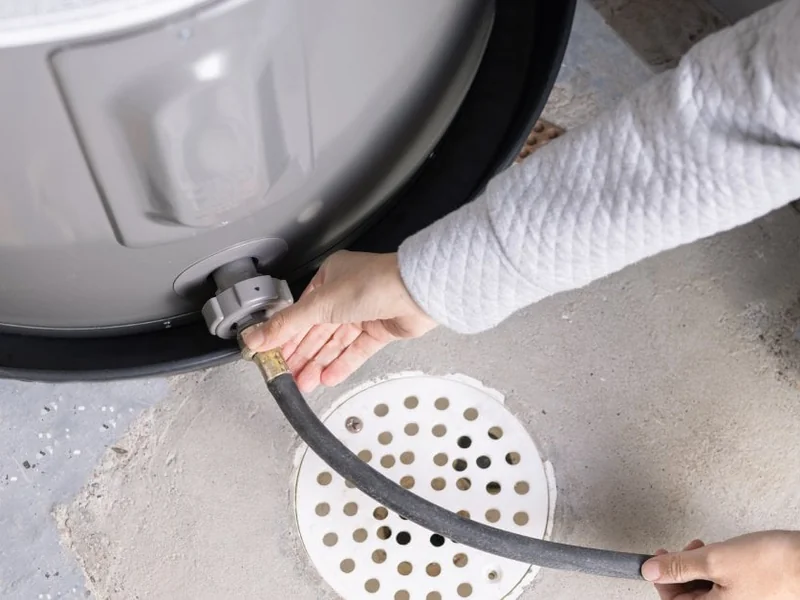
Daniel Island's water heaters are among the youngest in the Lowcountry — five to fifteen years old, many still inside their warranty periods, installed in finished garages and tidy utility closets. Their drain valves, however, are the same cheap plastic components installed on every tank everywhere: narrow passages, twist handles, and a design life that assumes someone will actually use them regularly.
Almost nobody does. The plastic valve sits untouched for years in a Daniel Island garage — and plastic valves that sit, seize. When the owner finally tries the annual flush the manual recommends, the handle will not turn, or it turns and the valve drips ever after, or it opens to a trickle and never quite closes. The maintenance the warranty assumed never happens, because the valve made it impossible.
We upgrade Daniel Island drain valves to full-port brass ball valves — proactively, on young tanks, before the plastic fails. The straight-through brass opening flows sediment freely, the lever operates positively for decades, and the annual flush becomes the five-minute job it was always supposed to be. Every upgrade includes a full tank flush and written documentation for your home records.
The Disuse Trap: Why Young Valves Fail When Finally Needed
On a young Daniel Island tank, the drain valve's enemy is not sediment — it is disuse. The factory plastic valve sits untouched for years in a finished garage. Plastic under constant heat and pressure, never operated, undergoes slow changes: the stem stiffens, seals take a set, mineral scale films the internal parts. When the owner finally attempts the annual flush, the valve protests — a handle that will not turn, a stem that turns without opening, a valve that opens and then drips forever.
This is the most frustrating failure mode in water heater service: a valve that fails not from wear but from never being used, at the exact moment someone tries to do the right thing. We see it constantly on Daniel Island's young tanks — the maintenance-minded owner, the seized valve, the abandoned flush.
The proactive brass answer
Upgrading to brass before the plastic fails changes the entire dynamic. A full-port brass ball valve does not seize from disuse — the quarter-turn ball mechanism operates positively whether it was last used yesterday or last year. The straight-through opening flows whatever sediment the young tank has accumulated. And the metal body shrugs off the island's marine air that embrittles plastic. Install brass at year five, and the valve is a non-issue for the tank's entire remaining life.
- Disuse seizure: plastic valves freeze when never operated
- Brittle aging: marine air embrittles plastic faster than inland
- Narrow passage: restricts flush flow even when the valve works
- Warranty logic: the flush the warranty assumes requires a working valve
The Upgrade Process: Clean, Quick, and Documented
A Daniel Island valve upgrade is a clean, quick procedure — young tanks, accessible installations, no decade of sediment to fight. Our process is built around protecting the finished spaces these tanks live in.
We shut off the energy and close the cold-water inlet, then lay drop cloths across the garage floor and work path. Draining runs through a hose to a suitable discharge point, with a hot tap opened elsewhere to break the vacuum. On a young 29492 tank, the drain-down is usually straightforward — moderate sediment, a valve that may still operate, no drama.
Swap, flush, document
The old plastic valve threads out, the port threads are cleaned and inspected, and the brass ball valve threads in with proper sealant. Then a full flush through the new full-port valve — clearing the young tank's accumulated sediment and proving the new valve flows strongly. The tank refills, air purges from the lines, heat is restored, and we leave written documentation: date, valve installed, flush performed, tank condition notes. The whole visit typically runs one to two hours, and the garage looks untouched when we leave.
After the Upgrade: The Five-Minute Annual Flush, Unlocked
The brass valve's real value on Daniel Island is what it enables: the annual flush, finally possible. With the factory plastic valve, flushing was a gamble that most owners lost once and never attempted again. With a full-port brass ball valve, it is a five-minute homeowner job: attach a garden hose, open the lever, let it run until clear, close the lever. We demonstrate the operation before we leave, so there is no mystery.
That five minutes, done yearly, is what keeps a young tank young. Sediment never accumulates into the insulating blanket that overheats the tank bottom. Heating efficiency stays at factory levels. The tank lives its full designed life — which, on Daniel Island's moderate municipal water, should be a long one. The brass valve does not just replace a part; it unlocks the maintenance schedule the tank was designed around.
A permanent improvement
Unlike the plastic valve it replaces, a brass ball valve does not have a replacement schedule — it lasts decades, and when the tank eventually ages out, the valve threads right into the replacement. It is a buy-once improvement, which suits the Daniel Island ownership style: quality installed once, documented, and then simply working, year after year.
Valve Upgrade or Deeper Issue? The Daniel Island Assessment
On Daniel Island's young tanks, the valve question is usually straightforward — but we still diagnose before we recommend, because the honest answer matters at every housing age.
Upgrade the valve when: the plastic valve is stiff, sticky, dripping, or simply has never been operated in years — or proactively, on any tank you plan to keep past year five. On a young, sound tank, the brass upgrade plus a flush is preventive maintenance at its best: inexpensive, permanent, and protective of both the tank and its warranty.
Look deeper when: the tank shows base rust, flush water runs persistently rusty, or fittings weep — unusual on a young tank, but worth investigating when present. These can occasionally trace to installation issues or defective components still inside warranty, and we document everything so the manufacturer sees a clear record.
The documented difference
Every Daniel Island valve service includes written notes for your home file. In a community where homes are significant investments and records matter, that documentation is part of the service — proof of maintenance for warranties, for future buyers, and for your own peace of mind.
Local Insight
Daniel Island is a master-planned island community of upscale homes built from the late 1990s onward — and its water heater fleet is correspondingly young. The 29492's tanks are mostly five to fifteen years old, installed in finished garages, designer utility rooms, and attic-adjacent closets. These are not the sediment-buried, valve-frozen relics we find in older suburbs; they are healthy young tanks with a single weak point: the factory plastic drain valve.
The island's maintenance culture is the opportunity here. Daniel Island homeowners maintain their homes meticulously — HVAC service agreements, landscaped grounds, detailed home files. The water heater's drain valve is the gap in that otherwise thorough maintenance, purely because it is invisible and unglamorous. A brass valve upgrade fits naturally into the Daniel Island ownership style: a small, permanent improvement, documented for the records, that makes all future maintenance actually happen.
The island setting adds a mild environmental note: the marine air, while gentler than the open-ocean exposure of the barrier islands, still accelerates the deterioration of plastic components over time. A plastic valve that might survive a decade inland gets brittle faster in a Daniel Island garage. Brass does not care about salt air. For a community that buys quality once rather than replacing cheap parts repeatedly, the brass upgrade is simply the right specification.