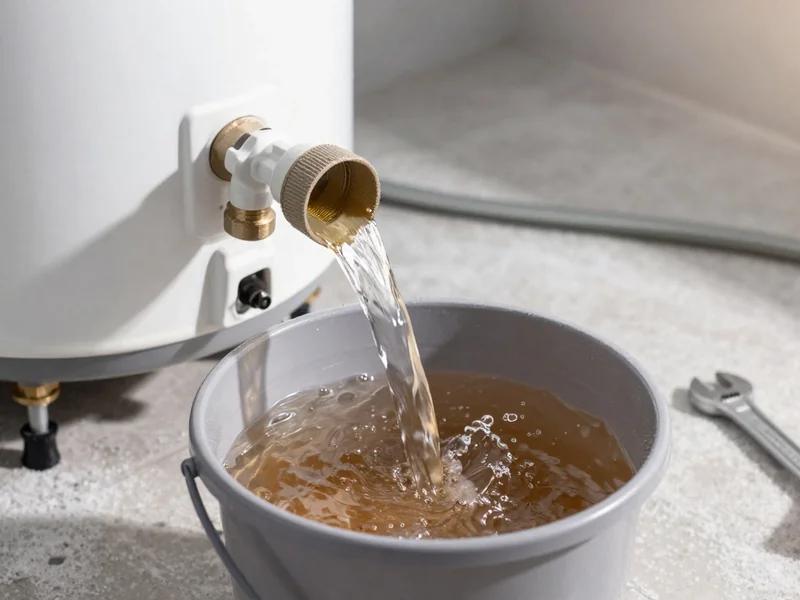
The drain valve is the small spigot at the base of your water heater — meant for flushing sediment and draining the tank, and almost always the cheapest plastic component the factory could install. In downtown Charleston, that plastic valve faces a two-front war: sediment and scale working from the inside, salt air corroding the handle, stem, and body from the outside.
The downtown failure pattern is distinctive. The handle corrodes frozen long before the passage clogs — salt air sees to that. The plastic body, heat-cycled in unconditioned historic utility spaces, eventually cracks and starts its slow drip. And in a historic building, that drip does not land on a concrete garage floor; it lands on heart pine, plaster, or the ceiling of the room below.
We replace drain valves across the peninsula with full-port brass ball valves — metal that resists the marine air, a straight-through opening that flows sediment freely, and a lever that works positively for years. Every replacement includes a full tank flush and careful water containment, because in a historic building, how the work is done matters as much as the work itself.
Salt Air vs. Drain Valves: Downtown's Outside-In Failure
Downtown drain valves fail differently than suburban ones, and the difference is the salt air. On the mainland, the story is interior: sediment packs the narrow plastic passage until the valve trickles or seals. On the peninsula, the exterior often fails first — the handle corrodes to the stem, the stem corrodes to the body, and the valve becomes a single fused lump of plastic and mineral crust that no amount of force will operate safely.
The failure sequence we see across the 29401: seizing of the handle by salt-air corrosion, often within five years. Cracking of the heat-cycled plastic body, starting the characteristic slow drip. Clogging of the passage by sediment in tanks that could never be flushed through the seized valve — a vicious circle, since the frozen valve prevents the flushing that would have kept it clear. And in flood-prone installations, compromise of seals and threads by submersion.
Why brass wins downtown
A full-port brass ball valve answers both fronts. The straight-through opening flows sediment instead of trapping it, breaking the clog cycle. The metal body and stem resist salt-air corrosion that destroys plastic — brass develops a patina, not a failure. And the quarter-turn lever operates positively for years, even in marine air. For the peninsula's conditions, brass is not an upgrade; it is the correct material.
- Salt air: fuses plastic handles and stems, often before interior clogging
- Heat cycling: cracks aging plastic bodies in unconditioned historic spaces
- Seized valves: prevent flushing, accelerating the sediment buildup that kills tanks
- Flood exposure: compromises seals and threads in low-lying installations
The Replacement Process: Containment First in Historic Spaces
Replacing a drain valve means draining the tank — and in a historic building, every gallon must be accounted for. Our downtown process is built around containment.
We shut off the energy and close the cold-water inlet, then lay protection across every finished surface in the work path. Draining runs through a hose to a suitable discharge point — planned in advance, because historic closets rarely offer convenient options — with a hot tap opened elsewhere to break the vacuum. On peninsula tanks with long-seized valves, this step reveals the valve's condition: a working valve flows, a corroded one resists, a fused one does nothing until we work the port.
Working with seized downtown valves
Fused valves need careful handling. We clear the port, manage the water level, and remove the failed valve without disturbing the tank's other fittings — critical in old installations where every fitting is original and every thread is precious. The port threads are cleaned and inspected, the brass ball valve threads in with proper sealant, and then the tank refills, air purges, and heat is restored. We flush fully through the new valve to prove it flows — often the tank's first real flush in years.
After the Swap: Breaking the Seized-Valve Cycle
A new brass valve breaks the vicious circle that kills downtown tanks. With the factory plastic valve seized by salt air, flushing was impossible — so sediment accumulated, efficiency dropped, and bottom corrosion accelerated, all while the valve sat frozen. With a full-port brass ball valve, flushing becomes a five-minute job: attach the hose, open the lever, watch the sediment run out, close the lever.
That restored ability to flush is the real longevity win. Annual flushing through a working valve sheds sediment before it can insulate the tank bottom and accelerate corrosion. The tank that could never be maintained can now be maintained — and in a historic building where tank replacement means navigating 200-year-old architecture, every extra year of tank life is genuinely valuable.
What the first flush reveals
The flush with every downtown replacement is often the tank's first in many years, and it is diagnostic. Clear water with moderate sediment says the tank has been coping. Thick sludge says the bottom has been buried — and on an older peninsula tank, that informs the honest conversation about remaining life. Either way, the new brass valve means maintenance is possible from now on, which changes the tank's trajectory.
Valve Problem or Tank Problem? The Careful Downtown Diagnosis
Not every drip at the tank base is the drain valve — and downtown, we verify with particular care, because the buildings punish wrong guesses. A drip can come from the temperature-pressure relief valve discharge, a weeping fitting above, condensation in a damp historic space, or a flood-compromised seal — each needing a different fix than a valve swap. We trace every leak to its source during the inspection.
Replace the valve when: it drips from the valve body or spout, the handle is corroded frozen or stripped, flow is restricted to a trickle, or the plastic shows cracks or heavy mineral crust. These are valve failures, and the brass ball valve upgrade resolves every one permanently.
Look deeper when: the tank shell shows base rust, flush water runs persistently rusty, or moisture appears at the tank seam. Those point to tank failure — and a new valve on a dying tank is money misspent, especially in a building where the eventual replacement is already a project. We will tell you which one you have, with the evidence in front of you, before any work begins.
Local Insight
The 29401 is Charleston's historic peninsula — three centuries of building stock between two rivers and the harbor, where salt air is a permanent condition. That marine air is the defining factor for drain valves here. While mainland valves mostly die from interior sediment clogging, downtown valves frequently die from the outside in: the handle and stem corrode frozen, the plastic body chalks and cracks, and mineral crust blooms across every fitting. We see five-year-old peninsula valves with the exterior deterioration of a fifteen-year-old suburban one.
The buildings multiply the consequences. Water heaters in the 29401 live in historic closets, under-stair compartments, carriage houses, and low crawl spaces — spaces with finished floors, plaster walls, and occupied rooms below. A dripping valve here is not a garage-floor nuisance; it is a slow-motion threat to historic fabric. And flood history adds another dimension: low-lying installations that have taken water may have compromised valves and fittings that look intact but seal poorly.
Access is the third downtown factor. Tight historic spaces leave little room for drain hoses, buckets, and maneuvering — the replacement has to be planned, not improvised. We scope the drainage path before we start, protect every finished surface in the work area, and contain every gallon. On the peninsula, a drain valve replacement is as much about the building as the plumbing.