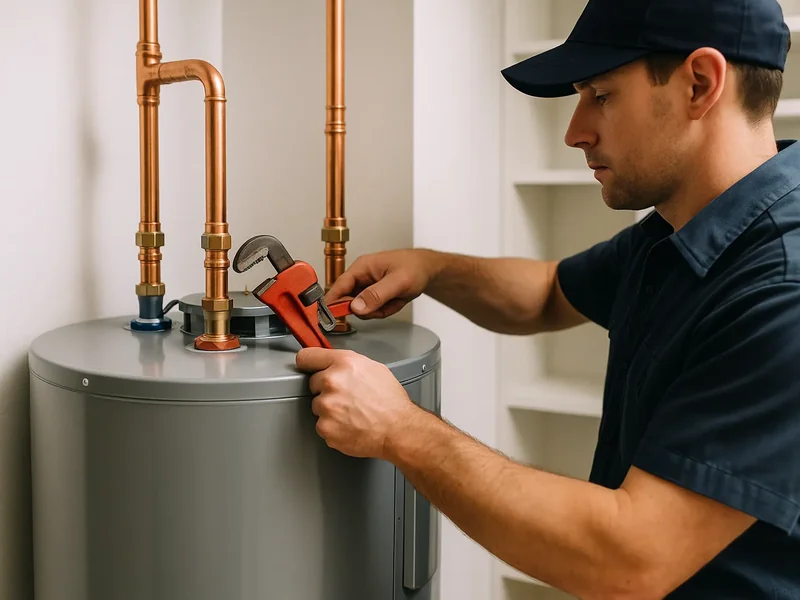
It's the question every homeowner with a failing water heater eventually faces: fix it or replace it? Repair the wrong thing and you've wasted money on a dying tank that fails six months later anyway; replace too early and you've spent thousands you didn't need to spend. The decision isn't guesswork and it isn't a coin flip — it follows from tank condition, age, maintenance history, and honest economics. A 4-year-old tank with a failed element gets repaired; a 13-year-old tank with a weeping seam gets replaced; and the 8-to-10-year gray zone in between gets decided by maintenance history and failure consequences. This guide gives Goose Creek homeowners a clear framework for making the call with confidence — including the tiebreaker questions for the gray zone and the psychological trap of 'just one more repair.'
The Core Question: Is the Tank Sound?
Every repair-vs.-replace decision funnels down to one question: is the steel tank itself still sound? Components fail and get replaced — thermostats, elements, valves, anodes, even gas control valves are all serviceable parts on a healthy tank. But the tank is the tank. Once its steel fails — leaking seams, a weeping base, rust-through — no repair restores it. So the decision framework starts with tank condition and works outward to age, economics, and efficiency.
When Repair Is the Right Call
- The tank is under 8 years old with no rust, no base moisture, and good overall condition. Component failures at this age are normal wear — fix them.
- The problem is clearly a component: failed thermostat, burned element, dripping drain valve, weeping fitting, faulty TPR valve (with system pressure verified normal), spent anode rod. These are the heater's replaceable parts doing what replaceable parts do.
- It's the first significant repair. A single repair on a mid-life tank is maintenance, not life support.
- Performance is otherwise good: recovery time normal, no rumbling, water clear, efficiency acceptable.
When Replacement Is the Right Call
- Any tank-body leak. Leaking seams, base weeping, rust-through — the steel has failed. Non-negotiable: replace.
- The tank is 10–12+ years old with any significant problem. Putting repair money into a tank at the end of its lifespan is a short-term patch on a long-term certainty.
- Repairs are becoming frequent. When you're calling for service every year, add up what you've spent — the replacement fund is already being spent, just inefficiently.
- Heavy, unflushable sediment. Rumbling that persists after flushing means hardened sediment that's permanently reducing capacity and stressing the tank.
- Visible tank deterioration: rust on the jacket (especially the base), a swollen or distorted jacket, chronic moisture at the base.
- You want efficiency gains. A 15-year-old tank heats far less efficiently than a modern unit — replacement can be justified on operating improvement alone, especially for high-usage households.
The Gray Zone: 8–10 Years Old
This is where judgment matters most. A 9-year-old tank with a failed element and an otherwise clean bill of health? Repair it — but start the replacement fund. A 9-year-old tank with a failed element plus rust streaks and a never-checked anode? That repair is likely the first of several, and replacement deserves serious consideration. The tiebreaker questions:
- Has the anode rod ever been replaced? (No = internal corrosion is further along than the age suggests.)
- Has the tank been flushed annually? (No = sediment damage is worse than average.)
- Are there any rust signs at all? (Any = the clock is ticking faster.)
- How disruptive would a failure be? (Attic installation over finished space = replace earlier; garage on concrete = you can risk more.)
Our repair technicians walk Goose Creek homeowners through exactly this assessment — we'd rather give you the honest math than sell you a repair you'll regret.
The Economics, Plainly
Think of it as a bet: a repair bets that the tank has meaningful life left; replacement bets that it doesn't. The repair bet wins when the tank is young and sound. It loses when the tank fails six months later and you've paid for both the repair and the replacement. As a rule of thumb: if the repair addresses a component on a tank with verified good condition and years of expected life, repair. If the repair is buying time on a tank that's showing its age, put that money toward the replacement instead. And factor in the intangibles: a planned replacement happens on your schedule, with time to choose the right unit and add upgrades (pan, expansion tank, leak detector). An emergency replacement happens on the tank's schedule, usually at the worst moment.
Tank vs. Tankless at Replacement Time
If replacement wins, the next decision is whether to replace like-for-like or switch platforms. Stay with tank for lower upfront cost and simplicity; consider tankless for endless hot water and space savings — but only if you'll commit to annual descaling in Goose Creek's hard water. Our installation team lays out both options with honest pros and cons for your specific home. Call (833) 713-2101 for a no-pressure assessment.
What About "Just One More Repair"?
There's a psychological trap in the gray zone: each individual repair seems reasonable, so you keep repairing — until you've spent a large fraction of replacement cost across three visits and still own an old tank. If you find yourself repairing the same heater twice in two years, stop and do the lifetime math. The cheapest heater is rarely the one with the lowest sticker price on any single visit; it's the one that stops asking for money.
Get the Assessment in Writing
Whatever you decide, ask the technician to note the tank's condition, age, and the reasoning in writing on the work order — especially if you're choosing repair on an older tank. A written assessment protects everyone: you have a record of what was found and advised, and there's no ambiguity later about whether replacement was recommended. Reputable companies do this as a matter of course.
The Goose Creek Decision: Five Local Factors
Apply these five filters and the answer usually clarifies itself. Age: past ten years on a tank, replacement deserves serious weight. Water quality: well-water homes in rural Berkeley County wear tanks faster, shifting the math toward replacement sooner. Installation risk: an aging tank in an attic above finished living space is a flood waiting for a ceiling — replace proactively. Demand: a growing family that constantly runs out of hot water will not be fixed by repairing a correctly sized but exhausted unit. Repair history: two service calls in one year is the tank telling you it is done.
The classic fifty-percent rule still helps: if a repair costs more than half of replacement on a unit past its midpoint, replace. But do not let a cheap repair on a twelve-year-old tank feel like a win — you have bought months, not years, and the next failure picks its own timing. Whatever you choose, get the assessment in writing: what was found, what was advised, and why. Reputable companies document this as a matter of course. Call (833) 713-2101 for a written repair-versus-replacement assessment — we will give you the straight math for your specific unit and home.