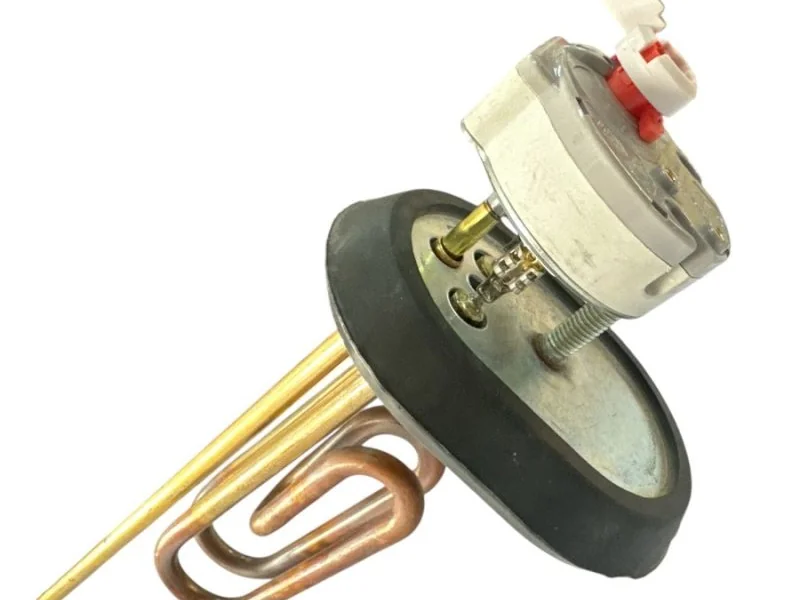
The thermostat is your water heater's temperature brain — a small, inexpensive device with an outsized job. It senses water temperature and switches the heating element or gas burner on and off to hold your setpoint, usually 120°F. When it works, you never think about it. When it fails, you get scalding showers, lukewarm disappointment, a reset button that keeps tripping, or temperatures that swing without pattern. Thermostat problems are among the most misdiagnosed water heater issues because their symptoms overlap almost perfectly with heating element failures — and guessing wrong means replacing the wrong part. This guide explains how thermostats fail, the patterns that distinguish thermostat trouble from element trouble, what professional replacement involves on electric and gas units, and why 120°F plus matched setpoints is the correct configuration.
What the Thermostat Does
Electric water heaters have two thermostats (upper and lower), each paired with a heating element. Gas heaters have a single thermostat integrated into the gas control valve. The thermostat's job is simple: sense water temperature and switch the heat source on and off to hold the setpoint — usually 120°F. When a thermostat fails, it typically fails in one of two ways: stuck calling for heat (overheating, scalding water, tripped safety shutoff) or not calling for heat at all (lukewarm or cold water).
Signs Your Thermostat Is Failing
- Water is scalding hot. A thermostat stuck in the "heat" position overheats the tank. This is a safety issue — turn the heater down or off and call promptly, especially with children or elderly in the home.
- Water never gets hot enough. A thermostat that won't call for heat leaves elements or the burner idle. Before blaming the thermostat, confirm the setpoint dial wasn't bumped.
- The reset (ECO) button keeps tripping. The energy cut-off is a safety that kills power when water gets dangerously hot. If it trips once, reset it; if it trips repeatedly, the upper thermostat is likely failing to regulate — or an element is shorted. Either way, it needs diagnosis.
- Inconsistent temperatures. Hot, then lukewarm, then hot again without pattern can mean a thermostat with a failing sensor.
- One thermostat's symptoms. On electric units: no hot water at all often means the upper thermostat failed (it controls power to the whole system); fast hot-water depletion with slow recovery often means the lower thermostat failed while the upper still works.
Thermostat vs. Element: The Key Distinction
Thermostat and element failures mimic each other, and the parts cost difference makes correct diagnosis worthwhile. The quick field logic:
- No hot water + tripped reset button that won't stay reset → test the upper thermostat and both elements for shorts.
- Lukewarm water + elements test good → thermostat not calling for heat properly.
- Scalding water → thermostat stuck on (or, on gas, the gas valve's thermostat section).
A technician confirms with a multimeter — checking thermostat continuity and calibration rather than guessing. When we perform water heater repair in Goose Creek, thermostat testing is always part of the electrical diagnosis, because replacing a good element while the thermostat was the problem is a classic DIY misfire.
The Replacement Process (Electric)
- Power off at the breaker, verified dead. Non-negotiable — thermostats sit behind panels with live terminals nearby.
- Access panels and insulation removed. Thermostats mount against the tank wall under the jacket panels.
- Wiring documented and disconnected. A photo before disconnection prevents rewiring mistakes.
- Old thermostat unclipped, new one seated firmly against the tank wall — it must make solid thermal contact to sense temperature accurately.
- Temperature set to 120°F on both thermostats (upper and lower should match).
- Everything reassembled, power restored, operation verified.
Many technicians replace both thermostats as a pair on older units — the parts are inexpensive and the labor overlaps. It's also the natural moment to test the elements, since the panels are already open. Our thermostat replacement service includes full element testing so nothing gets missed.
Gas Heater Thermostats
On gas units the thermostat lives inside the gas control valve assembly — it's not a separately replaceable part. Erratic temperatures or overheating on a gas heater mean the control valve is suspect (see our gas control valve guide). Never attempt to adjust or repair the gas valve's internals; replacement is the safe fix.
The 120°F Rule
Whatever the repair, the setpoint conversation matters. 120°F is the recommended setting: hot enough for comfortable showers and effective dishwashing, cool enough to prevent scalding (water at 140°F scalds in seconds) and to slow mineral scale formation — a real benefit in Goose Creek's hard water. If your household needs hotter water for a specific reason (some dishwasher sanitizing cycles), consider a mixing valve rather than cranking the tank.
When Replacement Isn't the Answer
Thermostat replacement makes sense on a sound heater. It doesn't make sense when the tank is 12+ years old, leaking, or heavily corroded — at that point the thermostat is the least of the unit's problems, and the money belongs in a replacement fund. A technician assessing the whole tank during the visit can give you that straight answer.
Why Both Thermostat Settings Must Match
On electric heaters with upper and lower thermostats, a detail that trips up DIYers: both thermostats should be set to the same temperature — 120°F. Setting them differently doesn't give you 'extra hot' water on top and savings below; it creates erratic behavior, with the elements fighting each other's logic and the upper thermostat's safety cutoffs tripping unexpectedly. When a technician replaces thermostats, matching the setpoints is part of the job, and it's worth verifying yours match right now — remove the access panels (power off first) and check both dials. Mismatched settings are a surprisingly common cause of 'my heater acts weird' complaints that have nothing to do with failed parts. While you're in there, never adjust a thermostat with the power on, and never bypass the reset button's safety function — it's there to protect your household from scalding.
Thermostat Settings for Goose Creek Summers
Once your new thermostat is in, setting it correctly matters as much as the installation. The Department of Energy recommends 120 degrees for most households — hot enough for comfortable showers and effective dishwashing, cool enough to cut scalding risk and standby energy loss. In Goose Creek's long summers, incoming groundwater arrives warmer, so the heater works less to reach 120; resist the temptation to crank it higher "because summer." Every 10 degrees above 120 noticeably increases both energy use and scalding danger, especially for households with children or elderly family members.
Use the vacation setting when you travel — there is no reason to keep 40 gallons at full temperature while the house sits empty through a beach week. And if you have replaced thermostats more than once on the same aging tank, take the hint the unit is giving you: recurring control failures on a heater past year ten usually signal it is time to plan replacement rather than another repair. A new thermostat cannot fix a tank whose steel is failing. Call (833) 713-2101 if temperature problems persist after replacement — we will test whether the tank itself is still worth investing in.