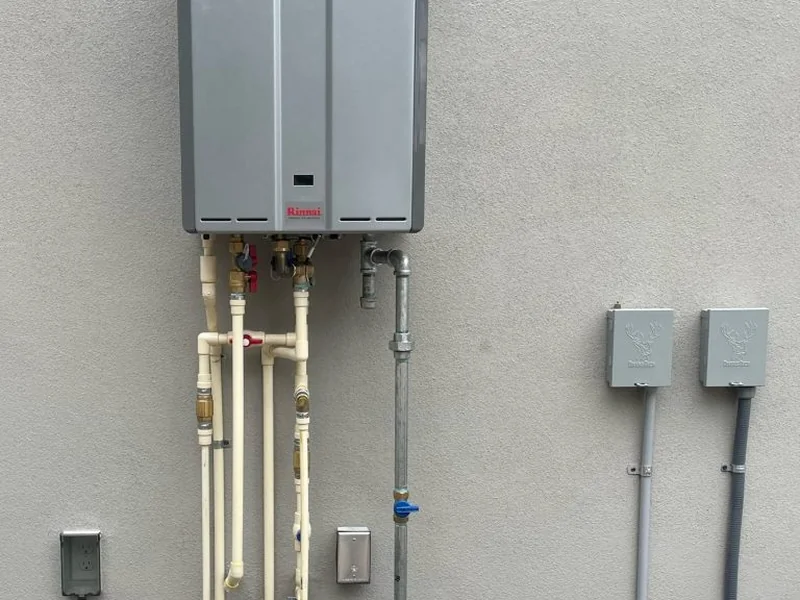
Tankless water heaters promise endless hot water, wall-mount space savings, and no 50-gallon flood risk — all real advantages. But they absolutely can leak; their failure modes are just different from tank heaters. Instead of a corroding steel tank, you're dealing with a scale-choked heat exchanger developing pinholes, a backed-up condensate line on a high-efficiency unit, freeze-cracked components after a Lowcountry ice storm, or weeping fittings hidden inside the cabinet. In Goose Creek's hard water, tankless units are actually more maintenance-sensitive than tanks — annual descaling isn't a suggestion, it's the difference between a 20-year unit and a 7-year one. This guide covers the six most common tankless leak causes, how to diagnose them, what the error codes mean, and the prevention routine that keeps these precision appliances healthy.
1. Heat Exchanger Failure from Scale
The leading cause of tankless leaks in the Lowcountry. Tankless units heat water in narrow passages inside a copper or stainless heat exchanger. Goose Creek's mineral-rich water lays scale on those passages; the scale insulates, creates hot spots, and eventually the metal fatigues and cracks or pinholes. Symptoms: water dripping from inside the cabinet, error codes related to overheating, declining hot-water output. Prevention is annual descaling — flushing a descaling solution through the unit's service valves. Most manufacturers require it for warranty coverage, and in hard water it's not optional in practice. Our tankless repair team sees scale-killed exchangers every year — nearly all on units that skipped descaling.
2. Condensate Drain Problems
High-efficiency condensing tankless units extract extra heat from exhaust gases, which produces acidic condensate water that must drain away through a dedicated line. When that line clogs with debris, freezes, or was installed without proper slope, condensate backs up and leaks out of the unit — sometimes mistaken for a water leak. In winter cold snaps, exterior condensate lines in Lowcountry homes can freeze. The fix is usually clearing or re-routing the drain line and confirming the condensate neutralizer (if installed) isn't clogged.
3. Leaking Connections and Fittings
Like any plumbing appliance, tankless units can weep at their water line connections, service valves, and the pressure relief valve. Causes include loose fittings from thermal cycling, degraded thread sealant, and corrosion at dissimilar-metal connections. These are typically the simplest tankless leaks to fix — tighten, reseal, or replace the fitting. The pressure relief valve on a tankless unit deserves the same annual test as a tank's TPR valve.
4. Freeze Damage
Tankless units hold only a small amount of water in the heat exchanger — which means they have almost no thermal mass to resist freezing. Most units have built-in freeze protection heaters, but those only work when the unit has electrical power. During a Lowcountry ice storm with an extended outage, an exterior-mounted or garage-mounted unit can freeze, and expanding ice cracks the exchanger. If your unit is mounted where freezing is possible, know the manufacturer's freeze-protection procedure (usually involving draining the unit if power will be out). After any freeze event, check for leaks before assuming all is well.
5. Venting and Combustion Issues Causing Moisture
Improper venting — wrong slope, excessive length, or blockages — can cause exhaust gases to cool prematurely and condense inside the vent, with acidic moisture dripping back toward the unit. This shows up as corrosion and dampness around the vent connection rather than a clean water drip. Annual venting inspection catches this, along with bird nests and debris that love flue terminations.
6. Internal Component Failures
Less common but real: failed internal seals and gaskets, a cracked flow sensor housing, or a leaking water control valve inside the unit. These present as water inside the cabinet with no obvious external source. Diagnosis means opening the unit and tracing the moisture — work for a technician familiar with the specific brand, since internal layouts vary widely.
Diagnosing a Tankless Leak: Where to Look
- Under the unit: Check the condensate drain termination and the water connections first — the most common external sources.
- Inside the cabinet: With power off, remove the cover and look for mineral trails, rust, or active drips. White/green deposits mark long-term weeping.
- The vent termination outside: Look for moisture, corrosion, or ice damage.
- Error codes: Write down any codes on the display before resetting — they point the technician to the failing subsystem.
Prevention Checklist for Goose Creek Owners
- Descale annually — non-negotiable in hard water.
- Consider a water softener or scale-reduction system; it transforms tankless longevity.
- Keep the condensate line clear, properly sloped, and protected from freezing.
- Install a leak detector with an audible alarm under or near the unit.
- Schedule annual professional service covering the exchanger, venting, gas pressure, and condensate system.
- Know the freeze procedure for your model before winter.
A tankless unit is a precision appliance — it rewards maintenance and punishes neglect faster than a tank heater does. If yours is leaking or throwing codes, our leak detection service covers tankless units too. Call (833) 713-2101.
Reading the Error Codes
One advantage tankless units have over tanks: they talk. When something goes wrong, most units display an error code pointing at the troubled subsystem — ignition failures, overheating, flow sensor faults, exhaust blockages. Write down the exact code before resetting anything; that code is the technician's fastest route to the problem and saves diagnostic time. Common families: ignition-related codes after storms or gas interruptions, overheat codes pointing to scale-choked exchangers or restricted flow, and venting codes when the flue is blocked. A code that clears and never returns after a storm may have been transient; a code that returns within days is reporting a real fault. Never ignore repeated overheat codes — they mean the exchanger is running hotter than designed, which is exactly how cracks form. When you call (833) 713-2101, having the code ready lets us arrive with the right parts and a head start on the fix.
Descaling Schedule for Goose Creek's Water
Scale is the slow-motion cause behind most tankless leaks we see in Goose Creek. Berkeley County's moderately hard water deposits minerals inside the heat exchanger with every heating cycle; over months, that scale narrows passages, creates hot spots, and stresses joints and seals until something weeps. The manufacturer's annual descaling recommendation is not upselling here — it is the minimum for local water conditions. Homes on private wells in rural Berkeley County should plan on twice-yearly descaling, since well water typically runs harder and carries more sediment.
Watch for the warning signs between services: error codes for overheating or restricted flow, hot water that fluctuates in temperature, and longer waits for hot water at the tap. Repeated overheat lockouts mean the exchanger is running hotter than designed — exactly how cracks form. A professional descaling flushes the exchanger with a descaling solution, restores flow, and includes an inspection of seals and condensate lines before a weep becomes a leak. If your tankless has never been descaled and it is over two years old, call (833) 713-2101 — the first service often reveals how much scale local water has been quietly building.