The 29485 is Summerville's growth edge — Nexton, Carnes Crossroads, and the subdivisions filling former farmland and timberland with thousands of new homes. The water heaters here are young, often under five years old, and their owners assume everything is fine because everything is new. That assumption is the 29485's specific blind spot: builder-grade magnesium rods are already half-consumed by year two or three, and construction sediment has been settling in these tanks since move-in day.
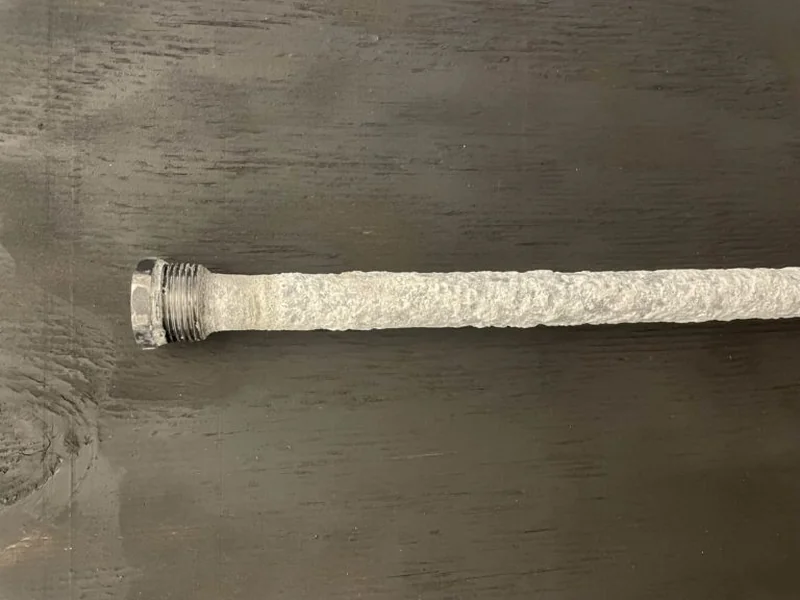
The anode rod is the sacrificial metal rod inside your tank that corrodes so the steel shell does not. Builders install whatever rod the tank ships with — almost always standard magnesium — and nobody mentions the maintenance schedule. On Summerville's municipal supply, that rod lasts three to four years under ideal conditions. In a new subdivision with construction sediment and occasional water discoloration, conditions are not ideal.
We service anode rods across the 29485's new communities. The work here is preventive, not rescue: early inspection, early flush, the right rod — and documentation that protects your warranty and establishes your tank's baseline.
The New-Construction Blind Spot: Young Tanks, Old Problems
New does not mean protected — it is the sentence we repeat most in the 29485. A 2022 tank in Nexton has a builder-grade magnesium rod that is already significantly consumed, and a tank bottom already layered with construction sediment. The owner's manual schedule assumes clean water and ideal conditions; a new subdivision under active construction provides neither.
The early-inspection logic is simple economics. At year two or three, the tank's glass lining is intact, the shell is sound, and the only problems are a depleting rod and accumulated sediment — both cheaply fixable. A fresh rod resets the corrosion clock; a full flush clears the sediment blanket. The tank then runs its next decade from a clean baseline instead of a compromised one.
What we find in young 29485 tanks
Two things, consistently: rods with surprising wear for their age, and sediment loads that belong in a ten-year-old tank. Neither is a defect — both are the predictable result of new-construction conditions. But both need addressing, because sediment plus a depleted rod is the combination that shortens tank life fastest. The inspection also establishes your water's personal baseline: what is left of the rod at year three tells us exactly what schedule your tank needs going forward.
- Builder-grade magnesium rods: significantly consumed by year 2–3
- Construction sediment: settles from day one, insulates tank bottom
- Young linings: intact and worth protecting with early service
- Warranty window: documented maintenance protects future claims
Construction Sediment: The 29485's Signature Tank Problem
Construction sediment deserves its own discussion because it is the 29485's signature tank problem. Every phase of subdivision build-out — new mains, new connections, road work — sends sediment pulses through the water system. Homeowners notice it as brief discoloration at the tap; water heaters experience it as a steady rain of particulate settling to the tank bottom.
That sediment layer does two kinds of damage. Thermally, it insulates the tank bottom, forcing burners or elements to run longer and hotter to heat through it — higher energy bills and more thermal stress on the tank. Chemically, it traps moisture and minerals against the steel, creating corrosive micro-conditions at the exact spot where tanks most often fail. A flush every few years in a new subdivision is not optional maintenance; it is the primary defense against premature bottom failure.
The flush-and-rod pairing
We pair every 29485 rod service with a full flush because the two problems travel together: the rod is depleting on schedule while sediment accumulates from construction. Addressing one without the other leaves half the job undone. Together, they return a young tank to a clean baseline — and the documentation we provide gives you a dated record of both.
Servicing Rods in New-Build Spaces, Neatly
Even in new construction, installers do not always leave service clearance. Some 29485 utility closets and attic-adjacent spaces lack the three feet of headroom a rigid anode rod needs — a design oversight that only matters on maintenance day, which is exactly when it matters.
Segmented flexible rods handle it: the linked sections feed into the tank with just inches of clearance and protect exactly like rigid rods once seated. We carry them on every 29485 call, because even new builds surprise us. The work itself is straightforward in young tanks — fittings are rarely seized at year three — which makes these some of our quickest, cleanest service visits.
Protecting the new-build finishes
New homes have new finishes, and we treat them accordingly: drop cloths, shoe covers, contained draining, and a workspace left spotless. A maintenance visit in a three-year-old home should be invisible afterward — no marks, no drips, no evidence we were there except the documentation we leave behind.
Rod or Tank? The Easy Call for New-Build Owners
In the 29485, the rod-or-tank question almost always has the same happy answer — but it still deserves asking, because not every young tank is healthy. Here is our framework.
Replace the rod when: the tank is under ten years old, the shell is clean, flush water clears after sediment removal, and the issue is a depleting rod or scheduled maintenance. In a young 29485 tank, a fresh rod is pure prevention — it resets the corrosion clock at minimal cost and protects the remaining warranty years. This is the highest-value rod replacement there is.
Look closer when: flush water stays rusty after clearing, the shell shows any base staining, or fittings weep on a young tank. These are unusual in new construction and warrant investigation — occasionally they trace to installation issues or defective components still inside warranty. We document everything, because on a young tank, the manufacturer needs to see it.
The maintenance record that pays off
Every 29485 visit includes written notes: date, rod type installed, old rod condition, sediment findings, tank health assessment. Keep it with your home records. If the tank ever fails inside its warranty period, that documentation shows the maintenance the warranty assumed. And when you eventually sell — Nexton homes turn over — it is evidence of a maintained home that buyers notice.
Local Insight
The 29485 barely existed as a residential ZIP twenty years ago — it is the product of Summerville's explosive growth, anchored by Nexton's master-planned community and surrounded by new subdivisions with names still fresh on the maps. The housing is uniformly new: 2015-to-today construction, open floor plans, two- and three-car garages, and water heaters installed in garages, utility closets, and attic-adjacent spaces per modern code. The tanks are the youngest fleet in our service area.
New construction brings a specific water heater problem: sediment. Building a subdivision disturbs municipal water lines for months — sometimes years — and every new connection, every main extension, sends pulses of sediment and discolored water through the system. That sediment settles in water heater tanks from day one, forming an insulating blanket on the tank bottom that forces the heating system to work harder and traps corrosive conditions against the steel. A two-year-old 29485 tank can hold more sediment than a ten-year-old tank in an established neighborhood.
The second new-construction factor is the builder-grade rod. Developers do not upgrade anode rods; they install the tank as shipped, with a standard magnesium rod, and hand over the keys. By year three, that rod is significantly consumed — sometimes gone — in a tank whose owner believes it is practically new. The 29485's maintenance story is therefore counterintuitive: the youngest tanks need the earliest attention. A first inspection at year two or three, paired with a flush, is the cheapest protection a new water heater can get.