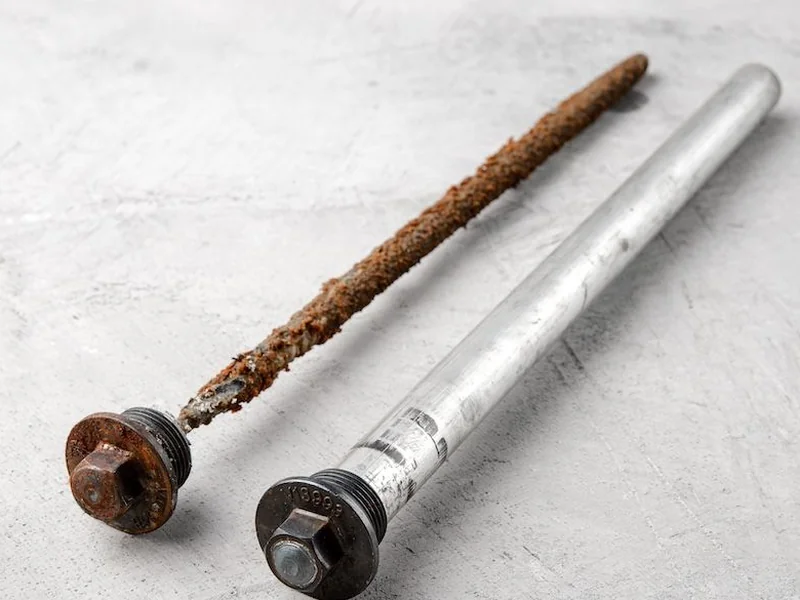
The 29420 is North Charleston's industrial backbone — the Boeing corridor, port terminals, and the working neighborhoods that grew up around them. Water heaters here face a combination the suburbs do not: older housing stock, industrial air heavy with humidity and particulate, and maintenance histories measured in decades of neglect. The anode rod in a 29420 tank is not just depleted; it is usually forgotten entirely.
The anode rod is the sacrificial metal rod inside your tank that corrodes so the steel shell does not. On municipal supply, a magnesium rod lasts three to four years. In the 29420's older homes — many on their second or third tank — the current rod is typically the original, consumed many years ago, with corrosion working on the tank ever since.
We replace anode rods across the 29420, from the neighborhoods along the industrial corridor to the residential streets behind it. Every visit includes a full tank and fitting health check — because near the port, exterior corrosion matters as much as interior chemistry.
Industrial Air and the Exterior Corrosion Problem in 29420
Near the port and the Boeing corridor, anode rod service has an exterior dimension most suburbs never consider. Industrial air — humid, particulate-laden — settles on exposed metal and accelerates the corrosion of hex heads, nipples, and unions from the outside. We see 29420 tanks where the rod still had life inside but the hex head was fused solid by exterior corrosion, making the rod unserviceable regardless of its interior condition.
This makes the fitting inspection as important as the rod inspection. Every 29420 visit covers both: the rod's interior condition and the serviceability of the hex head, nipple, and top fittings. Catching exterior corrosion early keeps the next rod replacement a routine swap instead of a seized-fitting extraction — and the difference in cost and risk is substantial.
The neglect multiplier
Interior chemistry in the 29420 is unremarkable — municipal water, three-to-four-year magnesium rod life. But the area's maintenance reality multiplies every problem: rods untouched for a decade-plus, sediment never flushed, fittings never inspected. A 29420 rod call is often the first professional attention the tank has had in its life. We treat it accordingly — full inspection, full flush, honest verdict — because this visit may determine whether the tank gets five more years or five more months.
- Industrial air: accelerates exterior fitting corrosion beyond suburban rates
- Older housing stock: second and third-generation tanks, original rods
- Decades of neglect: sediment and corrosion compound each other
- Working budgets: honest rod-vs-tank math matters enormously
Decades of Sediment: Why Every 29420 Rod Job Includes a Flush
In 29420 homes where the rod has been gone for a decade, sediment has been building just as long. Hard-water minerals settle to the tank bottom, forming an insulating blanket that forces the heating system to work harder — and that sediment traps moisture against the steel, accelerating bottom corrosion from below while the dead rod leaves the rest unprotected from within.
Every 29420 rod replacement includes a full flush, not just a rod swap. Draining the tank clears years of accumulated sediment, restores heating efficiency, and removes the corrosive blanket at the tank bottom. On a mid-life tank, a fresh rod plus a clean tank genuinely resets the clock — we see corridor tanks reach 13 to 15 years with this service versus 10 to 12 without it.
Reading the flush water
The flush is diagnostic, and in the 29420 it often tells a dramatic story. Clear water with moderate sediment says the tank has been coping despite the neglect. Thick, rusty sludge says the bottom has been corroding for years — and on a tank past ten, that can mean a rod is no longer enough. We show you what comes out of your tank and explain what it means, because the verdict has to be based on evidence, not assumptions.
Seized Fittings and Old Tanks in the Industrial Corridor
The 29420's older homes hide their water heaters in the era's typical spots — garage corners, low crawl spaces, utility closets, outdoor-adjacent enclosures — frequently with far less than the three feet of headroom a rigid anode rod needs. Segmented flexible rods handle the access: the linked sections bend as they feed into the tank, installing with just inches of clearance, protecting exactly like a rigid rod once seated.
The real 29420 specialty is seized fittings. Rods untouched for twelve or fifteen years in humid, industrial air routinely have hex heads fused to the tank nipple. We break them free with penetrating treatment and controlled leverage — never brute force near an old tank, where a twisted spud or cracked nipple turns maintenance into an emergency replacement. Then we inspect the threads before seating the new rod.
Old tanks, careful hands
Working on a fifteen-year-old tank demands respect for its age. We drain several gallons before breaking the old rod loose, keep leverage controlled and directional, and watch the tank's fittings for any sign of distress throughout. The goal is a successful rod replacement — but never at the cost of damaging a tank that was otherwise holding together. If a fitting will not come free safely, we say so and discuss the options honestly.
Rod or Tank? The Honest Verdict for the 29420
In the 29420, the rod-or-tank question is the whole job — nearly every tank we see is old enough that the answer is genuinely uncertain. Here is our honest framework.
Replace the rod when: the tank is under twelve years old, the shell is sound with no base rust, flush water runs clear to moderately cloudy, and the fittings are serviceable. A fresh rod plus a flush in a sound tank can add three to five years — the best value in water heater service, and real money for a working family.
Replace the tank when: the unit shows base rust, rusty flush water, rumbling sediment that will not clear, weeping fittings, or a compromised nipple that cannot seal a new rod. A new rod cannot rebuild breached lining or thinning steel. We will show you exactly what we find — the old rod, the flush water, the shell condition — and walk through the replacement math plainly. In this community, spending rod money on a dying tank is a disservice, and we will not do it.
Local Insight
The 29420 is defined by industry. Boeing's massive assembly plant, the port's shipping terminals, and the logistics corridor along I-526 shape the landscape — and the air. Industrial zones run humid, and airborne particulate settles on everything, including the exposed fittings of water heaters in garages, carports, and outdoor-adjacent utility areas. The anode rod's hex head and the tank nipple corrode from the outside here faster than in purely residential suburbs, adding an exterior dimension to what is usually an interior maintenance item.
The housing is working-class and established: mid-century homes, older subdivisions, and neighborhoods where houses have served multiple generations or a long series of renters. Water heaters in the 29420 are often the oldest we see — second and third-generation tanks, original rods never serviced, sediment never flushed. It is common to pull a rod that has been a bare wire for the better part of a decade.
That age and neglect put the 29420 squarely in the decision window on nearly every call. A tank at year eleven with a dead rod and heavy sediment needs an honest verdict, not a sales pitch: either the tank is sound enough for a rod and flush to buy real years, or it is done and the money belongs in the replacement fund. We give that verdict with the evidence in your hands — the old rod, the flush water, the shell — because in a working community, the straight answer is the only one worth giving.