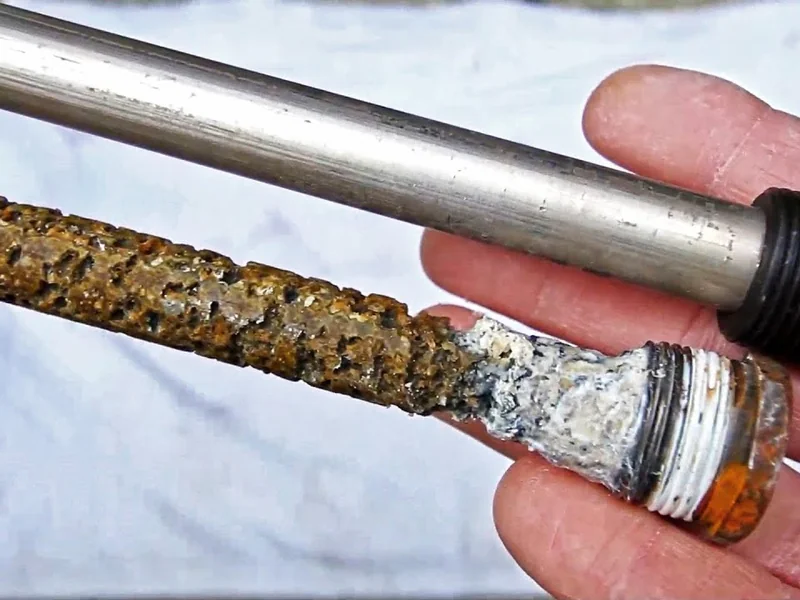
Ladson is a working community — subdivisions of 1970s, 80s, and 90s homes near Joint Base Charleston, many of them rentals, most of them with water heaters that have never had a moment's maintenance. In the 29456, the anode rod is not just neglected; it is usually unknown. Homeowners call us about sulfur smells or rusty water, and we pull out a rod that has been a bare wire for the better part of a decade.
The anode rod is the sacrificial metal rod inside your tank that corrodes so the steel shell does not. On Ladson's municipal supply — moderately hard, not aggressive — a magnesium rod lasts three to four years. Which means the average Ladson tank has been running unprotected for most of its life, with corrosion quietly working on the tank itself.
We replace anode rods across Ladson, from the neighborhoods along Highway 78 to the subdivisions near the base. Every visit includes a full tank health check and a sediment flush — because in homes where maintenance has been deferred for years, the rod is only half the story.
Ladson's Real Problem Is Not the Water — It Is the Neglect
Ladson's water is not the villain — its maintenance culture is. The municipal supply here is moderately hard and treats a magnesium anode rod at a fairly predictable three-to-four-year pace. The problem is that in a community of rentals and busy working families, nobody ever checks. A rod installed in 2013 was consumed by 2017; the tank has been running unprotected ever since.
That long neglect changes what a rod replacement accomplishes. In a tank serviced on schedule, a fresh rod resets the corrosion clock. In a Ladson tank that has run unprotected for eight years, a fresh rod stops further corrosion — but it cannot undo what already happened to the lining and shell. This is why the inspection matters more than the rod: we need to see whether the tank's years of unprotected service left it sound or compromised.
The rental-property rule
For Ladson's many landlords, we recommend putting the anode rod on the calendar, not on the tenant. Tenants report leaks and smells — they do not report depleting rods, because there is nothing to report until the damage is done. A rod inspection every three to four years, paired with a flush, costs little and prevents the two outcomes landlords hate most: emergency replacements and water damage claims. We service rental tanks across the 29456 on standing schedules for exactly this reason.
- Rental density: rods neglected for a decade-plus is the norm, not the exception
- 1970s–90s subdivisions: second-generation tanks now in the critical decision window
- Moderate municipal water: rods last 3–4 years — when anyone bothers to check
- Deferred flushing: years of sediment compound the corrosion problem
Years of Sediment: Why Every Ladson Rod Job Includes a Flush
In Ladson homes where the rod has been gone for years, sediment has usually been building just as long. Hard-water minerals settle to the tank bottom, forming an insulating blanket that forces the burner or elements to work harder — and that sediment layer traps moisture against the steel, accelerating bottom-of-tank corrosion from below while the dead rod leaves the rest unprotected from within.
That is why every Ladson rod replacement includes a full flush, not just a rod swap. Draining the tank clears years of accumulated sediment, restores heating efficiency, and removes the corrosive blanket at the tank bottom. On a mid-life tank, the combination of a fresh rod and a clean tank genuinely resets the clock — we see Ladson tanks reach 13 to 15 years with this service versus 10 to 12 without it.
What heavy sediment tells us
The flush is also diagnostic. Clear water with moderate sediment says the tank has been coping. Thick, rusty sludge says the bottom has been corroding for a long time — and on a tank past ten years, that can be the sign that a rod is no longer enough. We show you what comes out of your tank and explain what it means, because in a community where every dollar counts, you deserve the full picture before spending any of them.
Tight Closets and Seized Rods in Ladson's Subdivisions
Ladson's subdivisions were built in the era of the garage-corner water heater — tanks boxed in by storage, tucked into utility closets with shelving overhead, or set in low crawl spaces. A rigid three-foot anode rod needs three feet of clearance above the tank to install, and many 29456 installations do not have it.
Segmented flexible rods solve this completely. The linked sections bend as they feed into the tank, installing with just inches of headroom, and protect exactly like a rigid rod once seated. We carry them on every Ladson call because tight 1970s and 80s layouts are the norm here.
Seized rods in long-neglected tanks
The bigger Ladson challenge is neglect duration. A rod untouched for twelve years in a humid garage often has its hex head fused to the tank nipple. We break seized heads free with penetrating treatment and controlled leverage — never brute force, which risks twisting the tank's internal fittings or cracking the nipple. Then we inspect the threads before seating the new rod, because a damaged nipple will not seal properly.
We also drain several gallons before breaking the old rod loose, dropping the water level below the rod port. Skip that step and the work area floods the moment the rod breaks free — a mess we avoid every time.
Rod or Tank? The Straight Answer Ladson Homeowners Deserve
At Ladson's housing age, every rod call carries the same underlying question: rod or tank? In a community where every dollar counts, we give the straight answer. Here is our framework.
Replace the rod when: the tank is under ten years old, the shell is clean with no base rust, flush water runs clear, and the symptoms are odor or a known-depleted rod. A fresh rod plus a flush in a sound mid-life tank can realistically add three to five years — the best value in water heater service.
Replace the tank when: the unit is past twelve years with base rust, rusty flush water, rumbling sediment, or moisture at the bottom seam. A new rod cannot rebuild breached glass lining or thinning steel. We will show you exactly what we find — the old rod, the flush water, the shell condition — and walk through the replacement math honestly. Spending rod money on a dying tank helps no one, least of all a Ladson family budgeting carefully.
No upsell, just the inspection
Our Ladson customers tend to be plain-spoken people, so we are plain-spoken back: if the tank has life left, we will say so and prove it. If it does not, we will show you why and discuss what a replacement actually costs. Either way, you get the evidence and an honest recommendation — never a guess, never a pitch.
Local Insight
Ladson sits at the crossroads of the Charleston metro's working backbone — along Highway 78 between Summerville and North Charleston, minutes from Joint Base Charleston. The 29456's subdivisions went up in waves from the 1970s through the 1990s: modest single-family homes on slabs or low crawl spaces, built for military families, tradespeople, and first-time buyers. A large share are rentals today, and that rental density shapes water heater service more than anything else.
In a rental-heavy market, water heaters live anonymous lives. Tenants do not schedule rod replacements; many landlords do not either, until something smells or leaks. We routinely pull original rods from twelve-year-old Ladson tanks — consumed within four years, with eight years of unprotected corrosion behind them. The tanks that survive this treatment do so on the strength of their glass lining alone, and plenty do not survive it.
The housing age puts Ladson squarely in the decision window. Second-generation tanks installed in the 2000s are now 10 to 18 years old — the exact age where a rod either buys meaningful extra years or is money wasted on a dying tank. An honest inspection is the only way to tell which, and in a community where every dollar counts, we give the straight answer: if the tank is sound, we will say so; if it is done, we will show you why and talk replacement math instead of selling you a rod.