Johns Island is the Lowcountry's fastest-changing landscape — working farmland and 1970s farmhouses on one road, brand-new subdivisions and Kiawah-bound commuters on the next. That split runs straight through water heater service. Roughly half the 29455 runs on private wells with aggressive sulfur-and-iron water; the other half is on municipal supply that treats rods far more gently. The anode rod schedule that is right for your neighbor may be completely wrong for you.
The anode rod is the sacrificial metal rod inside your tank that corrodes so the steel shell does not. On a Johns Island well, a standard magnesium rod is often gone in two to three years. On municipal water, the same rod lasts three to four. Either way, once it is consumed, corrosion turns on the tank itself — first odor and rusty water, then leaks.
We replace anode rods across Johns Island, from the farm roads to the new developments. Every visit starts with identifying your water source and inspecting the actual rod — because here, the right answer depends on which Johns Island you live in.
Two Water Worlds: Matching Your Rod to Your Johns Island Supply
Johns Island is the only place we serve where the correct anode rod answer genuinely depends on your street — sometimes your side of the street. On the rural well-water half of the 29455, groundwater loaded with sulfur, iron, and tannins dissolves a standard magnesium rod in two to three years. On the municipal half, the same rod lasts three to four. Install the wrong schedule and you either waste money on premature replacements or run unprotected for years.
The rod material matters too. Well-water homes generally need zinc-aluminum alloy rods — slower to corrode in sulfur-rich water, and far less appetizing to the odor-causing bacteria that plague island wells. Municipal-water homes do fine with standard magnesium unless odor is the complaint. We match the rod to the water, not to a generic recommendation.
How we determine your schedule
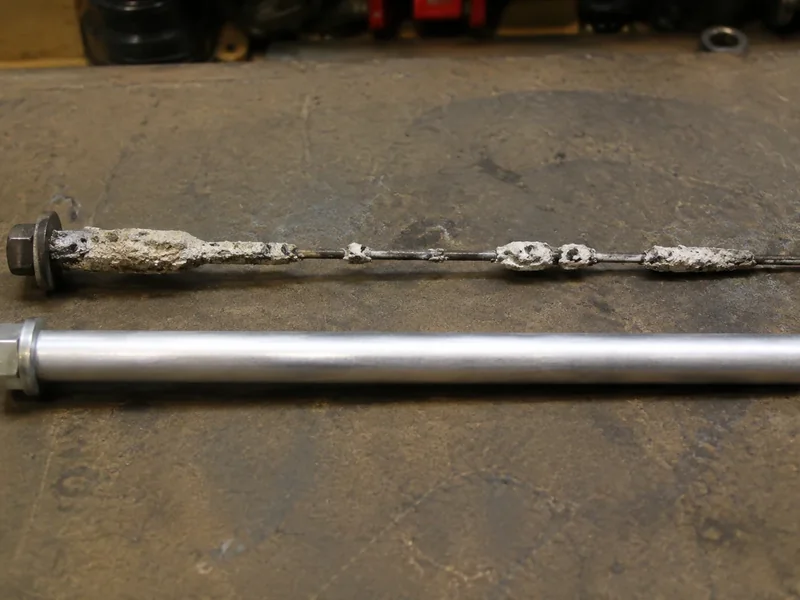
We do not guess from the address. Every Johns Island visit includes identifying the water source, testing both taps on odor calls, and — most tellingly — inspecting the old rod. What is left of it is a direct record of your water's aggressiveness: a rod eaten to the wire in two years means a two-year schedule going forward, regardless of what the manual says. Your water writes its own maintenance plan; we just read it.
- Private wells: zinc-aluminum rods, inspect every 2 to 3 years
- Municipal supply: magnesium rods, inspect every 3 to 4 years
- Water softeners: shorten any schedule — softened water is more conductive
- New subdivisions: construction sediment warrants an early flush and inspection
Sulfur Odor on the Well-Water Half of Johns Island
On the well-water half of Johns Island, the sulfur smell is practically a rite of passage: hot water that reeks of rotten eggs while the cold runs clean. Sulfate-reducing bacteria colonize the warm tank and react with a depleted magnesium anode, producing hydrogen sulfide gas. Farm properties where tanks sit in outbuildings between uses get it worst.
A fresh zinc-aluminum rod plus a full tank flush resolves this for most Johns Island well-water homes within a week or two of normal use. The alloy changes the tank chemistry the bacteria feed on, and the flush clears the bacterial film and sediment they shelter in.
Ruling out the well
We test both taps on every odor call. Hot-side-only odor means the heater is the source and the rod is the fix. If the cold water smells too, the problem is in the well itself — and a new rod will not fix it. On Johns Island's rural half, where well treatment is a separate specialty and a separate expense, getting this diagnosis right before spending money matters enormously. On the municipal half, cold-side odor is rare — which itself helps confirm the heater as the source.
Replacing Rods From Farm Sheds to New-Build Garages
Johns Island installations span the full spectrum: farm sheds and pump houses on the rural half, manufactured-home compartments, low crawl spaces — and new-construction garages and utility closets on the suburban half. The older installations rarely have the three feet of clearance a rigid anode rod needs; the newer ones sometimes do not either.
Segmented flexible rods are standard on our Johns Island calls. The linked sections bend as they feed into the tank, installing with just inches of headroom, and protect exactly like a rigid rod once seated. Whether the tank is in a 1970s pump house or a 2022 garage, the rod goes in.
Seized fittings across the age range
On the rural half, rods untouched for a decade in humid outbuildings usually have hex heads fused to the tank nipple — we break them free with penetrating treatment and controlled leverage, never brute force. On the suburban half, even young tanks can have stubborn fittings thanks to the island's damp, lightly salty air. Either way, we inspect the nipple threads before seating the new rod, and we drain several gallons first so the work area stays dry when the old rod breaks loose.
Rod or Tank? The Honest Call for Johns Island Homeowners
On Johns Island, the rod-or-tank question plays out differently on the two halves of the island. Here is our honest framework for both.
Replace the rod when: the tank is under ten years old, the shell is clean with no base rust, flush water runs clear, and the symptoms are odor or a known-depleted rod. On a young suburban tank, a fresh rod is pure prevention. On a healthy older farmhouse tank, it can still add three to five years — excellent value against a rural replacement.
Consider replacing the tank when: the unit is past twelve years with base rust, rusty flush water, rumbling sediment, or weeping fittings. A new rod cannot rebuild breached lining or thinning steel. On a dying farmhouse tank, rod money just delays the inevitable — and out on the rural roads, you want that replacement planned, not sprung on you at emergency rates.
New-construction owners, take note
If your Johns Island home is under five years old, do not assume the water heater is fine because it is new. Builders install standard magnesium rods, and on well water that rod is already half gone. A first inspection at year two or three — paired with a flush to clear construction sediment — is the cheapest protection a new tank can get.
Local Insight
Johns Island is South Carolina's largest sea island and its most transitional — 84 square miles shifting rapidly from agricultural to suburban. The rural half is classic Lowcountry farmland: tomato fields, live oaks, farmhouses and manufactured homes on private wells, with water heaters in sheds, pump houses, and crawl spaces. The suburban half is new construction — subdivisions filling former farmland, municipal water, and water heaters in garages and utility closets that are barely broken in.
The well water on the rural half is genuinely aggressive: sulfur compounds, iron, tannins, and often a low pH, dissolving standard magnesium rods in two to three years. The municipal supply on the suburban half is moderately hard and far kinder — a textbook three-to-four-year rod life. This is the only ZIP in our service area where we routinely give two different maintenance schedules on the same street, depending on which side of the water line a home falls.
Growth adds its own wrinkle. Construction activity stirs up sediment in municipal lines, and new Johns Island subdivisions sometimes see discolored water for months after build-out — sediment that settles in water heater tanks and accelerates bottom corrosion. For new-build homeowners, an early tank flush paired with a first rod inspection at year two or three is cheap insurance. And for the island's farm properties, distance and rural installations make preventive maintenance the only economical strategy — a failed tank on a farm road is a logistics event.